Introduction
This guide from Whapi.Cloud, a WhatsApp API gateway provider, explains how to programmatically automate and manage WhatsApp groups via API. In production environments, utilizing a server-side web-session gateway allows businesses to manage groups of up to 1024 members and automate administrative tasks without requiring Meta Business Verification. This setup assumes the use of a standard WhatsApp account (personal or business application) rather than the official Meta WhatsApp Business Platform (WABA), and it does not replace WhatsApp's official terms of service.
In this guide you will learn how to: connect a standard WhatsApp number via QR code and retrieve a secure API token; send text, images, and documents to groups; programmatically create groups and manage participants; set up webhook callbacks to receive group events; and implement production-ready resilience patterns, including secondary administrators and @lid identifier resolution.
Who is this for:
- Developers and software engineers building CRM, SaaS, or custom business integrations;
- No-code integrators and automation specialists utilizing Make, Zapier, or n8n;
Use cases include:
- Auto-creating dedicated support or client onboarding groups;
- Synchronizing group participant rosters with CRM deal pipelines;
- Broadcasting transactional announcements and alerts in group chats;
- Connecting interactive chatbots to group conversations;
Prerequisites:
- An active standard WhatsApp number (personal or business app, not official WABA);
- Basic HTTP request knowledge or access to a low-code automation platform;
The following sections provide a complete walkthrough with code examples, visual no-code configurations, and operational safety tips for production environments.
What you can do with WhatsApp Groups via API
Using WhatsApp group management via API, you can automate and control key group functions that normally require manual actions in the app. Here's what's possible:
- Send messages to groups: Broadcast updates, announcements, or reminders directly to any group.
- Create new WhatsApp groups: Automatically generate new groups based on events like new customer onboarding or course enrollment.
- Add members to a group: Programmatically invite contacts to a group without manual approval.
- Promote members to admins: Assign or revoke admin rights for selected participants.
- Fetch group participants: Retrieve a full list of members for analytics or CRM sync.
- Detect group events: Track messages, joins, and leaves using webhook listeners.
- Connect bots to groups: Enable bots to read and respond to group messages using defined logic.
These capabilities are not available in Meta's official WhatsApp Business API. Instead, they are made possible through Whapi.Cloud - a developer-friendly API provider that bridges the gap by allowing server-side control over a regular WhatsApp account. This gives developers and automation platforms full flexibility to build advanced group-based workflows. If you encounter any difficulties or need help implementing a specific use case, our team is here to assist you - just reach out via the chat widget on our website.
In the next sections, we'll go through each feature in detail - with code examples and step-by-step instructions.
Why Meta's Official Groups API Falls Short for Most Businesses
Meta's official Groups API is structurally limited for commercial use: group sizes are capped at eight members and many setups require an Official Business Account (OBA) blue badge — pushing teams toward session-based gateways like Whapi.Cloud.
To grant OBA status, Meta typically requires Business Manager verification, mandatory two-factor authentication, Tier 2 or Tier 3 messaging limits (up to 100,000 messages per day), and proof of brand notability in major media outlets.
Whapi.Cloud bypasses that barrier: connect any active WhatsApp number via QR and start group automation in under two minutes — no Meta review queue.
Key platform contrast: Meta's WhatsApp Business Platform restricts group automation severely, while Whapi.Cloud supports full group lifecycle control for up to 1024 participants on any standard number.
Teams migrating from WABA also notice pricing: official APIs often use metered session or per-message charges that spike in large group workflows. Whapi.Cloud uses a flat monthly subscription per connected channel — predictable at scale.
The table below summarizes the main limits of Meta's official platform versus Whapi.Cloud's web-session gateway:
| Feature Cap | Meta Official Business API | Whapi.Cloud Gateway |
|---|---|---|
| Group Member Limit | Strictly limited to 8 participants | Up to 1024 members (standard WhatsApp limit) |
| Verification Barrier | Requires Meta Business Verification & Blue Badge (OBA) | No verification required; connect any active number |
| Onboarding Speed | Days or weeks of application reviews | Under two minutes via quick QR code scan |
| Cost Structure | Metered session-based charges | Predictable flat monthly subscription |
| Rich Media & Actions | Basic template messaging only | Full access to groups, channels, statuses, and catalogs |
How to Link Your WhatsApp and Start Using the API
One of the most common automation tasks is sending messages to a WhatsApp group - whether it's to broadcast updates, deliver reminders, or notify participants of an event. This can be done either via direct API calls or by integrating with a low-code platform.
Before sending messages or building any automation, you'll need an API token from Whapi.Cloud. This token links the API to your WhatsApp account and authorizes all requests.
Instruction: How to get your API token from Whapi.Cloud
Create an account with the provider, it's free and doesn't require a credit card. After registering, you'll receive a free test channel with limited features - enough to start development. Whapi.Cloud is known for its stability, affordable pricing, and rich feature set.
Connect your WhatsApp number next. No Meta registration or number migration is required — scan the QR code and your production token is ready in under two minutes. This number will manage your groups and send messages on your behalf.
- 1) Go to your dashboard and open the Default Channel - it's already created for you.
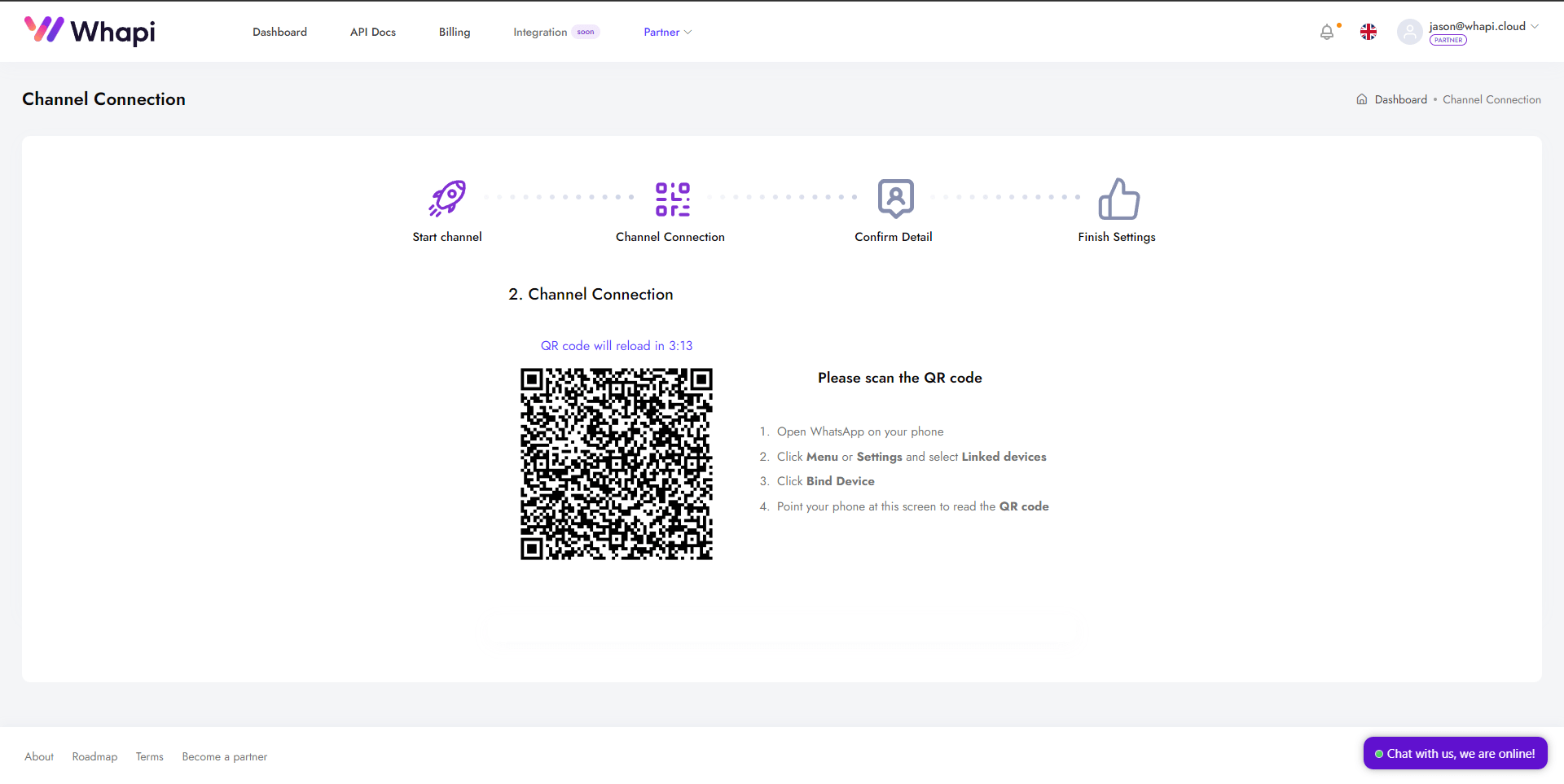
- 2) On Step 1, you'll see a QR code with instructions.
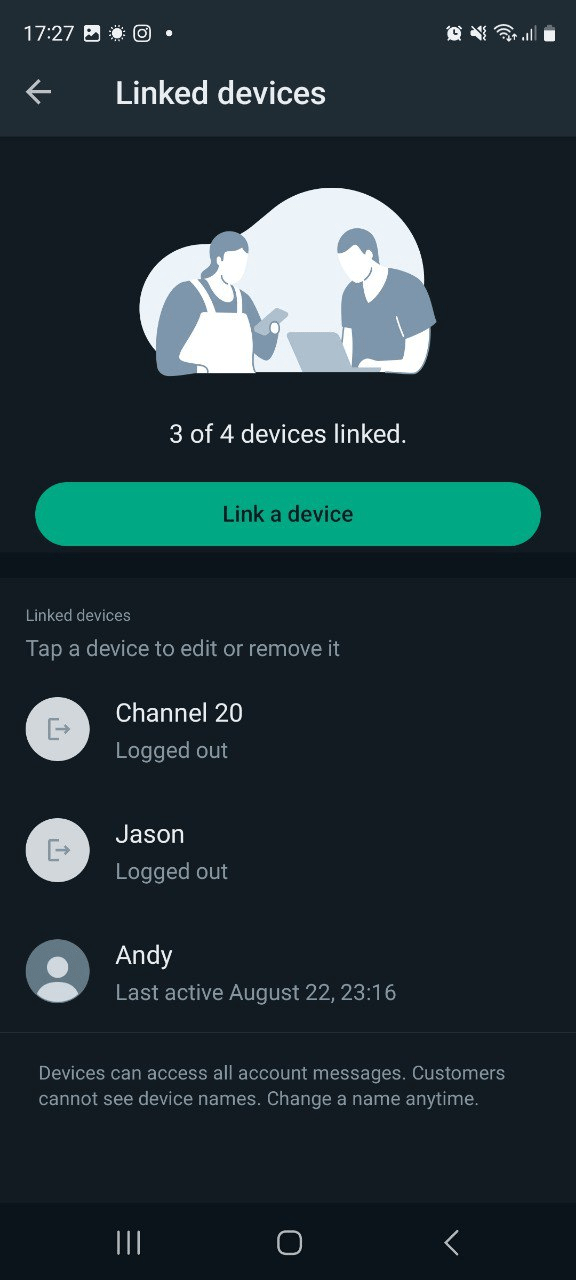
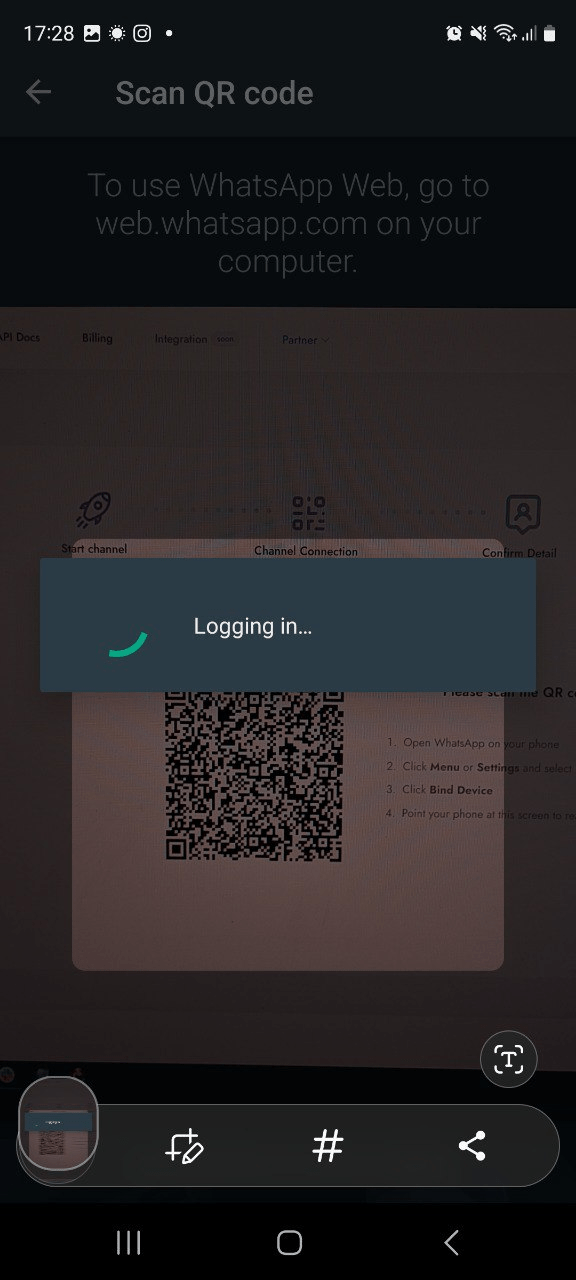
- 3) On your phone, open WhatsApp → Settings → Linked Devices → Link a Device, then scan the QR code.
- 4) Once connected, give your channel a name (e.g., "My Chatbot") for easier identification.
- 5) You'll be redirected to the channel settings screen, you can skip this step for now and return to it later.
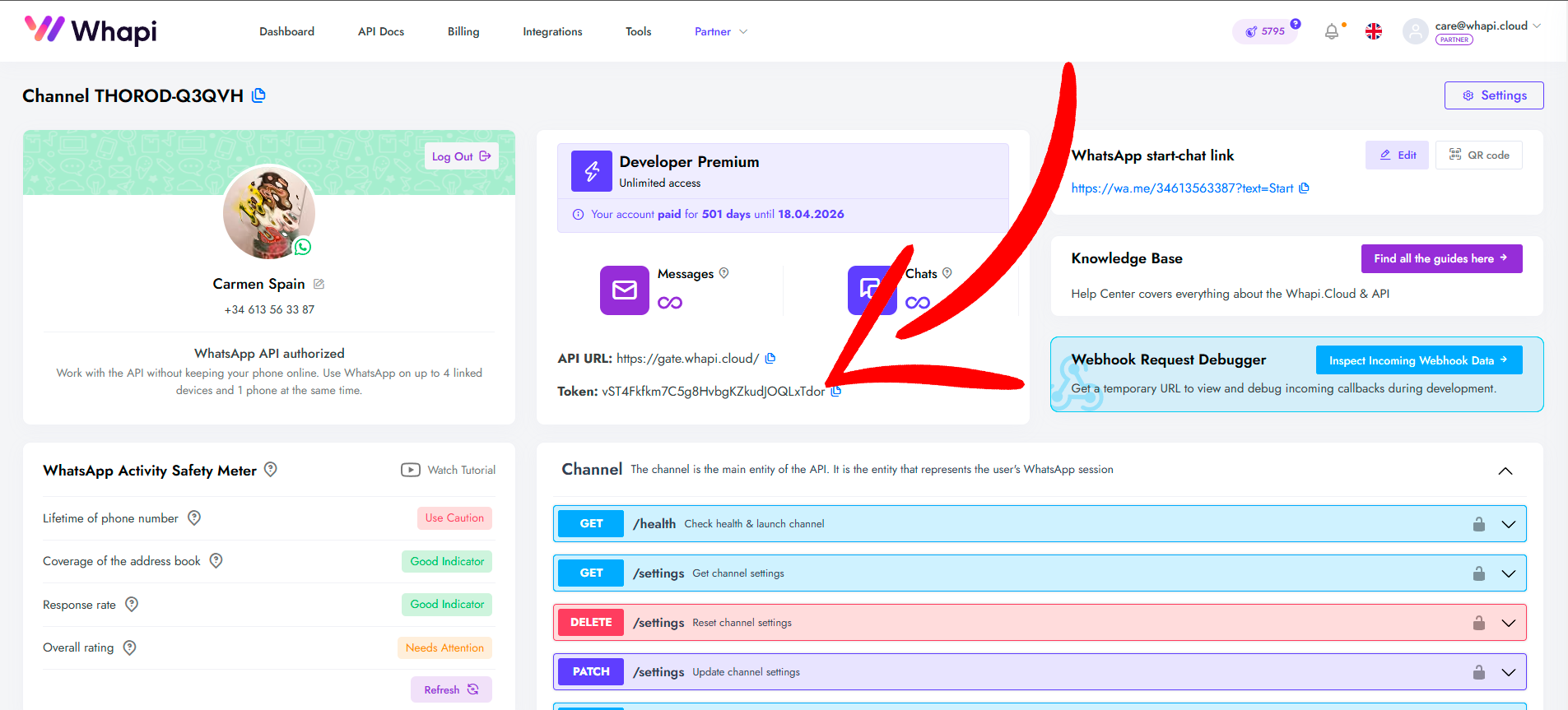
Your unique API token is displayed in the center of the connected channel page. This token is essential for authenticating API requests — it must be included in the request headers as a Bearer token or passed as a parameter, depending on the method.
Once connected, your phone acts as a server-side gateway. Store the API token in environment variables — never hard-code it in client-side scripts or public repositories.
Let's send our first message to the group!
How to Send WhatsApp Group Messages via API (with Code Examples)
Developer Tip: WhatsApp group IDs look like
[email protected]. They are not visible in the mobile or web app — retrieve them with GET /groups before sending messages.- 1) First, retrieve the group ID. Use the
GET /groupsendpoint to fetch a list of your WhatsApp groups along with their unique identifiers. For full details, see the documentation: Get groups. - 2) Once you have the group ID, you can send a message. Automatically generate new groups based on events like new customer onboarding or course enrollment. Use the
POST /messages/textendpoint, specifying the group ID in thetoparameter and your message content in thebodyparameter. For more details, refer to: Send text message.
To send a message to a WhatsApp group, you'll need its unique group ID. Unfortunately, this information isn't available directly in the WhatsApp app - it can only be accessed via the API.
You can obtain the group ID using the Get groups endpoint or by checking recent conversations through the chats endpoint.
You can obtain the group ID using the Get groups endpoint or by checking recent conversations through the chats endpoint.
You can get the group ID in several ways:
- 1) When you create a group, the group ID will be specified in the response from the API. Below, in a separate chapter, we will show you how to do this;
- 2) Endpoint Get a list of groups;
- 3) Endpoint Get a list of all chats;
The group ID looks like this: [email protected]. This information cannot be seen in the application or Web version!
Once you know the group ID, you can use the method to send any message. Let's take a closer look at how to do this. Below are examples of how to send messages to a WhatsApp group using different technologies.
curl --request POST \
     --url https://gate.whapi.cloud/messages/text \
     --header 'accept: application/json' \
     --header 'authorization: Bearer YOUR_API_TOKEN' \
     --header 'content-type: application/json' \
     --data '
{
  "to": "[email protected]",
  "body": "Hello, this message was sent via API!"
}
'
// composer require guzzlehttp/guzzle

require_once('vendor/autoload.php');

$client = new \GuzzleHttp\Client();

$response = $client->request('POST', 'https://gate.whapi.cloud/messages/text', [
  'body' => '{"to":"[email protected]","body":"Hello, this message was sent via API!"}',
  'headers' => [
    'accept' => 'application/json',
    'authorization' => 'Bearer YOUR_API_TOKEN',
    'content-type' => 'application/json',
  ],
]);

echo $response->getBody();
# python -m pip install requests

import requests

url = "https://gate.whapi.cloud/messages/text"

payload = {
    "to": "[email protected]",
    "body": "Hello, this message was sent via API!"
}
headers = {
    "accept": "application/json",
    "content-type": "application/json",
    "authorization": "Bearer YOUR_API_TOKEN"
}

response = requests.post(url, json=payload, headers=headers)

print(response.text)
// npm install axios --save

import axios from 'axios';

const options = {
  method: 'POST',
  url: 'https://gate.whapi.cloud/messages/text',
  headers: {
    accept: 'application/json',
    'content-type': 'application/json',
    authorization: 'Bearer YOUR_API_TOKEN'
  },
  data: {to: '[email protected]', body: 'Hello, this message was sent via API!'}
};

axios
  .request(options)
  .then(res => console.log(res.data))
  .catch(err => console.error(err));
OkHttpClient client = new OkHttpClient();

MediaType mediaType = MediaType.parse("application/json");
RequestBody body = RequestBody.create(mediaType, "{\"to\":\"[email protected]\",\"body\":\"Hello, this message was sent via API!\"}");
Request request = new Request.Builder()
  .url("https://gate.whapi.cloud/messages/text")
  .post(body)
  .addHeader("accept", "application/json")
  .addHeader("content-type", "application/json")
  .addHeader("authorization", "Bearer YOUR_API_TOKEN")
  .build();

Response response = client.newCall(request).execute();
//dotnet add package RestSharp

using RestSharp;

var options = new RestClientOptions("https://gate.whapi.cloud/messages/text");
var client = new RestClient(options);
var request = new RestRequest("");
request.AddHeader("accept", "application/json");
request.AddHeader("authorization", "Bearer YOUR_API_TOKEN");
request.AddJsonBody("{\"to\":\"[email protected]\",\"body\":\"Hello, this message was sent via API!\"}", false);
var response = await client.PostAsync(request);

Console.WriteLine("{0}", response.Content);
Sending Media and Documents to Groups
Group automation often requires visual reports, invoices, or onboarding PDFs. Send media with
POST /messages/image or POST /messages/document.Pass the group ID in
to, a publicly accessible file URL in media, and an optional description in caption.Below is a Node.js example that sends an image to a group:
// Send an image or PDF document to a WhatsApp group
const groupId = "[email protected]";
const res = await fetch('https://gate.whapi.cloud/messages/image', {
  method: 'POST',
  headers: {
    'accept': 'application/json',
    'content-type': 'application/json',
    'authorization': `Bearer ${process.env.WHAPI_TOKEN}`
  },
  body: JSON.stringify({
    to: groupId,
    media: "https://whapi.cloud/assets/img/whapi/logo-text.svg",
    caption: "Welcome to your automated support channel!"
  })
});
const result = await res.json();
console.log("Media message sent:", result);
How to Send WhatsApp Group Messages Using No-Code Tools like Make or n8n
For users without a strong programming background, platforms like Make (Integromat), Zapier, n8n, Pabbly, IFTTT, and others offer a flexible way to automate interactions with our API endpoints. You can trigger WhatsApp group messages based on CRM events, schedules, form submissions, or other workflows. Some of these platforms already have built-in integrations with our service, but even without native support, it's easy to set up a fully functional automation using HTTP modules or custom API calls.
To send a message to a WhatsApp group using a low-code platform like Make, follow these steps:
1. Obtain your API token
Ensure you have an active API token from Whapi.Cloud. If you haven't done this yet, refer to the earlier section of this guide for setup instructions. Once you have the token, configure your HTTP module with the proper Authorization header (Bearer token).
2. Get the Group ID
You'll need the unique identifier of the WhatsApp group you want to message. This ID cannot be retrieved from the WhatsApp app and must be obtained via the API.
If you're working with a fixed group, you can manually retrieve the group ID using the Get groups endpoint or copy it directly from the API response. For automated workflows involving multiple or dynamic groups, use the following GET request:
GET https://gate.whapi.cloud/groups In the JSON response, you'll see an array of group objects. Each object includes an id field with the group's unique identifier.
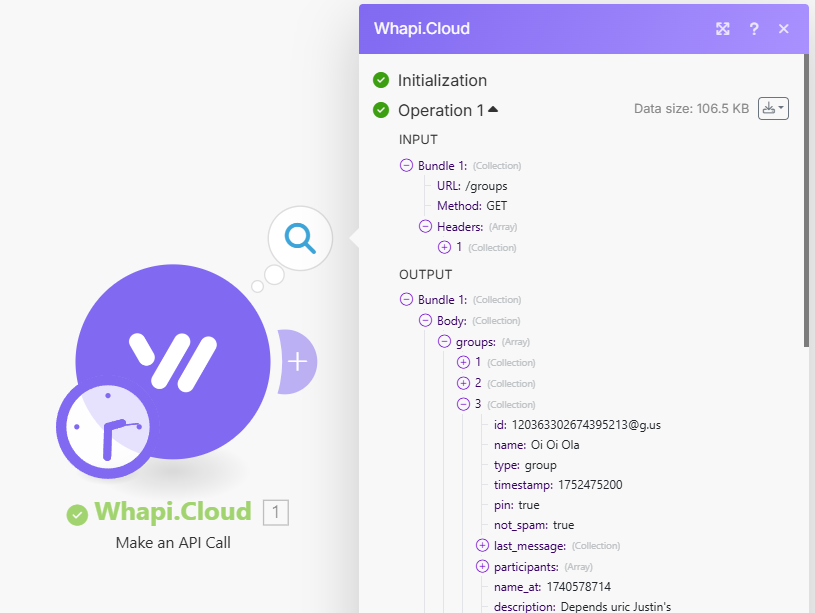
3. Send the Message
Once you have the group ID, use the following POST request to send a message:
POST https://gate.whapi.cloud/messages/text In the request body, provide:
to: the group ID.body: the message content
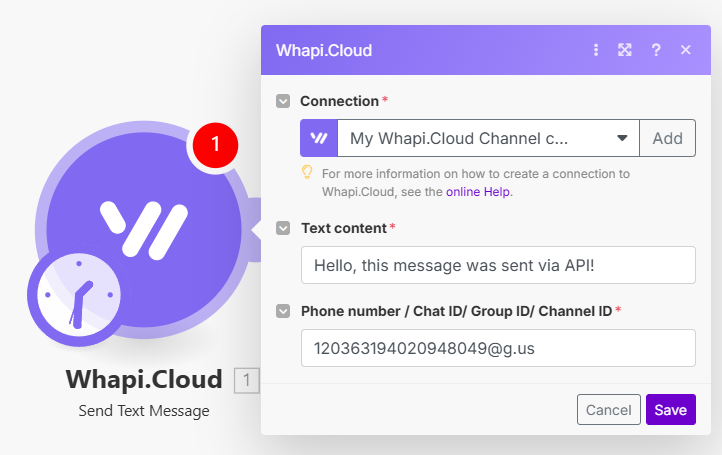
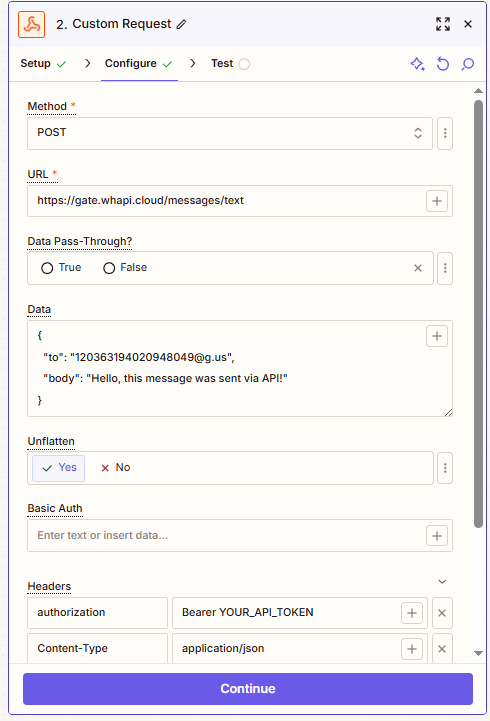
This setup allows you to automate WhatsApp group messaging through a low-code interface with minimal technical effort.
If you encounter any difficulties or need help implementing a specific use case, our team is here to assist you - just reach out via the chat widget on our website.
How to Create a WhatsApp Group via API
To create a WhatsApp group via API, follow these steps:
Technical constraint: a WhatsApp group must include at least one participant besides the creator. Always add your own number or a verified backup account to the initial
participants array.This pattern fits customer-success flows: when a client upgrades, auto-create a dedicated group, add your support team, and store the returned group ID in your CRM.
- 1) Use the
POSTmethod with thehttps://gate.whapi.cloud/groupsendpoint to create a new group. Provide the group name in the subject parameter and include at least one phone number in the participants parameter - this is required for the group to be successfully created. - 2) Upon successful creation, the API will return a group ID. You'll need this identifier to send messages to the group.
- 3) To send a message to the group, use the standard message-sending method. Specify the group ID in the
toparameter and the message content in thebodyparameter.
Be sure to enter numbers in international format and without the plus sign.
Note that some users may have privacy settings that prevent them from being added to groups. Since at least one participant is required to create a group, a good practice is to include your own number along with another contact in the
participants array to ensure successful group creation.
curl --request POST \
     --url https://gate.whapi.cloud/groups \
     --header 'accept: application/json' \
     --header 'authorization: Bearer Your_Token' \
     --header 'content-type: application/json' \
     --data '
{
  "participants": [
    "498935516106",
    "4915155985667"
  ],
  "subject": "SEO Common GmbH"
}
'
// composer require guzzlehttp/guzzle

require_once('vendor/autoload.php');

$client = new \GuzzleHttp\Client();

$response = $client->request('POST', 'https://gate.whapi.cloud/groups', [
  'body' => '{"participants":["498935516106","4915155985667"],"subject":"SEO Common GmbH"}',
  'headers' => [
    'accept' => 'application/json',
    'authorization' => 'Bearer Your_Token',
    'content-type' => 'application/json',
  ],
]);

echo $response->getBody();
# python -m pip install requests

import requests

url = "https://gate.whapi.cloud/groups"

payload = {
    "participants": ["498935516106", "4915155985667"],
    "subject": "SEO Common GmbH"
}
headers = {
    "accept": "application/json",
    "content-type": "application/json",
    "authorization": "Bearer Your_Token"
}

response = requests.post(url, json=payload, headers=headers)

print(response.text)
// npm install axios --save

import axios from 'axios';

const options = {
  method: 'POST',
  url: 'https://gate.whapi.cloud/groups',
  headers: {
    accept: 'application/json',
    'content-type': 'application/json',
    authorization: 'Bearer Your_Token'
  },
  data: {participants: ['498935516106', '4915155985667'], subject: 'SEO Common GmbH'}
};

axios
  .request(options)
  .then(res => console.log(res.data))
  .catch(err => console.error(err));
OkHttpClient client = new OkHttpClient();

MediaType mediaType = MediaType.parse("application/json");
RequestBody body = RequestBody.create(mediaType, "{\"participants\":[\"498935516106\",\"4915155985667\"],\"subject\":\"SEO Common GmbH\"}");
Request request = new Request.Builder()
  .url("https://gate.whapi.cloud/groups")
  .post(body)
  .addHeader("accept", "application/json")
  .addHeader("content-type", "application/json")
  .addHeader("authorization", "Bearer Your_Token")
  .build();

Response response = client.newCall(request).execute();
//dotnet add package RestSharp

using RestSharp;


var options = new RestClientOptions("https://gate.whapi.cloud/groups");
var client = new RestClient(options);
var request = new RestRequest("");
request.AddHeader("accept", "application/json");
request.AddHeader("authorization", "Bearer Your_Token");
request.AddJsonBody("{\"participants\":[\"498935516106\",\"4915155985667\"],\"subject\":\"SEO Common GmbH\"}", false);
var response = await client.PostAsync(request);

Console.WriteLine("{0}", response.Content);
How to Create a WhatsApp Group Using a No-Code Platform
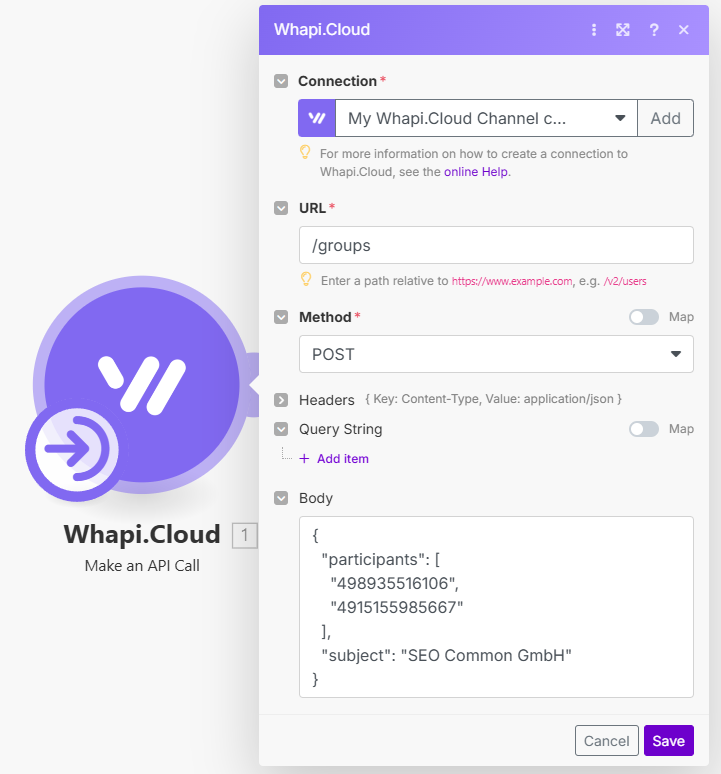
When it comes to creating WhatsApp groups using low-code platforms like Zapier or Make, the process is straightforward. You simply need to replicate the API
POST request to https://gate.whapi.cloud/groups with the correct subject (group name) and participants (array of phone numbers).In Make and n8n, this can be done using a custom module within the existing integration. In platforms like Zapier, IFTTT, or similar tools, you’ll need to use a raw HTTP request module to perform the API call.
{
  "participants": [
    "498935516106",
    "4915155985667"
  ],
  "subject": "SEO Common GmbH"
}
How to Add Participants to a WhatsApp Group
To add participants to an existing WhatsApp group, follow these steps:
- 1) Ensure you have the Group ID of the group you want to update. This is a required parameter for the request. We wrote above how to obtain a group ID.
- 2) Send a
POSTrequest tohttps://gate.whapi.cloud/groups/{GroupID}/participantsto add new members. You'll need to include the Group ID in the URL and provide an array of phone numbers for the participants you wish to add.
Direct Addition vs Invite Links
Directly adding members via the API removes click friction compared with manual invite links that require the user to open WhatsApp and confirm joining.
Conversion impact:
POST /groups/{GroupID}/participants adds users instantly. Invite-link flows often lose a significant share of users who never complete the join step.If a contact restricted group invites in privacy settings, direct addition fails. Handle the error, fetch a fallback link via
GET /groups/{GroupID}/invite, and deliver it in a personal message.Be aware of WhatsApp's anti-spam policies - in some cases, certain contacts may not be added automatically. If this happens, you may need to send a personal message inviting them to join the group. Please read here for more details on why this is happening: Why aren't participants being added to the group?
WhatsApp trusts operations more if you add the contact to your address book first. Therefore, we recommend adding the contact via the API before adding them to a group. This is easy to do using our dedicated endpoint. You can find the step-by-step instruction here.
Be sure to enter numbers in international format and without the plus sign.
curl --request POST \
     --url https://gate.whapi.cloud/groups/120367831625595066%40g.us/participants \
     --header 'accept: application/json' \
     --header 'authorization: Bearer Your_Token' \
     --header 'content-type: application/json' \
     --data '
{
  "participants": [
    "373983445541",
    "373983445542",
    "373983445543"
  ]
}
'
// composer require guzzlehttp/guzzle

require_once('vendor/autoload.php');

$client = new \GuzzleHttp\Client();

$response = $client->request('POST', 'https://gate.whapi.cloud/groups/120367831625595066%40g.us/participants', [
  'body' => '{"participants":["373983445541","373983445542","373983445543"]}',
  'headers' => [
    'accept' => 'application/json',
    'authorization' => 'Bearer Your_Token',
    'content-type' => 'application/json',
  ],
]);

echo $response->getBody();
# python -m pip install requests

import requests

url = "https://gate.whapi.cloud/groups/120367831625595066%40g.us/participants"

payload = { "participants": ["373983445541", "373983445542", "373983445543"] }
headers = {
    "accept": "application/json",
    "content-type": "application/json",
    "authorization": "Bearer Your_Token"
}

response = requests.post(url, json=payload, headers=headers)

print(response.text)
// npm install axios --save

import axios from 'axios';

const options = {
  method: 'POST',
  url: 'https://gate.whapi.cloud/groups/120367831625595066%40g.us/participants',
  headers: {
    accept: 'application/json',
    'content-type': 'application/json',
    authorization: 'Bearer Your_Token'
  },
  data: {participants: ['373983445541', '373983445542', '373983445543']}
};

axios
  .request(options)
  .then(res => console.log(res.data))
  .catch(err => console.error(err));
OkHttpClient client = new OkHttpClient();

MediaType mediaType = MediaType.parse("application/json");
RequestBody body = RequestBody.create(mediaType, "{\"participants\":[\"373983445541\",\"373983445542\",\"373983445543\"]}");
Request request = new Request.Builder()
  .url("https://gate.whapi.cloud/groups/120367831625595066%40g.us/participants")
  .post(body)
  .addHeader("accept", "application/json")
  .addHeader("content-type", "application/json")
  .addHeader("authorization", "Bearer Your_Token")
  .build();

Response response = client.newCall(request).execute();
//dotnet add package RestSharp

using RestSharp;


var options = new RestClientOptions("https://gate.whapi.cloud/groups/120367831625595066%40g.us/participants");
var client = new RestClient(options);
var request = new RestRequest("");
request.AddHeader("accept", "application/json");
request.AddHeader("authorization", "Bearer Your_Token");
request.AddJsonBody("{\"participants\":[\"373983445541\",\"373983445542\",\"373983445543\"]}", false);
var response = await client.PostAsync(request);

Console.WriteLine("{0}", response.Content);
How to Add Participants to a WhatsApp Group Using No-Code Tools
When using no-code platforms to add participants to a WhatsApp group, the only specific detail to note is that the group ID is included directly in the API URL, for example:
https://gate.whapi.cloud/groups/[email protected]/participants.Keep in mind that some platforms may require you to encode special characters — for instance, replacing
@ with %40.Aside from that, the process is identical to group creation: simply pass an array of phone numbers in international format.
{
  "participants": [
    "373983445541",
    "373983445542",
    "373983445543"
  ]
}
Real-World No-Code Automation: Auto-Creating Support Groups (Make & n8n)
Operational trigger: B2B SaaS teams often create a WhatsApp support group when a Stripe payment succeeds or a CRM deal reaches a paid stage.
In Make or n8n, chain three Whapi.Cloud calls after your CRM or billing webhook:
- Create the group:
POST /groupswith a subject like "Client Support: Company Name" and your bot number. - Add participants:
POST /groups/{groupId}/participantswith the customer and account manager numbers. - Send a welcome message:
POST /messages/imageorPOST /messages/textwith onboarding instructions.
Selection criteria: choose the path that matches your scale:
| Automation Path | When to Choose | Key Advantages |
|---|---|---|
| Make / n8n (No-Code) | Rapid prototyping and small to medium business operations. | Visual debugging, pre-built connectors, zero server maintenance. |
| Custom Code (Node.js / Python) | High-volume enterprise apps and complex database syncs. | Lower execution cost, full error handling, unlimited scalability. |
How to Fetch WhatsApp Group Participants via API
To retrieve the list of participants in a WhatsApp group, follow these steps:
- 1) Make sure you are a member of the group you want to access. Without being part of the group, you won’t be able to retrieve its participant list.
- 2) Use the API method Get Groups to fetch a list of all groups associated with your WhatsApp account. If you know the ID of the desired group, call it directly using the Get group endpoint.
- 3) The response will include an array of group objects, each containing information such as the group ID, name, and a participants field with a list of members. Example response:
{
  "id": "[email protected]",
  "name": "A group of researchers",
  "participants": [
    { "id": "972558557032", "rank": "member" },
    { "id": "14409416972", "rank": "creator" },
    { "id": "905589461962", "rank": "member" }
  ]
}
To better understand how participant data is collected and why it may not always be immediately available, we recommend reading the article "How Whapi Processes and Updates WhatsApp Group Data".
curl --request GET \
     --url 'https://gate.whapi.cloud/groups?count=100' \
     --header 'accept: application/json' \
     --header 'authorization: Bearer Your_Token'
// composer require guzzlehttp/guzzle

require_once('vendor/autoload.php');

$client = new \GuzzleHttp\Client();

$response = $client->request('GET', 'https://gate.whapi.cloud/groups?count=100', [
  'headers' => [
    'accept' => 'application/json',
    'authorization' => 'Bearer Your_Token',
  ],
]);

echo $response->getBody();
# python -m pip install requests

import requests

url = "https://gate.whapi.cloud/groups?count=100"

headers = {
    "accept": "application/json",
    "authorization": "Bearer Your_Token"
}

response = requests.get(url, headers=headers)

print(response.text)
// npm install axios --save

import axios from 'axios';

const options = {
  method: 'GET',
  url: 'https://gate.whapi.cloud/groups?count=100',
  headers: {accept: 'application/json', authorization: 'Bearer Your_Token'}
};

axios
  .request(options)
  .then(res => console.log(res.data))
  .catch(err => console.error(err));
OkHttpClient client = new OkHttpClient();

Request request = new Request.Builder()
  .url("https://gate.whapi.cloud/groups?count=100")
  .get()
  .addHeader("accept", "application/json")
  .addHeader("authorization", "Bearer Your_Token")
  .build();

Response response = client.newCall(request).execute();
//dotnet add package RestSharp

using RestSharp;

var options = new RestClientOptions("https://gate.whapi.cloud/groups?count=100");
var client = new RestClient(options);
var request = new RestRequest("");
request.AddHeader("accept", "application/json");
request.AddHeader("authorization", "Bearer Your_Token");
var response = await client.GetAsync(request);

Console.WriteLine("{0}", response.Content);
How to Retrieve WhatsApp Group Members via No-Code
Use a
GET request to https://gate.whapi.cloud/groups to retrieve a list of all WhatsApp groups you are a member of, along with details about each group - including participant information.Alternatively, if you already know the group ID, you can use
GET https://gate.whapi.cloud/groups/{GroupID} to fetch data for a specific group.In Make and n8n, this can be done using a custom module within the existing integration. In platforms like Zapier, IFTTT, or similar tools, you’ll need to use a raw HTTP request module to perform the API call.
How to Connect a Bot to a WhatsApp Group
Connecting a bot to a WhatsApp group is technically no different from connecting it to a private chat. The bot is simply a WhatsApp number linked to your API session, capable of receiving and sending messages programmatically. Incoming messages, whether from private chats or group conversations, are delivered to your system via webhook, and you can handle them using your bot logic.
To get started, you can build a bot in your preferred programming language using our API. We provide step-by-step guides for several environments:
- Create a WhatsApp Bot in Node.js;
- Create a WhatsApp Bot in Python;
- Create a WhatsApp Bot in PHP;
- Create a WhatsApp Bot in Java;
In addition, we’ve published several open-source bot templates on GitHub that you can use or extend for your own projects. Some of these bots already support advanced workflows — such as creating a new WhatsApp group with a user from a private chat, automatically adding both the bot and the user to that group, and sending an initial welcome message once the group is created.
These templates are great for onboarding, consultations, team workflows, or organizing users by context.
When your bot is part of a WhatsApp group, it will automatically receive all group messages via webhook. In the callback payload, you can identify group messages by checking the
chat_id, which will follow the format [email protected] (as opposed to a phone number in private chats). The from field will indicate the individual sender's number inside the group.By parsing and responding to these messages, your bot can participate in group conversations - whether to log activity, trigger workflows, or provide automated responses.
Tips, Limitations, and Best Practices
When working with WhatsApp groups via API, it's essential to be aware of key limitations and best practices to ensure stable and compliant automation.
Since the API operates by connecting to a regular WhatsApp account, the following guidelines should be observed:
- Do not add users to groups without their consent. Always respect user privacy and avoid unsolicited invitations;
- Avoid sending spam or unwanted content, as this may result in your account being flagged or permanently banned;
- Whapi.Cloud does not impose strict API rate limits on paid channels, but WhatsApp may flag accounts sending more than ~20 messages per minute without warm-up history. Use human-like pacing and randomized 1.5–3.5 second delays between actions.
Warm new numbers gradually — start with 5–10 outbound messages per day and scale over two weeks. See Whapi.Cloud's guide on avoiding account bans before production traffic.
Never rely on a single admin number for automated groups. If that account is restricted, you can lose operational control — even a replacement bot cannot manage the group without admin rights.
Use the Secondary Administrator Resiliency Pattern: promote a backup number (personal phone or internal manager) via
PATCH /groups/{GroupID}/admins immediately after group creation. If the primary bot disconnects, the secondary admin can re-add and promote a new bot. See also Promote to Group Admin.When the sole administrator is banned, WhatsApp may leave the group locked or randomly assign admin to another participant — including an external client — which creates a serious security risk.
// PATCH https://gate.whapi.cloud/groups/{groupId}/admins
const groupId = "[email protected]";
const res = await fetch(`https://gate.whapi.cloud/groups/${groupId}/admins`, {
  method: 'PATCH',
  headers: {
    'accept': 'application/json',
    'content-type': 'application/json',
    'authorization': `Bearer ${process.env.WHAPI_TOKEN}`
  },
  body: JSON.stringify({
    participants: ["4915155985667"]
  })
});
const status = await res.json();
console.log("Admin promotion status:", status);
Following these simple precautions can protect your automation flow and help you maintain reliable long-term group operations.
Troubleshooting
Various issues can arise during the testing and operation of the WhatsApp chatbot. Here are a few typical situations and recommendations for their resolution:
The Bot Does Not Respond to Incoming Messages
- Ensure you are sending messages to the number on which the bot is running from a different phone. The bot will not be able to respond to messages sent from the same number.
- If the bot does not respond to messages from other numbers, check the operation of webhooks. Use services to simulate webhooks, for example, Webhook.site, to ensure which path the callback requests are coming through. Afterwards, check if the path matches the one you have configured. Also, ensure your server responds with 200Ok.
If you encounter difficulties, do not hesitate to contact our technical support for help. You can write in the web chat widget on our site or email [email protected]. We will assist you and figure out exactly what's wrong with the webhook.
The Bot Sends Messages Non-Stop
Return to the original version of the code. Our script includes a check to determine whether a message is incoming or outgoing, to prevent getting into an infinite loop of sending messages. Infinite sending may occur if there is no check for outgoing messages in the code, causing the bot to call itself, or if there is a cyclic sending of messages in the code.
Webhook Callbacks and Common Group Automation Issues
Group bots rely on webhook callbacks for incoming messages and membership events. Configure your webhook URL in the Whapi.Cloud dashboard and subscribe to group-related events.
Callback validation: return HTTP 200 OK immediately when your endpoint receives a webhook — slow handlers cause retries and queued payloads.
Payloads include event types such as
message_created or group_updated. Parse chat_id ending in @g.us to distinguish group traffic from private chats.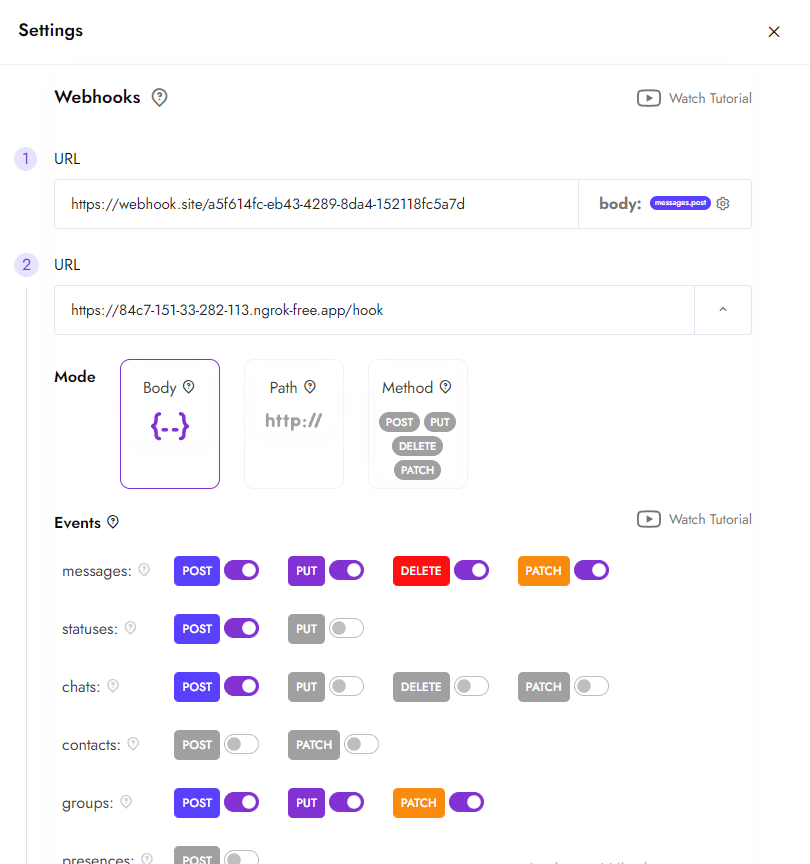
Common problems and quick fixes:
- Bot loop sending: check the
from_meflag — without it, the bot may reply to its own messages indefinitely. - Permission denied: the bot must be a group admin to add participants — verify rank via
GET /groups/{GroupID}. - Missing numbers in roster: group metadata sync can take up to 15 seconds after creation before all participant numbers resolve.
Can’t Add a User to the Group?
There are several possible reasons why a participant can’t be added:
- You must be a group admin. Only admins are allowed to add new members.
- The user may have restricted group invitations in their privacy settings. If so, they cannot be added automatically via API.
- The group may have reached the maximum size of 1024 participants. In this case, remove inactive members or consider creating a new group.
- WhatsApp’s anti-spam policies may block certain numbers from being added to groups — especially if the contact is not saved in your address book or hasn’t interacted with you. To reduce this risk, we highly recommend programmatically adding the contact to your list first using our Add Contact API.
For more details, see the article: Why aren't participants being added to the group?
Message Not Delivered?
If your message isn’t being delivered:
- Double-check the group ID - incorrect or expired IDs will result in delivery failure.
- If the message is sent but not visible in the group, review the message format. For example, WhatsApp groups may not display certain content types, such as webp images or interactive buttons.
Permission Denied?
This error typically occurs when:
- Your number is not recognized as a group admin.
- The API may not have correctly synced your admin status or phone number. In such cases, try re-authorizing your API channel to refresh permissions and metadata.
Group Members Not Displayed?
Whapi.Cloud automatically processes and updates group metadata in the background. After connecting your WhatsApp number and making the first
GET /groups or GET /group request, group data is queued for synchronization.Group data is updated every 15 seconds to stay within WhatsApp API limits. If participant phone numbers are not yet visible, it may be due to privacy restrictions or the synchronization still being in progress. In most cases, simply waiting a few moments after setup allows the system to fetch all available group details.
For more information, read: How Whapi Processes and Updates WhatsApp Group Data
What Does @lid Mean in Participant List?
@lid is a new participant identifier format introduced by WhatsApp to enhance privacy and anonymity in groups. Instead of displaying a phone number, members may appear as anonymized IDs like 1524746986546@lid. This typically occurs when number visibility is restricted by group settings or when the group is part of a community with stricter privacy controls.
These changes are part of WhatsApp’s broader privacy strategy. Whapi automatically processes such groups and attempts to resolve @lid values to actual phone numbers over time. However, if your WhatsApp account doesn't have permission to access a participant’s number due to their privacy settings, the number will remain hidden.
When rosters show
@lid instead of phone JIDs, resolve them for CRM mapping with GET /contacts/lids or GET /contacts/ids/{ContactLID}. See resolving anonymized @lid identifiers.// GET https://gate.whapi.cloud/contacts/ids/{contactLid}
const contactLid = "1524746986546@lid";
const res = await fetch(`https://gate.whapi.cloud/contacts/ids/${contactLid}`, {
method: 'GET',
headers: {
'accept': 'application/json',
'authorization': `Bearer ${process.env.WHAPI_TOKEN}`
}
});
const { phone } = await res.json();
console.log("Resolved JID phone number:", phone);
For more details, see: What Is lid in WhatsApp Groups?
Deployment and Using Servers
To ensure your WhatsApp chatbot is available 24/7, it needs to be hosted on a reliable hosting platform. You can use your server, but in this chapter, we will consider the three most popular platforms - Firebase, AWS, and Heroku - and go through the basic steps of deploying your bot on each of them.
The choice of platform depends on your preferences, budget, and project requirements. Each of the considered platforms offers its unique features and advantages. Firebase and AWS Lambda provide powerful backend functionality without the need to manage a server, while Heroku offers simplicity in deploying applications based on Git.
Firebase
Firebase offers Cloud Functions functionality, allowing you to run your bot without worrying about server infrastructure. In our opinion, this is the most optimal option.
- Create a project in Firebase Console;
- Install Firebase CLI, following the instructions;
- Initialize Firebase in your project directory with the command firebase init;
- Deploy your bot using the command firebase deploy --only functions.
AWS (Amazon Web Services)
AWS Lambda offers the ability to run code in response to triggers from other AWS services, making it a good choice for a bot.
- Register or log in to AWS Management Console;
- Create a new Lambda function through the AWS console, selecting API Gateway as the trigger;
- Upload your bot's code into the Lambda function;
- Configure the API Gateway to interact with your bot and the outside world.
Heroku
Heroku offers an easy-to-use platform for hosting applications, which can automatically deploy code from your Git repository.
- Create an account on Heroku;
- Install Heroku CLI and log in;
- Create a new Heroku app through the console or using the command heroku create;
- Link your Git repository to Heroku and perform deployment with the commands git push heroku master;
- Set the webhook URL provided by Heroku.
Summary & What’s Next
With Whapi.Cloud and tools like Make or n8n, you can automate group messaging, creation, member management, and bot workflows — including resilient admin patterns and safe sending pace.
You can spin up a test workflow in under ten minutes using the free sandbox. For broadcast-only use cases, explore the WhatsApp Channels API as an alternative to groups.