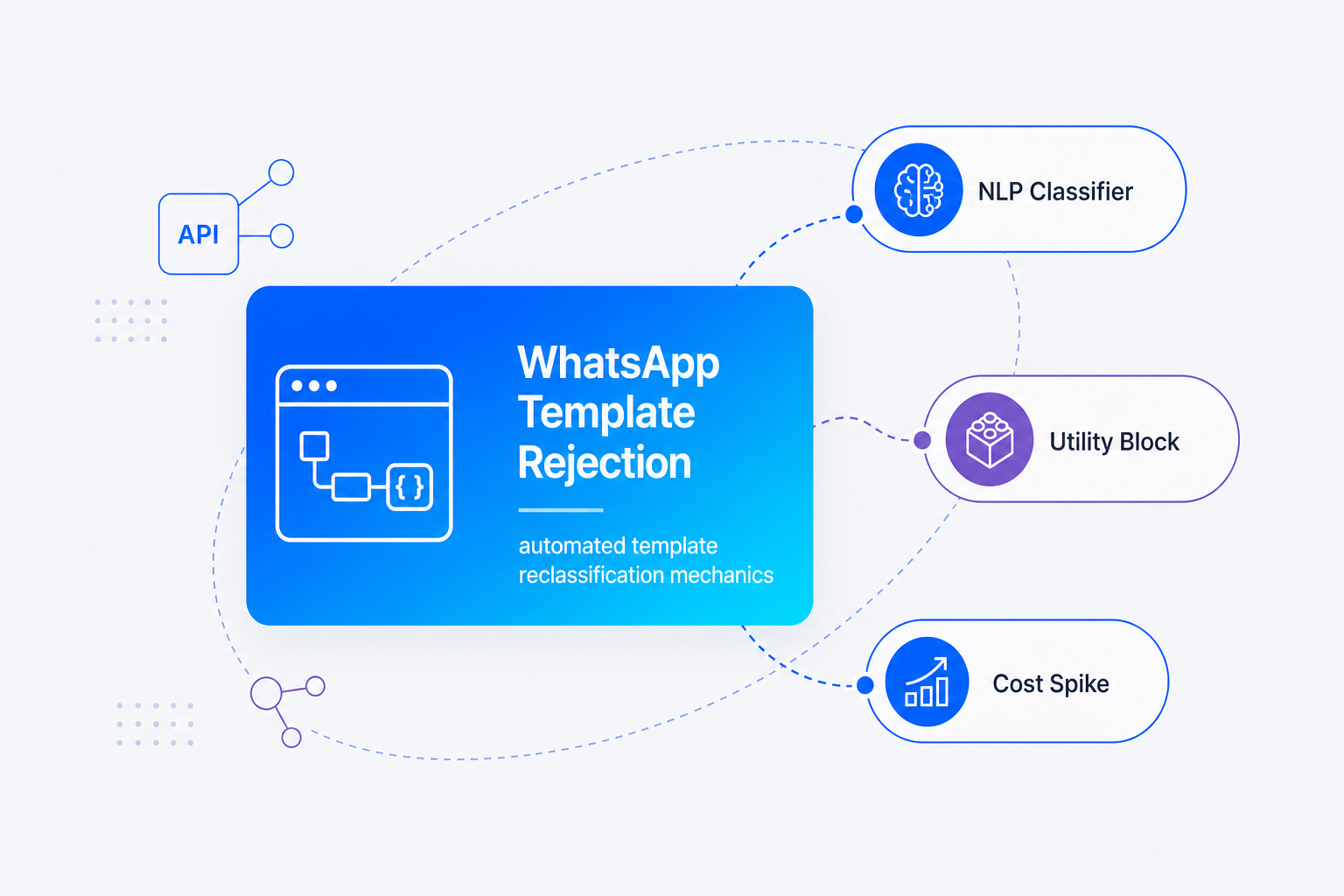
TL;DR: Meta's automated NLP classifier silently reclassifies critical Utility templates to Marketing based on CTA buttons and promotional filler words, causing immediate 5x to 10x billing spikes and delivery blocks. To fix this, strip all marketing-like buttons, remove polite filler words, and keep templates strictly factual. If you want to bypass template restrictions entirely, use a session-based API like Whapi.Cloud.
Why Does Meta Keep Rejecting Your WhatsApp Utility Templates?
Your copywriting is not the reason Meta rejects your WhatsApp templates. While copy quality affects reader response, automated categorization algorithms determine your message delivery cost. Whapi.Cloud bypasses this entirely by routing messages via template-free web-session sockets.
We've seen setups where automated classifiers silently reclassify utility templates to marketing, causing 5x to 10x cost spikes. When you send an order notification in the official WhatsApp Business API, Meta's automated NLP classifier scans the template for promotional intent. The most common mistake we observe is developers attempting to rewrite the message body text--fixing spelling, grammar, or word choice--while leaving promotional CTA buttons or discount codes intact. This immediately triggers the NLP classifier, rendering your editing efforts useless.
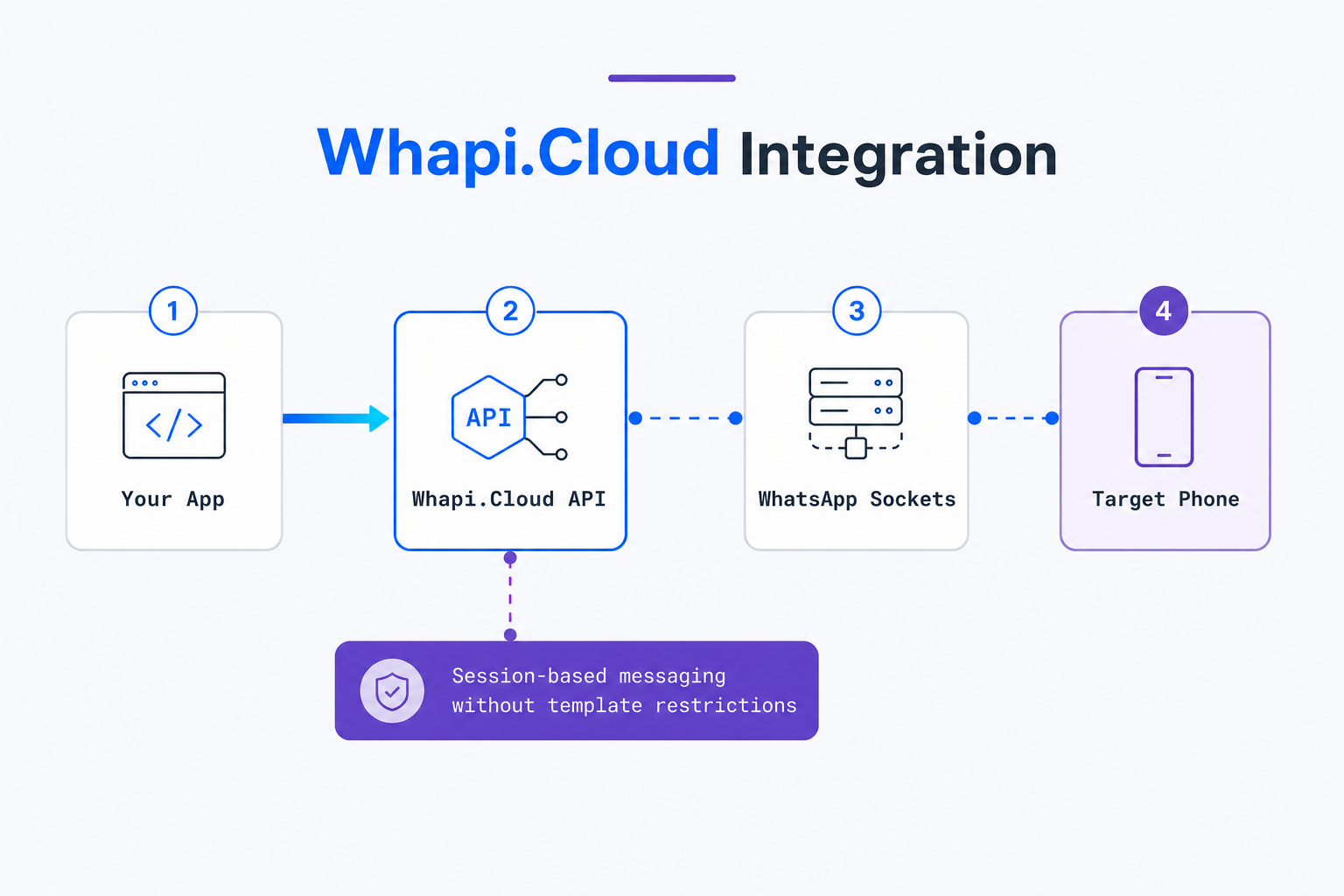
In the official WhatsApp Business API, every message must go through a rigid approval system. In Whapi.Cloud, you send any message freely without template gating or reclassification because our platform connects via web-session sockets, entirely bypassing Meta's template registry.
Why the April 2025 Updates Make Template Reclassification Instant
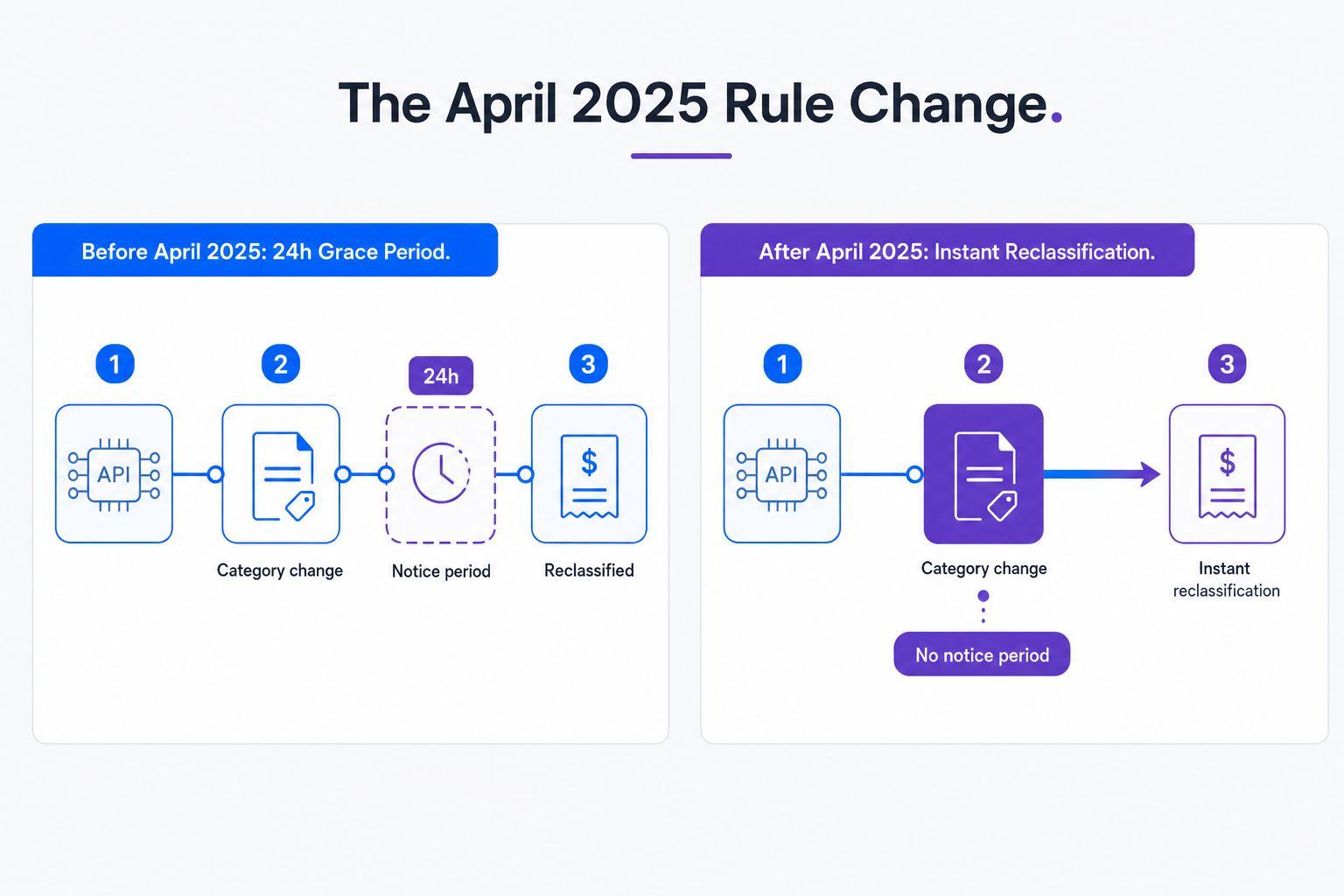
Meta's April 2025 updates stripped the notice period, making category updates instantly punitive. In the official API, reclassification happens in real time. In contrast, Whapi.Cloud is immune to these policy updates because it does not use message templates.
In the official WhatsApp Business API, Meta removed the allow_category_change parameter from the template creation API. This means templates are auto-approved as Marketing without your consent if the classifier detects promotional cues. Whapi.Cloud avoids this constraint entirely because our platform has no template approval gate, allowing you to send any layout instantly.
To monitor these changes in production, your system must listen for Meta's template status webhooks. Below is the exact JSON-payload schema for the template_category_update event (which you can map using our webhook format reference) that your webhook handler will receive when Meta silently updates your template's category:
{
  "object": "whatsapp_business_account",
  "entry": [
    {
      "id": "109283746501928",
      "changes": [
        {
          "value": {
            "event": "template_category_update",
            "message_template_id": "872635491029384",
            "message_template_name": "order_shipping_update_v2",
            "previous_category": "UTILITY",
            "new_category": "MARKETING",
            "rejection_reason": "AUTOMATED_CLASSIFIER_PROMOTIONAL_INTENT"
          },
          "field": "message_template_status"
        }
      ]
    }
  ]
}
While official API developers must build complex webhook handlers to catch these silent category updates, Whapi.Cloud users enjoy 100% predictable routing with no template status monitoring required. This isolates your application from unexpected API behavior and lets you focus on delivery logic.
July 2025 Per-Message Pricing and the Looming 5x to 10x Cost Spikes
Silent Utility-to-Marketing reclassification inflates North American template costs from $0.0034 to $0.0250 per message. While official API invoices swing with Meta's category shifts, Whapi.Cloud's flat subscription keeps your monthly costs completely predictable regardless of message volume.
This pricing shock is not unique to North America. Across all major markets, the cost of sending marketing templates is significantly higher than utility templates. The table below outlines the exact cost differentials under the July 2025 pricing model across key global regions:
| Region / Country | Utility Cost (Per Message) | Marketing Cost (Per Message) | Price Increase Factor |
|---|---|---|---|
| North America (US) | $0.0034 | $0.0250 | 7.35x Cost Increase |
| India (IN) | ₹0.1150 | ₹0.8631 | 7.50x Cost Increase |
| Brazil (BR) | $0.0068 | $0.0625 | 9.19x Cost Increase |
| Germany (DE) | $0.0550 | $0.1365 | 2.48x Cost Increase |
For high-volume senders, these multipliers are unsustainable. A retail store or SaaS platform managing multi-step transactional flows (Order Confirmation -> Shipped -> Delivered) will see its margins heavily impacted if even one of those templates is silently shifted to the Marketing category.
By choosing Whapi.Cloud, businesses bypass this financial vulnerability entirely. Our flat-rate subscription means your transactional delivery costs remain static, allowing you to scale your messaging volume without risking sudden margin inflation or complex billing audits.
How Delivery Error 131049 Blocks Your Critical Transactional Messages
When promotional filters hijack critical transactional templates, Error 131049 blocks order notification delivery. While Meta's strict per-user marketing limits cause delivery failures in official setups, Whapi.Cloud ensures uninterrupted delivery by routing messages via template-free web-session sockets.
In the official WhatsApp Business API, Meta enforces unpublicized daily limits on marketing messages, which can block your critical notifications if they are reclassified. Whapi.Cloud has no template-based limits, meaning your transactional messages are never blocked by ecosystem-wide marketing caps.
This exact scenario occurs when critical transactional alerts are blocked by the network. When Meta's NLP classifier hijacks your utility template, your operational flow breaks entirely, leaving your users in the dark.
With Whapi.Cloud, developers never encounter Error 131049 or similar template delivery blocks. Because our API does not rely on Meta's template registry, your order updates are delivered directly via web-session sockets, bypassing the ecosystem limits that disrupt standard integrations.
The Trigger Checklist for Automated Category Rejections
Exceeding the ten-emoji limit or adding discount codes triggers immediate automated category rejections. While official API templates are subject to strict character and emoji caps, Whapi.Cloud allows you to send rich, personalized content without any automated gating.
Typical triggers that cause instant utility rejection on the official API include promotional filler copy, discount codes, and emoji thresholds. Whapi.Cloud users can ignore these restrictive guidelines entirely, as our platform does not enforce content-based template audits.
-
Promotional Filler Copy: Words like "We are pleased to inform you," "Thank you for choosing us," or "Enjoy your purchase" are flagged as promotional tone.
-
Discount Codes & Cross-Sells: Including a standard 10% discount code or a line like "Check out our new arrivals" in a shipping template triggers immediate reclassification.
-
Emoji Thresholds: Exceeding a maximum of 10 emojis in a single template body triggers automated rejection. Keep emojis to a minimum (ideally zero) in utility templates.
-
Character Limits: Stricter character caps (typically a 550-character limit on the body text) are enforced on utility templates. Exceeding this cap on some CRM gateways triggers instant rejection.
-
Promotional CTA Buttons: Adding buttons like "Shop Now," "View Catalog," or "Join Community" to an order update will instantly force a marketing classification.
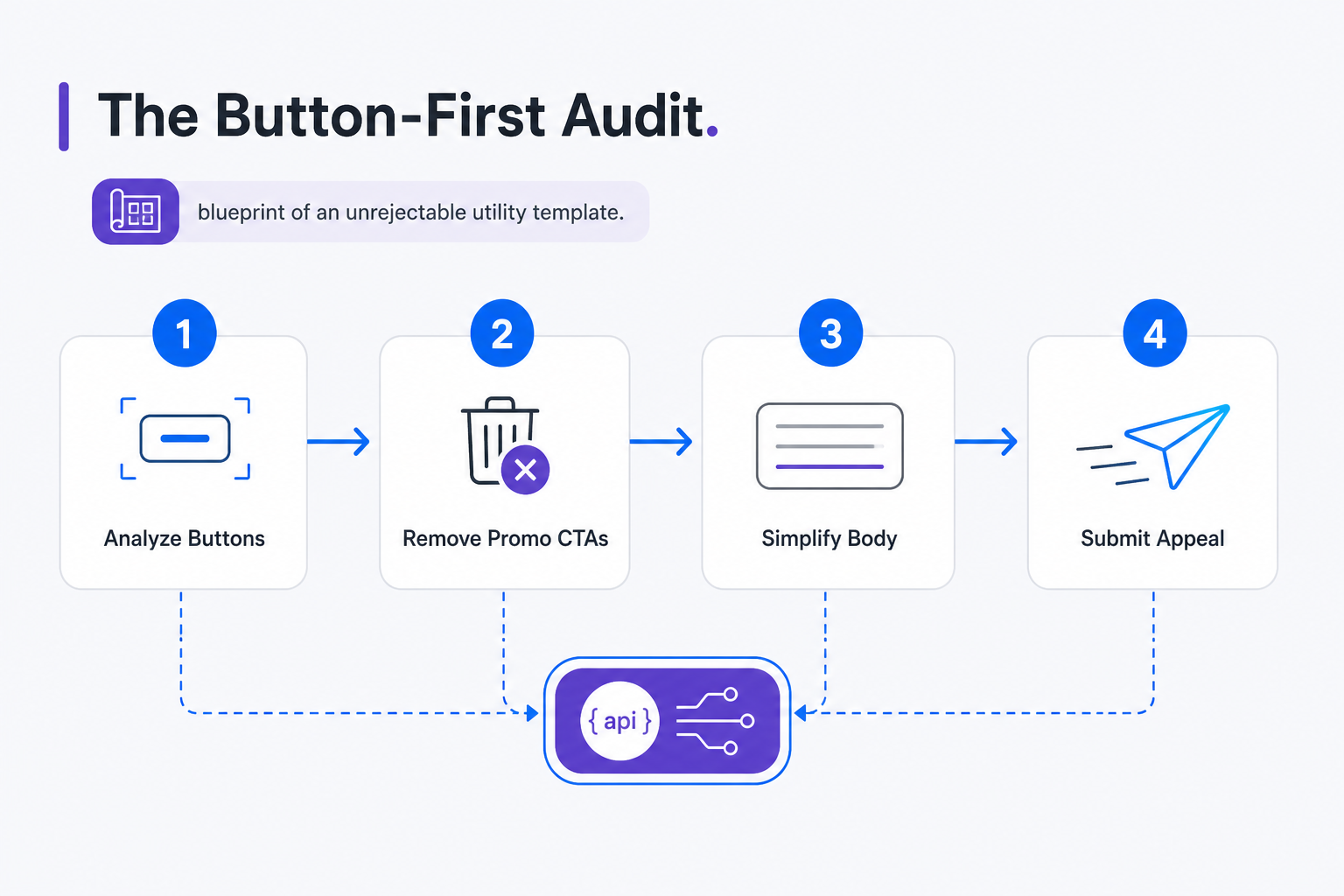
The Button-First Audit: Restructuring Templates to Restore Utility Status
Accumulated misclassifications trigger a thirty-day utility block, paralyzing all new transaction-based templates. While Meta's utility restrictions lock down official accounts, Whapi.Cloud users are immune to these lockdowns because our platform operates independently of Meta's template approval gate.
Factual, neutral, and stripped of polite fillers: the blueprint of an unrejectable utility template. The most critical step in this audit is modifying your template buttons. The NLP classifier weighs button text and button URLs far more heavily than the message body. You might try to appeal Meta's decision repeatedly without changing your template; however, this rejected alternative will fail, and consecutive rejected appeals will only accelerate your WABA-wide utility restriction or lead to a complete account ban. Read our guide on how to avoid a WhatsApp ban in 2026 to keep your account safe.
Whapi.Cloud eliminates the need for complex button audits and manual appeals. Since our session-based API does not use the official template approval workflow, you can include any CTA buttons or links without risking account restrictions or blocking critical workflows.
Below are three realistic before/after template button comparison pairs demonstrating how to restructure your templates to guarantee utility approval under The Button-First Audit pattern:
Pair 1: Order Shipping Notification
Body: "Hi {{1}}, your order {{2}} has been shipped! Track it here: {{3}}"
Before (Rejected as Marketing): Button 1: "Track Order" (URL: yoursite.com/track?id={{3}}) | Button 2: "Shop More" (URL: yoursite.com/shop)
After (Approved as Utility): Button 1: "Track Order" (URL: yoursite.com/track?id={{3}}) only.
Pair 2: Booking Confirmation
Body: "Your appointment is confirmed for {{1}} at {{2}}."
Before (Rejected as Marketing): Button 1: "Add to Calendar" (URL: yoursite.com/cal) | Button 2: "Refer a Friend" (URL: yoursite.com/refer)
After (Approved as Utility): Button 1: "Add to Calendar" (URL: yoursite.com/cal) only.
Pair 3: Account Verification Code
Body: "Your verification code is {{1}}. It expires in 10 minutes."
Before (Rejected as Marketing): Button 1: "Copy Code" (Copy action) | Button 2: "Upgrade Plan" (URL: yoursite.com/upgrade)
After (Approved as Utility): Button 1: "Copy Code" (Copy action) only.
Timing is Money: How to Leverage the Free 24-Hour Customer Service Window
Utility messages delivered within active user-initiated windows incur zero cost under per-message billing. While official API users must carefully time templates to utilize this free window, Whapi.Cloud's flat-rate subscription provides unlimited free messaging 24/7 without any session-timing constraints.
Bypassing Template Gating with Whapi.Cloud Session-Based APIs
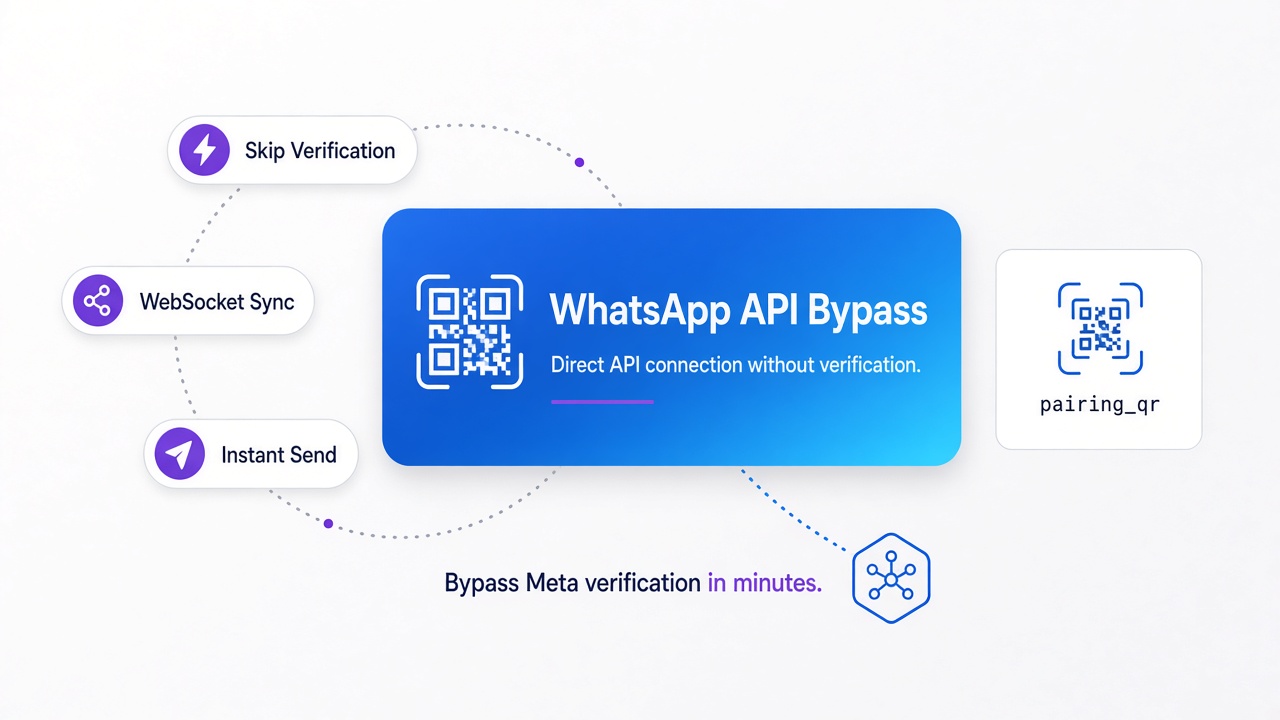
Whapi.Cloud offers bypass capabilities for transactional systems without the restrictions of WABA templates. By connecting via web-session sockets, Whapi.Cloud eliminates the official template approval gate, letting you send any customized message instantly without per-message Meta fees. You can find all available methods in the general API documentation.
Because Whapi.Cloud operates on a flat subscription model per connected number, your messaging costs remain completely predictable regardless of your volume or message content. You can include discount codes, multiple CTA buttons, emojis, and personalized copy without ever worrying about an NLP classifier reclassifying your transactional flow or blocking your critical notifications. This architectural approach separates your compliance management from your delivery pipeline, ensuring that your system remains operational 24/7.
While official API setups require continuous template monitoring to prevent sudden billing spikes, Whapi.Cloud's flat subscription model isolates your business from Meta's algorithmic classification risks entirely.
How to Set Up Free-Tier WhatsApp API Integration with Whapi.Cloud
Setting up a reliable transactional delivery pipeline with Whapi.Cloud takes less than five minutes. While official API setups require days of business verification and template approvals, Whapi.Cloud connects instantly via a simple QR code scan.
We've observed that teams who transition to Whapi.Cloud's flat-rate subscription can immediately deploy their existing order notification scripts without modifying their copywriting or stripping out helpful CTA buttons, ensuring account safety. The forever-free sandbox tier allows you to test this integration with up to 5 active conversations per month.
Below is a production-ready Node.js integration script (derived from our comprehensive Node.js WhatsApp bot tutorial) demonstrating how to send an order confirmation notification with custom buttons and links using Whapi.Cloud's HTTP REST API:
// Send order confirmation via Whapi.Cloud HTTP REST API
async function sendOrderNotification(customerPhone, orderId, customerName, trackingUrl) {
  const payload = {
    to: customerPhone, // must include country code, e.g., "15551234567"
    body: `Hi ${customerName}, your order #${orderId} has been confirmed! Track your shipment here: ${trackingUrl}\n\nEnjoy a 10% discount on your next purchase with code: UTILITY10`
  };

  try {
    // If the WHAPI_TOKEN is missing or invalid, gate.whapi.cloud returns a 401 Unauthorized error
    const response = await fetch('https://gate.whapi.cloud/messages/text', {
      method: 'POST',
      headers: {
        'Content-Type': 'application/json',
        'Authorization': `Bearer ${process.env.WHAPI_TOKEN}`
      },
      body: JSON.stringify(payload)
    });

    if (!response.ok) {
      const errorData = await response.json();
      throw new Error(`Whapi API Error: ${errorData.message || response.statusText}`);
    }

    const result = await response.json();
    return result;
  } catch (error) {
    console.error('Failed to deliver order notification:', error.message);
    throw error;
  }
}
In addition to sending messages, Whapi.Cloud provides full access to WhatsApp-native features that are completely unavailable or highly restricted on the official API. You can programmatically manage WhatsApp Groups, broadcast to WhatsApp Channels, update account Statuses, and perform number existence checks to verify if a phone number has an active WhatsApp account before sending.
Conclusion: Taking Back Control of Your Transactional WhatsApp Delivery
Control your transactional delivery by separating strict template compliance from flexible API routing. While relying entirely on Meta's automated classifier is a high-risk strategy, Whapi.Cloud provides a stable, template-free alternative that secures your delivery and pricing.
Relying entirely on Meta's automated NLP classifier to determine your delivery costs and operational stability is a high-risk strategy for any growing business. By understanding the category classifier, auditing your CTA buttons, utilizing 24-hour free windows, and integrating session-based APIs like Whapi.Cloud, you can guarantee that your critical order notifications reach your customers without unexpected billing spikes or delivery blocks.
Ready to eliminate template rejection pains and secure predictable pricing? Start Your Free Sandbox on Whapi.Cloud