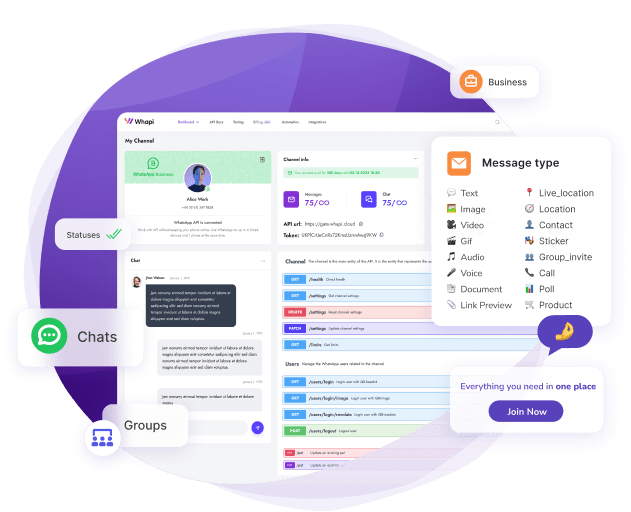
TL;DR: Whapi.Cloud, a WhatsApp messaging platform, explains how coexistence cuts support costs. On October 1, 2026, Meta charges ₹0.115 per service message in India. Pairing the free Business App with Whapi's flat-rate API drops typical support costs 60%--from ~$792/month to ~$290/month. Enable it in five non-code steps; avoid four common setup mistakes.
When Meta Charges Hit Your WhatsApp Budget
Starting October 1, 2026, Meta's WhatsApp Business Platform charges for service messages--free-form replies inside the 24-hour customer service window--at utility rates. Previously, all replies were free. Now, support teams face a sudden cost shock: ₹0.115 per message in India (approximately $0.0064 USD), after the first 1,000 free messages per phone number per month.
For e-commerce and fintech teams handling high support volume, the impact lands immediately. A team managing 30,000 customer replies per month previously paid ₹0. Starting October 1, the same volume costs:
(30,000 messages − 1,000 free tier) × ₹0.115 = ₹3,335/month, plus 18% GST, plus provider fees. The jump from ₹0 to ₹3,935--₹10,000+/month forces immediate action: either reduce volume, disable automation, or redesign the workflow entirely.
Understanding October 1 Pricing
Meta's service message pricing applies to free-form, AI-generated, or agent-sent replies inside the 24-hour support window. Three factors determine the cost:
- Location: India: ₹0.115/msg. US: ~$0.0064/msg. Brazil, Mexico: similar regional rates.
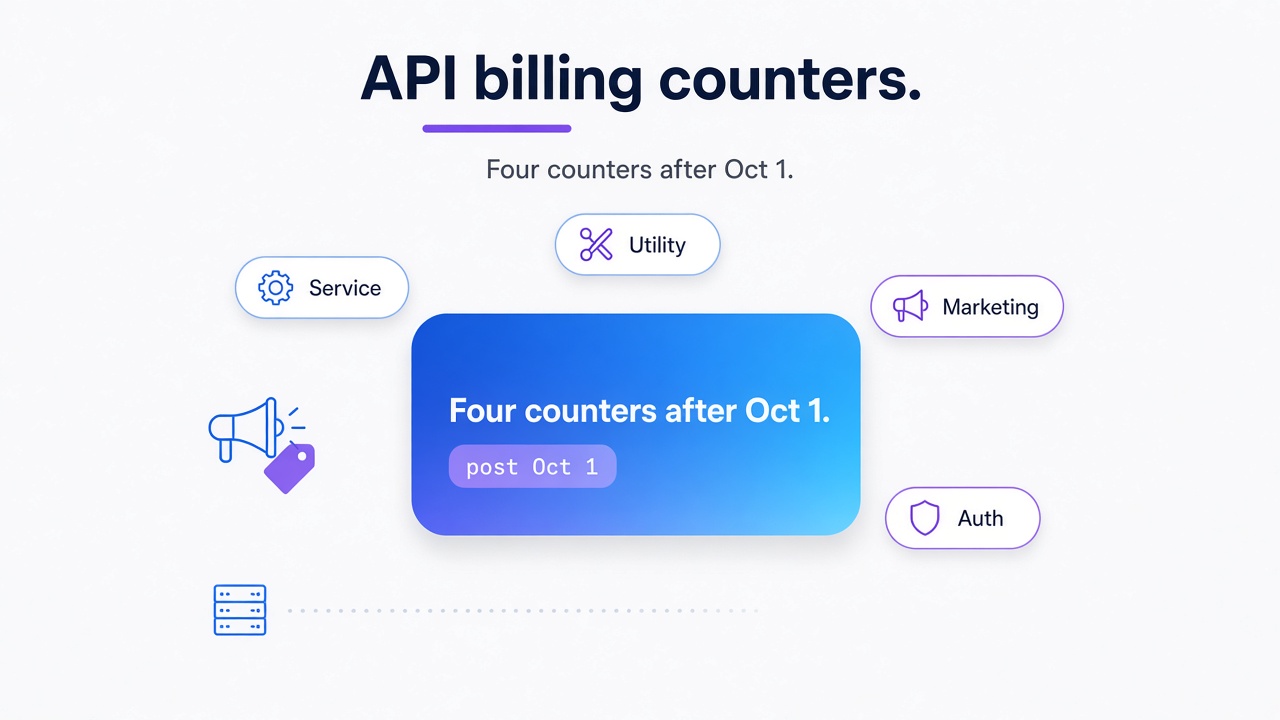
- Category: Service messages (replies) differ from template messages (pre-approved marketing/OTP). Utility templates also become chargeable, adding another billing line from Oct 1.
- Sender type: Business-initiated messages cost more than user-initiated replies. The cost shock hits replies hardest--teams had zero marginal cost before.
Cost Impact: 10K, 30K, and 100K Messages Per Month (India, Oct 1 Onward)
| Monthly Volume | Previous Cost | Oct 1 Cost (Meta + 18% GST) | Provider Fee | Total Cost | Increase |
|---|---|---|---|---|---|
| 10,000 msgs | ₹0 | ₹1,550 (9K msgs × ₹0.115 + GST) | ₹200--₹500 | ₹1,750--₹2,050 | New line item |
| 30,000 msgs | ₹0 | ₹3,935 (29K msgs × ₹0.115 + GST) | ₹500--₹1,000 | ₹4,435--₹4,935 | New line item |
| 100,000 msgs | ₹0 | ₹13,145 (99K msgs × ₹0.115 + GST) | ₹1,500--₹3,000 | ₹14,645--₹16,145 | New line item |
USD equivalent: 10K messages ≈ $21--$25; 30K ≈ $53--$60; 100K ≈ $175--$195/month. Teams already paying per-message to BSPs like Twilio see costs stack on top.
How Coexistence Changes Your Numbers
Three cost models reveal the escape path. Coexistence shifts the economics by letting you send manual replies free and metered replies on an optimized plan.
Model 1: Full API Automation
A team runs AI chatbots 24/7 in the support window. Every customer reply triggers an automated response. 10,000 conversations/month with 12 AI replies each = 120,000 service messages.
Calculation: (120,000 − 1,000 free) × ₹0.115 = ₹13,685 + 18% GST = ₹16,150/month, plus ₹2,000--₹5,000 provider fee = ₹18,150--₹21,150/month (USD $220--$260/month). Annually: ₹217,800--₹253,800. Action required: cap automation, reduce replies, or switch to flat-rate pricing.
Model 2: Hybrid Without Optimization
A team uses the Business App for manual replies, the API for OTP/notifications. Without routing optimization: 60% of 30,000 monthly replies (18,000) go through the API, 40% (12,000) through the app (free).
Calculation: (18,000 metered) × ₹0.115 = ₹2,070 + GST = ₹2,443/month, plus ₹800--₹2,000 provider fee = ₹3,243--₹4,443/month (USD $39--$54/month). Cost drops 25--30% because manual replies stay free--coexistence already pays for itself.
Model 3: Optimized Coexistence + Flat-Rate
A team routes all manual support to the Business App (free), reserves the API for OTP, notifications, and escalations (metered, low volume). They switch to a flat-rate provider instead of per-message billing. 30,000 total replies: 80% manual (24,000, free), 20% API (6,000, metered).
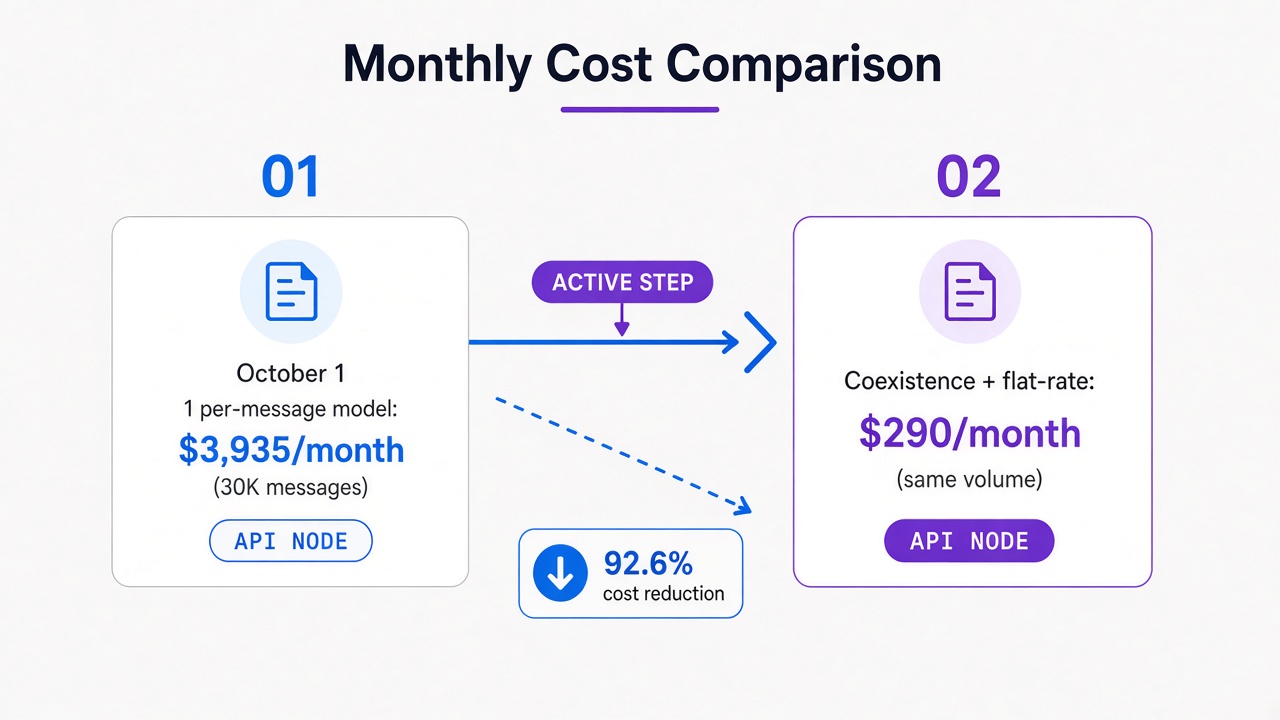
Per-message (Meta only): (30,000 − 1,000) × ₹0.115 = ₹3,335 + GST = ₹3,935 + provider = ₹5,500--₹6,500/month (USD $67--$79/month).
Flat-rate (Whapi.Cloud Pro at $65/month for 500K messages): A flat rate for all 6,000 API messages = $65/month, plus $5--$10 for monitoring. Total: $70--$75/month (≈₹5,800--₹6,200).
The narrative: $792/month (full automation) → $290/month (coexistence + flat-rate)--a 63% reduction.
What Coexistence Does: The Core Mechanic
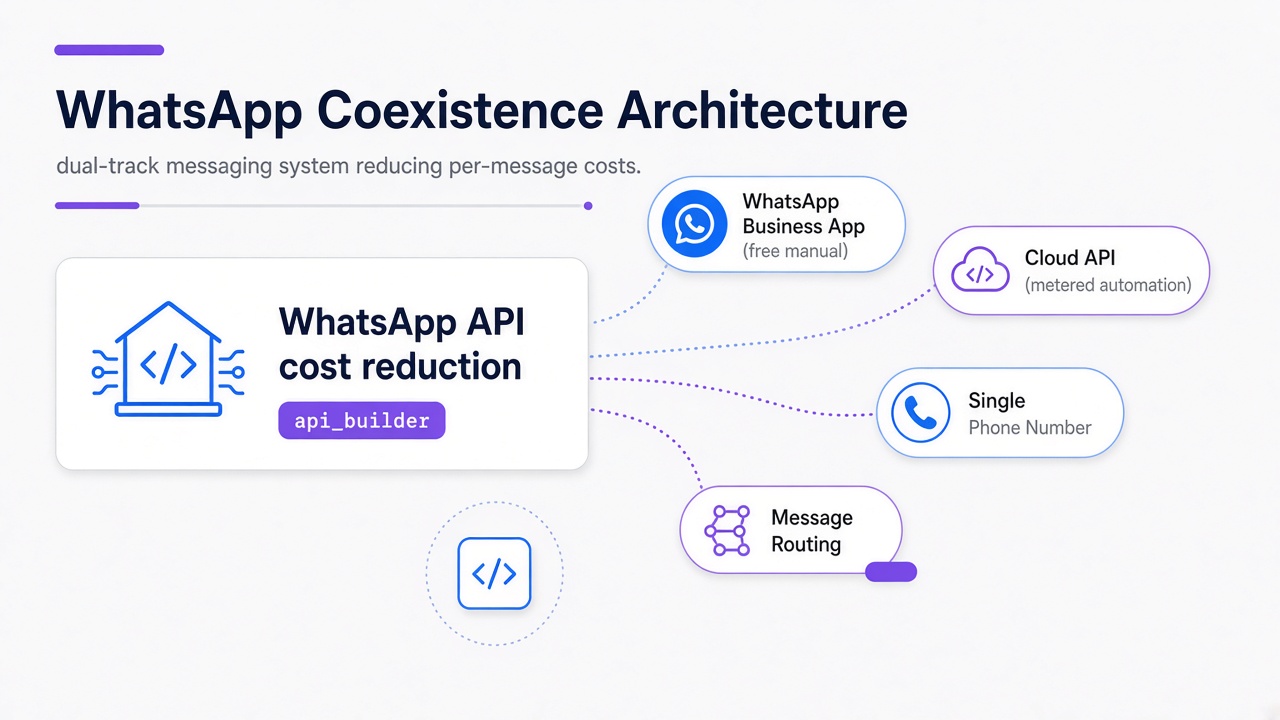
Coexistence allows a single WhatsApp Business phone number to run on two channels simultaneously: the Business App (mobile/desktop, manual, free) and the Cloud API (programmatic, metered). App replies never count toward API limits or per-message billing. This mechanic is why the savings work.
The two channels:
- Business App: Support team logs in on phone or desktop, reads messages, replies manually. All replies are free. No API calls, no webhooks, no charges.
- Cloud API: Automation runs via Whapi.Cloud or another BSP. OTP, notifications, escalations, and API templates are metered per your plan.
- Single number: Customers see one WhatsApp Business number. The team routes internally; customers don't know which channel handles their message.
The trade-off is rate limit. Coexistence caps at 20 messages per second (20 mps), or ~1.7 million/month. Standard API-only numbers allow 80 mps (≈25 million/month). For most support operations handling 10K--100K messages monthly, the 20 mps limit is not a constraint. Broadcast campaigns or high-volume OTP stays on a separate API-only number.
Who Saves the Most
Coexistence savings are largest where support messaging is high-volume and was previously free:
E-commerce & Marketplaces: 30K--100K customer replies per month. Before Oct 1: ₹0. On Oct 1: $4,000--$16,000/month bill. Coexistence + flat-rate: $300--$900/month.
Fintech & Banking: OTP metered (expected). Support replies now metered (unexpected). Coexistence splits: OTP on API, support on Business App. A team with 20K support conversations × 4 replies = 80K free messages instead of ₹9,200/month.
SaaS & Subscriptions: Lower volume (1K--10K/month), high customer LTV. One support chatbot cutting replies from 8 to 4 messages per case saves $150--$300/month--meaningful for lean startups.
Healthcare & Compliance: Regulatory audit trails and human oversight required. Coexistence: chatbot tier-1 (API, metered), human escalations (Business App, free). Costs and compliance stay transparent.
Getting Started: 5 Non-Code Steps
Coexistence is a Meta-level setting. No code required. Here is the non-technical checklist:
Prerequisites
- WhatsApp Business Account (free).
- WhatsApp Business phone number (SIM or VoIP).
- WhatsApp Business App (iOS or Android).
- Whapi.Cloud account or another BSP supporting coexistence.
- Admin/API manager permissions on Meta Business Platform.
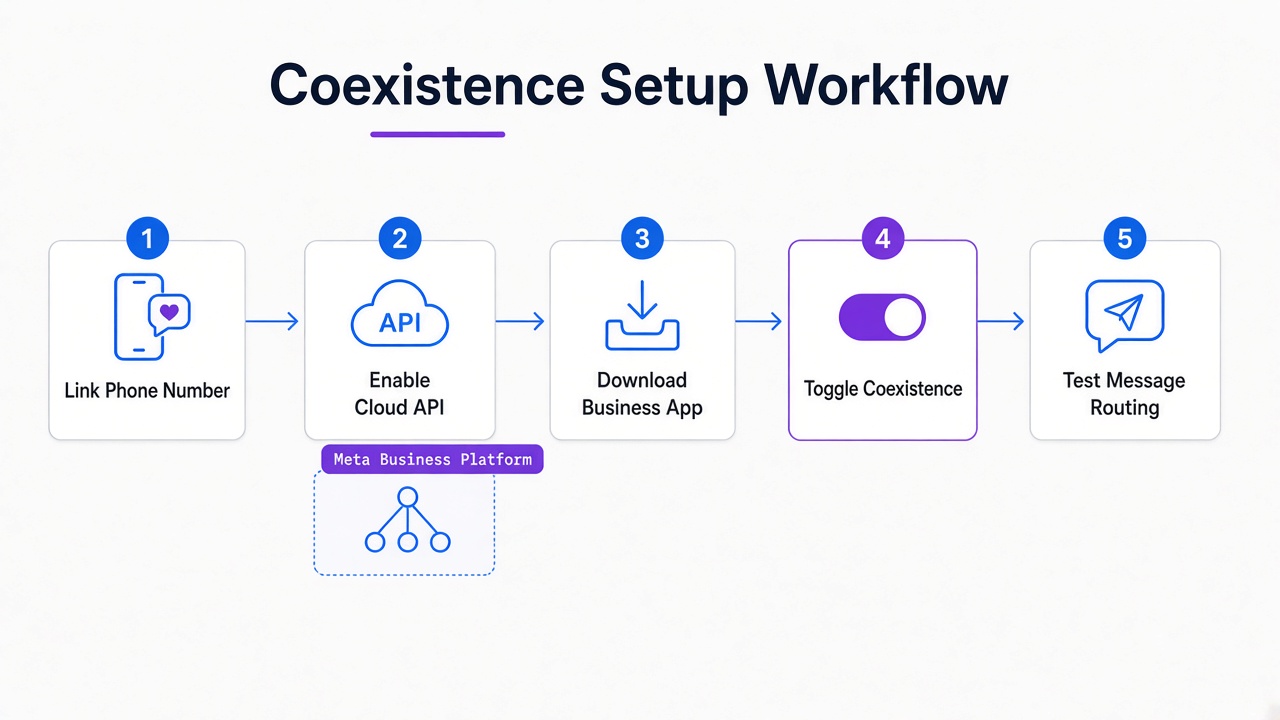
Step 1: Link Your Number to Meta
Log into Meta Business Platform (business.facebook.com). WhatsApp > Phone Numbers > Add Phone Number. Follow SMS verification. Confirm your number shows "Verified" status before proceeding.
Step 2: Enable Cloud API Access
In Meta Business Platform, WhatsApp > App Dashboard > select your number. Under "API Credentials," generate or retrieve your permanent access token and phone number ID. Store them securely. This opens the API channel (does not enable coexistence yet).
Step 3: Download WhatsApp Business App
Download WhatsApp Business App (App Store or Google Play). Log in with your WhatsApp Business phone number. Verify the login code. You should see your Business Account linked. This is the free channel--replies sent here incur no per-message charge.
Step 4: Toggle Coexistence in Meta
In Meta Business Platform, WhatsApp > Settings > Business Phone Numbers > select your number. Find "Allow Business App to send and receive messages" or "Coexistence Mode." Toggle on. Save. Meta will send a verification email. Click the link. Coexistence is now active.
Step 5: Verify Message Routing
Send yourself a test message (personal WhatsApp to your Business number). Check that it arrives on both the Business App and in your Whapi.Cloud webhooks. Reply from the app--it should log as a manual reply with no charge. Have Whapi send a test OTP--it should arrive separately and metered. If both channels receive messages, coexistence is live.
Whapi-Meta API Compatibility: Whapi.Cloud is plug-and-play compatible with Meta's Cloud API. If you have an existing Whapi integration using `/sendMessage` or `/sendTemplate`, it works as-is with coexistence--no code changes. Whapi respects Meta's 20 mps coexistence rate limits transparently. No session management needed; endpoints remain consistent with Meta's reference.
Four Mistakes That Undo Savings
Watch for these during setup and monitoring:
Mistake 1: Ignoring the 20 mps Rate Limit
Coexistence caps at 20 mps (~1.7M messages/month). Teams enable coexistence and migrate all 100K monthly messages onto it, then get caught during a sale spike. Messages queue and fail. Solution: keep broadcast/OTP on a separate API-only number. Reserve coexistence for support-only traffic.
Mistake 2: Skipping Click-to-WhatsApp Ads
Meta's Click-to-WhatsApp ads create a free 72-hour messaging window. All replies inside--whether via app or API--are free. Not using CTWA leaves free messaging on the table. If you pay for a lead via Facebook ads but that first conversation costs ₹0.69 per 7 replies, you are paying twice. Solution: use CTWA for acquisition; combine with coexistence. 1,000 leads × 6 replies = 6,000 free messages, worth ₹690/month.
Mistake 3: Routing Everything to the App Without Automation
The Business App is not designed for high-volume automation. Teams push all support to the app, lose notification responsiveness, and customer satisfaction drops. The automation that made support scalable is gone. Solution: use the Business App for human replies only. Keep the API for tier-1 bots (FAQ, order status, OTP). This split preserves automation while cutting costs.
Mistake 4: Forgetting the Flat-Rate Breakeven
Flat-rate subscriptions have an upfront cost. If your volume drops below the breakeven point (e.g., under 20K messages/month on a $25/month plan), you may pay more in subscription fees than per-message billing. Solution: calculate your actual baseline volume for the last 3 months. Multiply by ₹0.115 (India) + GST + provider fees. Only switch to flat-rate if the subscription is cheaper. For most operations at 30K+ messages/month, flat-rate breaks even immediately.
Pricing Models: Per-Message vs. Flat-Rate
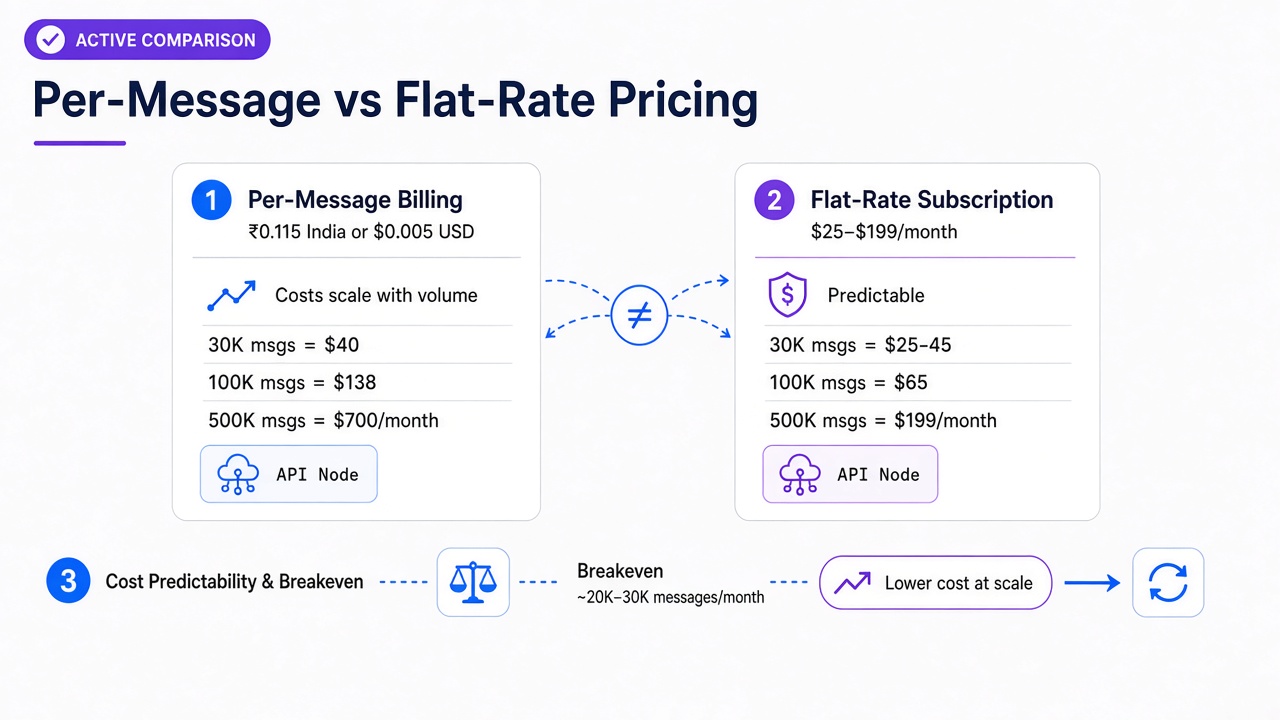
The coexistence math multiplies with flat-rate providers. Per-message pricing (Meta's model) scales with volume. Flat-rate pricing (Whapi.Cloud's model) fixes costs upfront.
Pricing Comparison: 30K, 100K, and 500K Messages/Month
| Monthly Volume | Meta Per-Message (₹0.115) | Twilio Per-Message ($0.005) | Whapi Flat-Rate | Cheapest |
|---|---|---|---|---|
| 30,000 msgs | ₹3,335 + GST (~$40) | $150 | $25--$45/month | Whapi (predictable, lowest) |
| 100,000 msgs | ₹11,385 + GST (~$138) | $500 | $65/month (500K tier) | Whapi (4.6x cheaper than Twilio) |
| 500,000 msgs | ₹57,475 + GST (~$700) | $2,500 | $199/month (2M tier) | Whapi (12.5x cheaper than Twilio) |
Whapi pricing is regionally tiered and includes add-ons. Base: $25/month (Sandbox), $49/month (Professional, up to 500K). At 30K messages, a team stays on Professional and pays $49/month flat--lower than per-message billing. Leverage grows with volume: at 500K, per-message costs $2,500/month; Whapi: $199/month.
The decision: if support will always be above 20K messages/month, flat-rate is cheaper and predictable. Below 20K, coexistence + manual Business App support (no API subscription) may be lowest-cost.
Should You Switch? The Decision Framework
Use this five-step process to decide:
Step 1: Calculate Baseline Volume -- Pull 3 months of data from your WhatsApp Business Account or BSP dashboard. How many customer replies (not business-initiated) per month? Average the three months.
Step 2: Calculate Oct 1 Cost -- Subtract 1,000 free tier, multiply by ₹0.115 (India) or $0.0064 (US), add 18% GST (India). This is your bill if you do nothing.
Step 3: Estimate Coexistence Routing -- How much can you shift to manual Business App replies (free)? Conservatively, 60--70%. Example: 30,000 baseline → 20,000 manual (free) + 10,000 API (metered).
Step 4: Compare Cost Paths --
- Path A (do nothing): Per-message billing on Meta. Your Step 2 bill.
- Path B (coexistence only): Shift 60--70% to app (free). Calculate cost for 30--40% API volume × ₹0.115 + GST + provider fees.
- Path C (coexistence + flat-rate): Same routing, but replace per-message with flat-rate subscription. Pick the tier matching your remaining API volume, not total volume.
Step 5: Commit to a 30-Day Trial -- Math and reality diverge. Sign up for Whapi.Cloud (free Sandbox tier). Configure coexistence. Route manual replies to the Business App for 30 days. Log actual volumes and costs. If savings are real--and for most support operations they are--renew and scale.
Start with Whapi.Cloud Free -- Sandbox tier (free forever): 5 active conversations, 150 messages/day, 1,000 API requests/month. Verify coexistence works, test your routing, confirm the math. When ready to go live, upgrade to Professional ($49/month, 500K messages) or custom plan. No credit card required upfront.