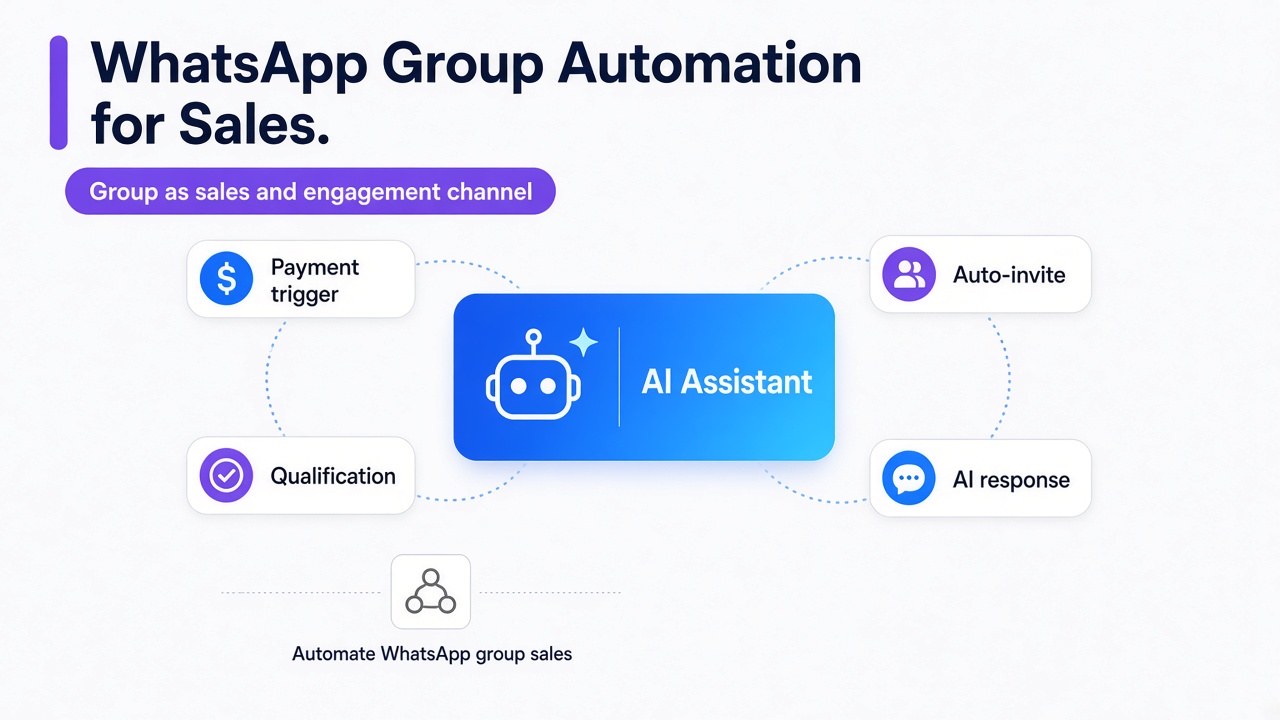
TL;DR: Start with one pilot group: gate access behind payment (auto-invite on completion), automate member approval to block spam, use a webhook to monitor messages for buyer intent keywords, and set up AI responses for common questions. These four moves alone typically convert 15--20% more trial members to paying customers and cut support response time from hours to seconds. Run this stack for 2 weeks, then expand to 10 groups.
WhatsApp Groups Compress Every Customer Relationship Into One Real-Time Channel
WhatsApp groups have become a business channel in their own right. Businesses with 10+ active groups report 40--60% higher customer lifetime value compared to single-channel strategies because groups compress customer relationships into real-time touchpoints -- support, buying signals, and community proof arrive simultaneously. Teams that treat groups as a systematic sales and support channel -- not a side communication -- see measurable lift in conversion, retention, and word-of-mouth referrals.
The challenge: scaling group operations without hiring a dedicated community manager. Winning teams automate member lifecycle (invite on purchase, block spam, qualify leads), automate responses (FAQ, support triage, deal announcements), and extract intelligence (buyer intent signals, discussion trends, feedback themes). This guide covers 10 proven tactics that operations leaders implement in 2--4 weeks, starting with a single pilot group.
Tactic #1: Payment Unlocks Exclusive Group Access -- Auto-Invite Your Customers in Seconds
The business problem: Free trial converts to paying customer -- but many abandon within 7 days because they don't feel part of your business community or see the network effects of your product. You want to onboard paid members into an exclusive group immediately, before the buyer's remorse window closes.
Winning teams run this automation: When a customer completes payment in your billing system, an automation trigger sends a WhatsApp message with the group invite link plus a welcome message. Within seconds, the new member sees other power users, case studies, and upcoming feature announcements in real time. No manual invite. No delay. The automation ties payment completion to group access, compressing the onboarding moment.
Real example -- SaaS: A B2B SaaS company with 2,000 customers created a "power users" group reserved for annual subscribers. When a trial member upgrades, the system automatically sends a WhatsApp message with the group link. Within 30 days, 65% of invited members join; within 60 days, 85% have posted at least once. That visibility and community feeling is the difference between a customer who barely uses the product and one who becomes a reference for your sales team.
Real example -- Healthcare: A clinic's patient onboarding group: payment confirmation (booking appointment + processing insurance) triggers an auto-invite to a group where patients see appointment reminders, pre-visit instructions, and post-visit follow-ups -- all from the clinic directly in WhatsApp.
The automation loop uses a webhook: your payment processor (Stripe, PayPal) triggers a webhook on successful charge; the webhook hits your backend, which then calls the WhatsApp API to send a templated message with the group invite link to the customer's number. At scale, this costs just pennies per invite because the per-group flat rate doesn't increase with member count or message volume -- adding 50 new members to a 500-member group costs the same as adding 50 to a 50-member group.
Quick win: Pilot teams see 15--20% improvement in day-7 retention (the critical "am I going to use this?" moment) and 25% higher NPS within the first cohort of invited customers. Word-of-mouth referrals also spike because members see active peers using the product.
Tactic #2: Course or Training Groups with Automatic Enrollment Control
The business problem: You run an online course or certification program. Enrollment is manual: students sign up, you add them to a cohort WhatsApp group by hand, some get forgotten, some get added before they've paid, and onboarding friction causes drop-off before week one ends.
Winning teams automate enrollment: When a student completes payment for your course, they're immediately added to the week-1 cohort group. The system sends a welcome message with the course schedule, a reminder bot posts daily lessons and office-hour links at scheduled times, and when a student completes a week's assignments, they're automatically added to the week-2 group. The workflow is linear; every student follows the same path without manual intervention.
Real example: An online coding academy running a 12-week bootcamp with 200+ students per cohort was spending 10+ hours per week manually adding students to groups as they paid, then managing drop-off and re-entry when students joined late. After implementing automatic enrollment based on payment stage, the team recovered 2 hours per week and cut student drop-off in the first week from 18% to 8%. The group became the student's primary touchpoint for schedule, deadlines, and peer support -- higher engagement, clearer accountability.
The automation uses a simple trigger: when a student's course status changes to "active," a webhook adds their WhatsApp number to the corresponding cohort group and sends them a welcome message. As they progress (submit assignments, attend office hours), the system moves them to the next group. No human review needed.
Quick win: Training-dependent companies (SaaS, e-learning, certifications) see 20--30% improvement in course completion rates and 40% reduction in administrative overhead per student onboarding.
Tactic #3: Find Buyers Before They Know They're Buying -- Real-Time Intent Monitoring in Public Groups
The business problem: Your target customers are already discussing their needs in public WhatsApp groups -- industry groups, local business networks, niche communities. But you're not monitoring them. Your competitors are. By the time you hear about a customer's pain point, 3 competitors have already solved it.
Winning teams run real-time monitoring: They join relevant public groups, set up a webhook to capture group messages, run incoming text through an intent classifier (looking for keywords like "need", "how do I", "anyone know", "problem with"), score the message on a 1--10 buying intent scale, and when a high-intent message is detected, extract the sender's phone number and auto-qualify them as a lead. No manual scrolling. The system works 24/7 and captures intent signals you'd miss in a 9--5 workday.
Real examples: Spun monitors 50+ WhatsApp groups at scale, scoring buyer intent with confidence ratings. MoltFlow uses the same pattern for E-commerce groups, assigning 1--10 intent scores to messages (10 = "I need a supplier for X"). These platforms report that 40--60% of their qualified leads originate from groups the customer didn't know existed. Whapi.Cloud's LID Resolution feature allows you to map a WhatsApp message sender ID to their actual phone number, so you can contact high-intent users outside the group without asking them directly.
Quick win: B2B companies deploying this tactic report 50--80 net-new qualified leads per month from group monitoring alone, with 15--25% conversion rates because the leads are self-identified (they said the need publicly; you're not cold-calling).
Tactic #4: Send Team Operations Alerts and Internal Automations -- Keep Your Org in Sync
The business problem: Critical updates -- a customer escalation, a production incident, a major deal closing, inventory running low -- get lost in email threads and Slack. Important context spreads across multiple tools, and by the time ops sees it, service has already suffered.
Leading teams abandon email for ops updates -- they use a private WhatsApp group as their ops command center. When a P1 incident fires, the monitoring tool sends a summary to the ops group; when a customer reaches a contract milestone, the CRM pushes a notification; when a major deal lands, the sales system broadcasts to leadership. Everyone sees the same message at the same time, can respond in one place, and decisions get logged in the group thread instead of scattered across email.
Real example: An e-commerce operations team managing 5 fulfillment centers set up a WhatsApp group for shift leads. When inventory dips below 20% on a top SKU, the inventory system sends an alert to the group. When a high-value order arrives, it's posted to the group with packing instructions and a deadline. When a supplier delivery is delayed, the group gets a heads-up so the team can adjust plans in real-time. The result: fulfillment became predictable instead of reactive, and cross-center coordination time dropped from 2 hours (via email/Slack) to 15 minutes (via group discussion).
The integration is simple: your internal tools (monitoring, CRM, payment processor) send structured messages to your ops group via the WhatsApp API. The group becomes the single source of truth for operational state.
Quick win: Teams using groups for ops see 30--50% faster incident resolution time and 20% reduction in duplicate escalations.
Tactic #5: Automate Deal Distribution -- Scrape Real Discounts and Broadcast to Groups
The business problem: You manage a B2B affiliate group or run flash sales. Deals change every 30 minutes, but sharing them manually is slow. By the time a human posts a deal, it's already half-expired. Worse, fake inflated "original prices" confuse members, so deals feel like clickbait even when they're real.
Winning affiliates automate deal distribution: A price-monitoring system scrapes real discounts from Amazon, Shopee, Mercado Libre every 30 minutes, validates that the original price is genuine (not inflated), formats the deal with a shortened link that tracks clicks, and broadcasts to 20+ WhatsApp groups at the same time. If a deal expires, it's removed from the feed. Members see real, validated discounts in real-time.
Real examples: AutoPromo uses price-scraping and history validation to show real discounts across 10K+ products, updating every 30 minutes; their users report 2--3x higher CTR on deals because members trust the prices. Cognizy adds a price-history visual so members can see when a "deal" was actually normal price vs. a true discount.
The workflow: your deal aggregation service schedules a message to 10--20 groups at peak times (e.g., 9 AM, 12 PM, 6 PM), includes affiliate links, and auto-removes messages when deals expire. All via API, no manual posting.
Quick win: Affiliate groups using this tactic see 35--50% average click-through improvement and 60--80% higher member retention because the group becomes a trusted deal feed, not a spam channel.
Tactic #6: Let AI Handle the FAQ -- Human-Powered Escalations in Support Groups
The business problem: Your support team is drowning. Customers ask the same FAQ questions in group chats, but responding manually is slow. Some questions go unanswered for hours. Customers get frustrated and escalate to email, creating duplicate tickets.
Smart teams automate first-response: When a message appears in the support group, an AI analyzes it against your FAQ knowledge base. If it's a common question (refund policy, feature explanation, billing), the AI responds immediately with a templated answer and a "More help?" button. If the AI detects the question is complex or emotional, it routes to a human agent with context. The human then approves the AI response or types a custom one. Response time drops from hours to seconds for 70% of questions.
Real example: A SaaS support team handling 500+ daily messages was paying 2 FTEs just to manage FAQ repetition. After deploying an AI-powered first-response system to their WhatsApp support group, they reduced average response time from 2.5 hours to 8 minutes for FAQ questions and 15 minutes for escalations. The same two FTEs now handle 1,500+ messages/day with higher CSAT because members get immediate confirmation instead of a 2-hour wait.
The automation uses webhooks (inbound messages) + intent classification (is this a FAQ?) + response routing (human or AI). If human-routed, the message lands in your support system with group context, so the agent doesn't waste time re-reading the conversation.
Quick win: Support teams report 60--70% reduction in FAQ resolution time, 40% improvement in first-response time, and 20--30% higher CSAT from the same headcount.
Tactic #7: Qualification Workflow Inside Groups -- Automate Lead Scoring Without Friction
The business problem: You run an invite-only group for high-potential leads. Manual qualification is slow: a lead fills out a form, your sales team reviews it (taking 1--3 days), decides yes/no, and finally sends the invite. Many leads go cold during the wait. Those who join the group interact casually, and you don't have a clear signal of when they're genuinely sales-ready.
Winning sales teams run this automation: When a lead submits a qualification form (company size, budget, timeline), the system sends them a WhatsApp message with a quick confirmation link. If they confirm, they're added to a "warm leads" group where they see case studies, customer testimonials, and upcoming product demos for 2 weeks. During those 2 weeks, their activity is tracked: did they click links? Did they respond to messages? Did they ask questions? Based on that engagement, they're auto-scored on a 1--10 scale. When they hit 7+, they're moved to the "sales-ready" group where a rep reaches out. If they stay below 7, they stay in nurture until they engage more.
Real example: A B2B sales team managing 2,000+ monthly inbound leads was manually qualifying 20% and missing 80%. After implementing WhatsApp-based lead scoring inside a group, they qualified 60% of leads automatically within 7 days based on engagement (message clicks, demo signups, question asks). Sales reps then focused only on the qualified 60%, resulting in 3x higher sales productivity. Leads also felt "in the loop" because they were seeing content and engagement signals that showed they were progressing, not abandoned.
The automation uses webhooks (track clicks, responses), intent scoring (ML model assigns points for each signal), and group routing (move leads between groups based on score). No human judgment needed until the rep makes the final call.
Quick win: B2B companies deploying this report 2--3x faster lead-to-sales conversion and 40% improvement in sales rep productivity (more time on closing, less on qualification).
Tactic #8: Admin Approval Gates -- Scale Group Growth Without Manual Moderation
The business problem: Your group is growing, but spammers, competitors, and low-intent members are joining faster than your admins can remove them. Moderation is becoming a full-time job. You want to grow the group but fear losing control.
Smart teams automate member approval: When someone requests to join the group, an approval bot immediately sends them a screening question ("What's your company size?" or "What problem are you solving?"). The user responds, and the bot evaluates their answer against a spam rule set. If the response matches spam patterns (generic, off-topic, or matching known bad keywords), the bot blocks them silently. If the response looks legitimate but borderline, it sends the user to a human admin for a 10-second yes/no decision. If the response is clear good fit, the bot auto-approves instantly. The result: 80% of spam is blocked automatically, 15% takes 30 seconds of admin time, and 5% of best applicants are auto-approved instantly.
Real example: A 2,000-member business community group was receiving 50--80 join requests per day, with 60% spam. The two admins were spending 3+ hours per day on approval. After implementing an approval bot with spam detection, 80% of spam requests were rejected automatically, 15% were routed to an admin for quick review (average 15 seconds per decision), and 5% of best leads were auto-approved. Admin time dropped to 1 hour per day, and the group grew to 5,000 members in 3 months without quality loss.
The automation uses webhooks (listen for join requests) + text classification (spam vs. legitimate) + routing (auto-approve, auto-reject, or escalate to human). Rules are updated based on false positive feedback from admins.
Quick win: Community-driven groups report 70--80% reduction in moderation time and 3--5x faster group growth because admins can focus on engagement, not spam removal.
Tactic #9: Turn Group Discussions Into Product Intelligence -- Daily AI-Powered Summaries
The business problem: Your 500-member group has 300+ messages a day. You can't read them all. Important customer feedback, feature requests, and support issues get buried. You have no systematic way to surface trends or extract insights from the noise.
Winning product teams automate summaries: Every day at 6 PM, an AI reads all messages from the previous 24 hours, identifies key themes (5 people asked about refunds, 10 discussed a feature gap, 3 praised a recent update), scores sentiment, and posts a summary to an admins-only group. The summary includes direct quotes (anonymized), sentiment count, and "this needs escalation" flags for critical issues. Product managers get weekly trend reports that inform roadmap decisions. Support teams get daily issue reports that help them prioritize. The system turns unstructured group chat into structured product intelligence.
Real example: A product team running a 1,200-member customer group was relying on manual notes from community managers, which missed 40% of feedback. After implementing AI summaries, they captured 95% of feature requests, identified product gaps 2 weeks earlier than before, and reduced average response time to customer concerns from 3 days to 4 hours. Within two quarters, three major product improvements were directly traced to insights from group summaries.
The automation uses webhooks (capture messages as they arrive), NLP (extract themes, sentiment, intent), and reporting (daily email or Slack message to leadership with structured insights). No manual summarization needed.
Quick win: Product-driven companies deploying this report 30--40% improvement in feature discovery speed, 50% improvement in time-to-awareness of support issues, and significantly better roadmap alignment with actual customer needs.
Tactic #10: Collaborate on Code and Decisions Transparently -- Engineering Groups with AI Assistance
The business problem: Your engineering team uses Slack for code reviews, but threads get hard to follow, decisions disappear into scroll history, and junior engineers miss learning moments. You want a persistent, searchable record of technical decisions and a space where peer review is visible and collaborative.
Smart engineering teams use a WhatsApp group as a code-review collaboration space: A developer pushes code, an automation sends a message to the group with a summary (what changed, why, link to PR), and teammates review in the group thread. AI reads the discussion and surfaces conflicts (two reviewers disagreeing) or blockers (review pending for >2 hours), so a tech lead can step in quickly. Once consensus is reached, the bot posts a "APPROVED" summary back to GitHub or GitLab, and the code merges. The group becomes a durable record: search for a past decision, find the full context including dissenting views, understand the reasoning behind a tricky pattern.
Real example: An open-source project with 15 active contributors was struggling with slow code review and lost context. After moving review discussions to a WhatsApp group, they cut average review time from 18 hours to 4 hours because all reviewers were in one place and saw notifications in real-time (not buried in email). New contributors cited the group thread as "the best place to learn how we think" because they could read full decision-making, not just final comments.
The automation uses webhooks (listen to code push events), summarization (extract PR title, files changed, link), and async coordination (notify group, wait for consensus, post decision back to source control).
Quick win: Engineering teams deploying this report 50--60% faster code review cycles, better onboarding for junior engineers (they can read decision history), and clearer architectural decision records.
The Winning Pattern: Treat WhatsApp Groups as a Scalable Distribution Channel
The 10 tactics above look different -- paid access, course automation, lead monitoring, ops alerts, deal distribution, support, qualification, member approval, analytics, and code review -- but they share one underlying pattern: automation + human judgment at critical gates = speed at scale. Each one takes a manual process that slowed your business down and replaces it with a webhook + simple logic + human oversight where it matters.
Winning companies don't treat groups as "another chat app." They treat groups as a systematic channel for sales (tactic #1), education (tactic #2), market research (tactic #3), operations (tactic #4), distribution (tactic #5), support (tactic #6), qualification (tactic #7), moderation (tactic #8), analytics (tactic #9), and collaboration (tactic #10).
Start small: pick one tactic that solves your most acute pain. Run a 2-week pilot with 50 people (a subset of your audience, not your entire customer base). Measure: conversion, response time, member sentiment, or whatever metric defines success for your use case. If it moves the needle, expand to 5 groups. Then 10. Within 3 months, groups become your highest-ROI customer channel.
The economics work: a WhatsApp group costs pennies to operate at scale (flat monthly subscription, no per-message fees, no seat costs). The leverage is in your team's time reclaimed (2--3 FTE savings in the examples above) plus revenue uplift (15--50% conversion improvements across pilots). One group profitably scales to 500+ members; 10 groups handle 5,000+.