WhatsApp bulk messaging is being throttled and banned at the account level. Meta's algorithm treats broadcast behavior as a spam signal, cutting your daily messaging capacity overnight. Stop sending to any contact who hasn't explicitly opted into WhatsApp communications. Verified opt-ins, gradual volume ramp-up, and messages triggered by user actions rather than your broadcast calendar are the only pattern that holds.
The most expensive misconception in WhatsApp marketing: bulk messaging is the cost-effective way to reach customers at scale. That mental model was built for email. Applied to WhatsApp, it destroys accounts.
The platform penalizes engagement loss, not message count. Each block, report, or ignored broadcast registers as a negative signal against your number. That signal shifts your quality rating, which controls tomorrow's reach.
1. Your Phone Number Has a Quality Score That Caps Your Daily Reach Overnight
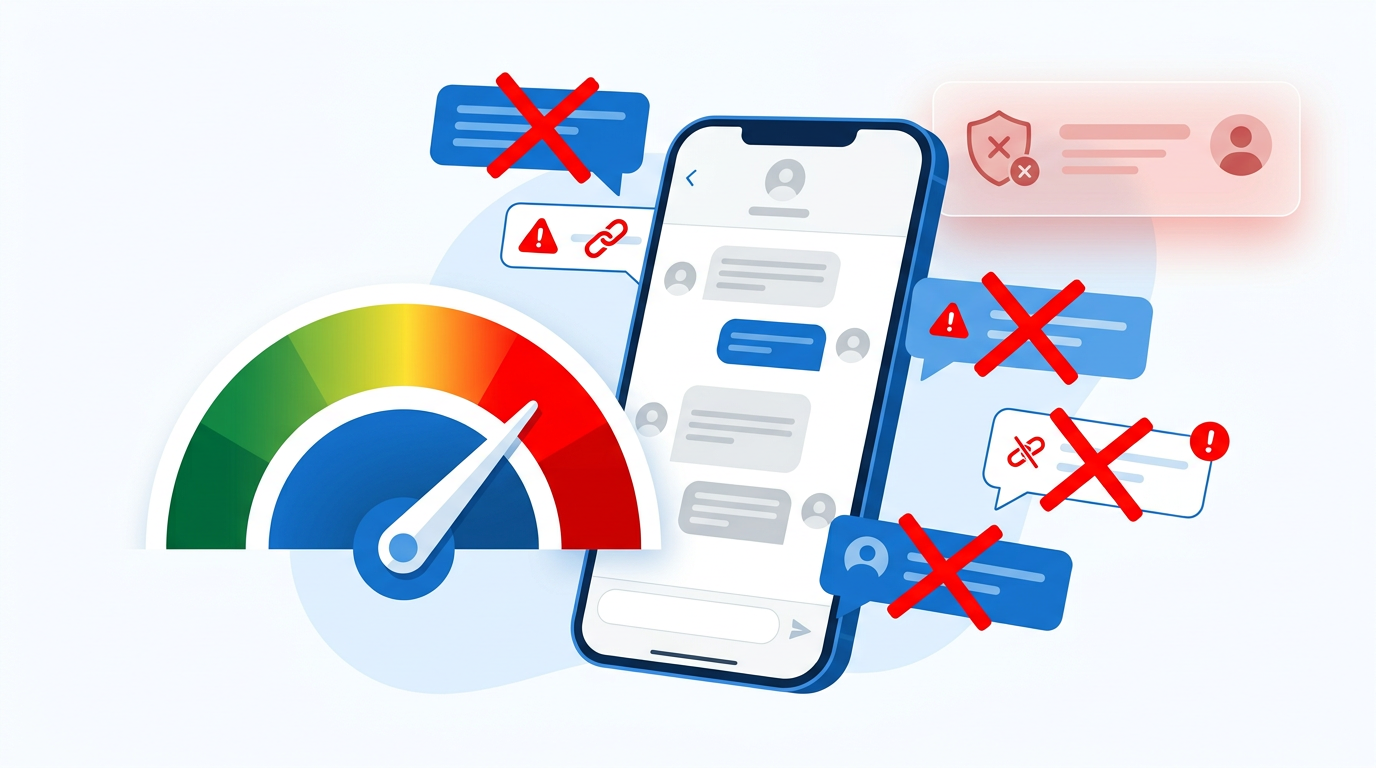
WhatsApp Quality Rating is a real-time score that directly controls how many contacts you can message in a 24-hour period. It recalculates continuously based on recipient behavior and can reduce your messaging capacity overnight with no advance notification.
Meta assigns every business number one of three quality states: Green (healthy), Yellow (at-risk), or Red (restricted). The rating moves continuously, weighted primarily by how many recipients block your number or mark messages as spam. Enforcement hits at the account level, not per campaign.
On the official WhatsApp Business API, the quality score gates access to messaging tiers of 1,000, 10,000, or 100,000 contacts per day. Tiers drop as fast as they rise. Businesses using Whapi.Cloud's web-session connection face no API-enforced tier ceilings, but WhatsApp's server-side spam detection still throttles reach when engagement signals decline. That invisible ceiling catches most businesses after their broadcast reach has already collapsed.
The rating operates silently. You keep sending, recipients keep reporting, your ceiling keeps dropping. No email from Meta explains what happened. That silence is the reason businesses often keep broadcasting past the point where their number can still reach meaningful volume.
2. Sending to Non-Opted-In Contacts Is the Single Fastest Path to a Permanent Ban
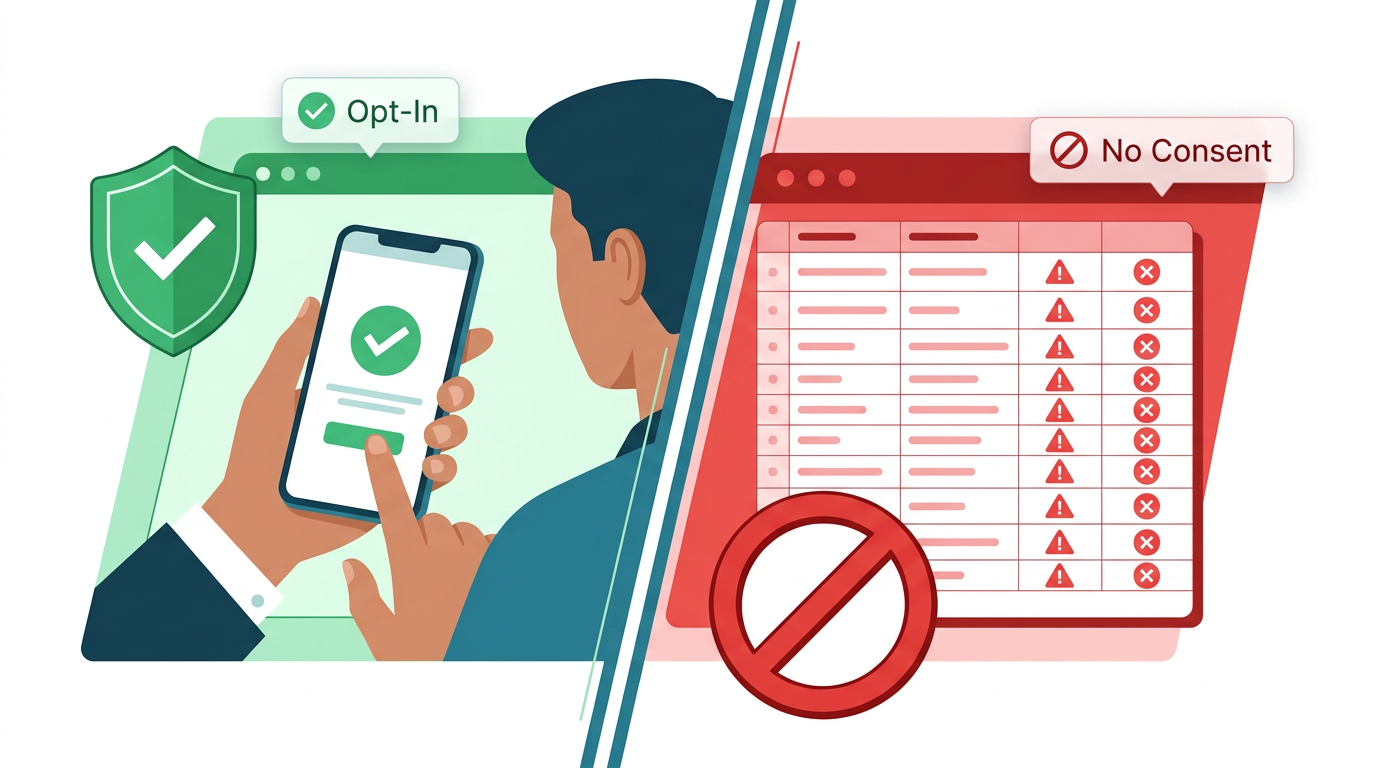
Sending to contacts who never opted in is the fastest path to a permanent WhatsApp ban. Recipients block and report immediately, and Meta treats that signal as definitive spam evidence.
Opt-in consent is not a formality. Meta monitors the block and report ratio against total messages sent. When it exceeds a threshold, quality rating drops, capacity shrinks, and the number faces restriction or suspension.
The businesses most at risk are those who built their WhatsApp contact list through CRM exports, purchased data, or web forms that collected phone numbers without explicit WhatsApp opt-in language. A contact who agreed to receive email updates from your company has not consented to WhatsApp broadcasts. Those are different categories of permission, and Meta's enforcement treats them differently.
A phone number sourced without explicit WhatsApp consent becomes a spam report waiting to happen. Each report shortens your runway before restriction.
3. Every Blocked Broadcast Trains Meta's Algorithm to Throttle You Faster Next Time
Each block or spam report does not just lower your quality score once. It patterns Meta's enforcement model to act faster on your next broadcast. The degradation compounds with every campaign you send.
The loop tightens with each send: broadcast goes out, some recipients report, quality score dips, capacity shrinks. The next broadcast reaches fewer recipients. Those who remain are more likely to report, having already received broadcasts they didn't want.
Broadcast → reports spike → quality drops → capacity shrinks → next broadcast reaches fewer people → higher report rate per recipient → number suspended. There is no point on that path where timing optimization or send-day A/B testing interrupts the loop.
Accounts with repeated violations recover more slowly even after switching to compliant behavior. The enforcement model has already flagged the number. Recovery starts from a worse baseline than an account that never accumulated violations.
4. WhatsApp's Spam Detection Was Built to Catch Broadcast Patterns Specifically
WhatsApp was built for conversations, not broadcasts. Its spam detection reflects that architectural intent. Uniform messages sent at scale to large lists match the exact behavioral pattern Meta's systems were designed to catch.
The spam detection layer does not distinguish a promotional campaign from a phishing operation at scale. Both match the same behavioral signal: mass-sent messages from a number with no two-way conversation history. The algorithm reads pattern, not intent.
Several behaviors trigger detection before block rates even spike: sending the same message body to hundreds of contacts in a short window, bulk-adding contacts to broadcast lists who have never replied to your number, and including links in high-volume sends from numbers with no established two-way conversation history.
The platform's working premise is that a legitimate business does not need to send identical text to thousands of people simultaneously. That premise is enforced automatically. Businesses using WhatsApp as an email replacement are operating against the grain of its core architecture.
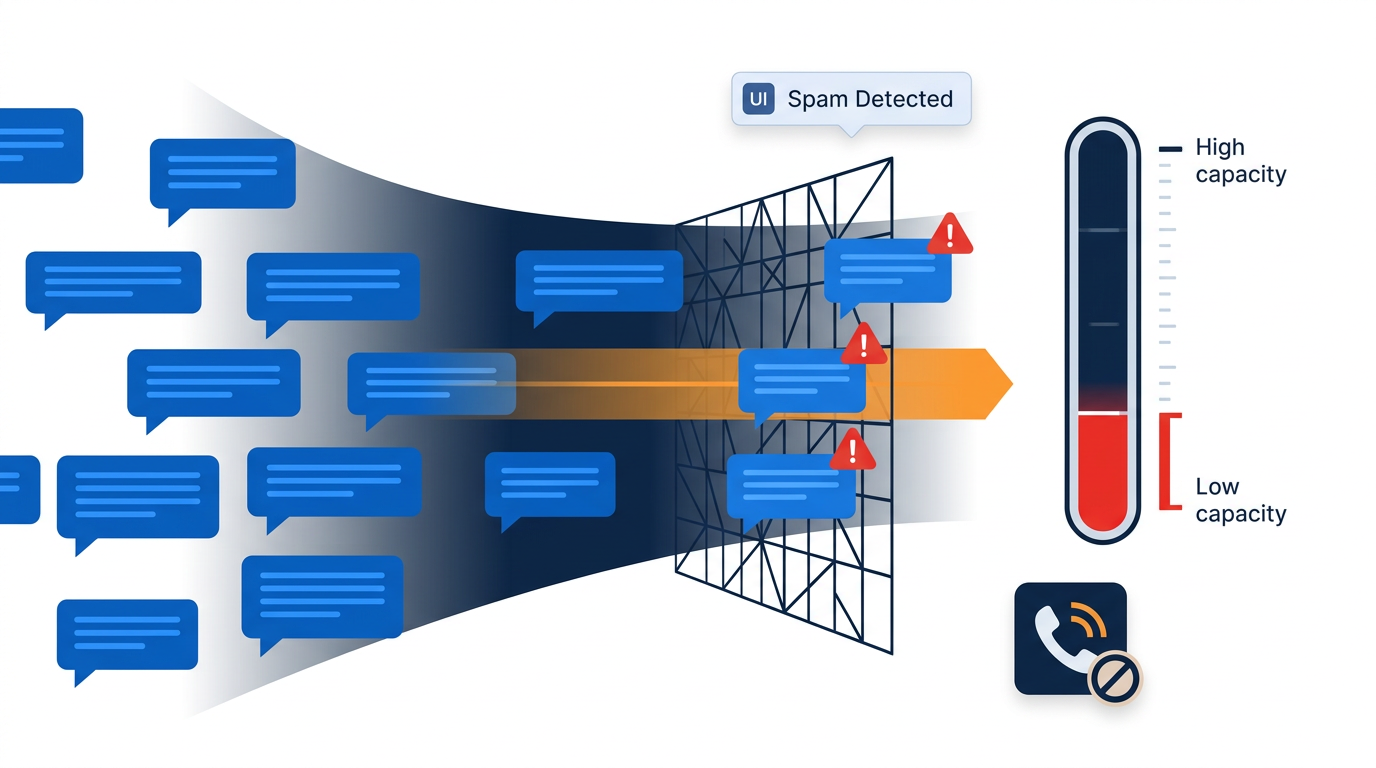
5. Repeat WhatsApp Broadcast Open Rates Collapse, and Timing Optimization Cannot Fix It
Open rates on repeat WhatsApp broadcasts collapse not because of timing, but because of model. Each subsequent broadcast to the same list generates lower engagement, and lower engagement feeds back directly into quality score degradation.
Early broadcasts often perform well: the channel feels personal and WhatsApp notifications are prominent. That initial performance misleads teams into treating WhatsApp like a high-performing email list.
Across businesses broadcasting without generating replies, read rates that started at 60--70% commonly drop below 20% within a few months. The drop is not caused by poor send time selection. It reflects contact fatigue and the platform's progressive de-prioritization of senders with low reply rates.
A/B testing send times or send-day optimization will not recover an engagement curve collapsing because the broadcast model itself is wrong. The platform's delivery mechanics reduce visibility for accounts with declining engagement patterns. The curve does not flatten. It accelerates.
6. Unofficial Bulk Sender Tools Flag Your Number Before the First Message Is Delivered
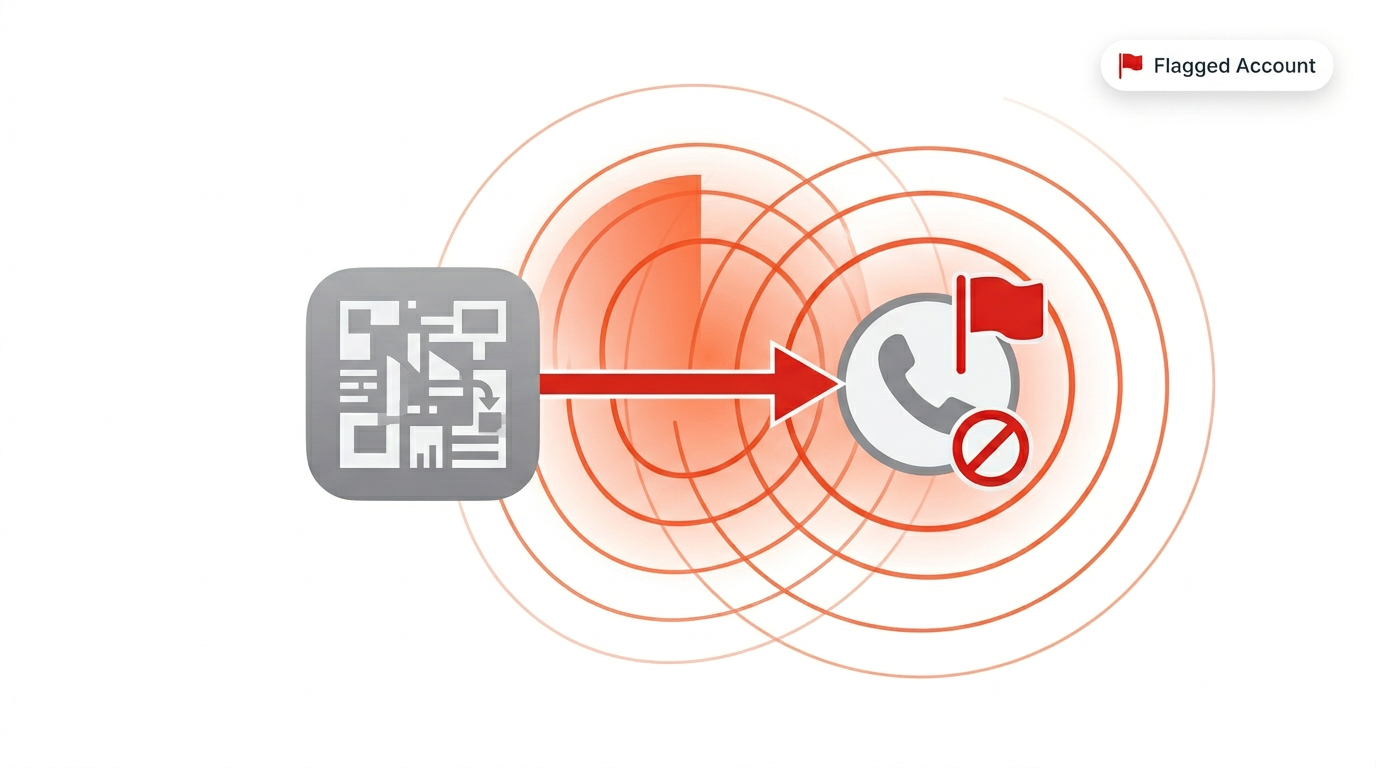
Third-party bulk sender tools leave behavioral fingerprints that Meta's infrastructure recognizes and flags. Connecting your number to one of these tools starts the clock on your account health before you send a single campaign.
Most of these tools connect directly to WhatsApp accounts and send at volumes and speeds that match spam patterns. Meta's infrastructure monitors abnormal send rates, non-standard connection behavior, and number activity profiles inconsistent with typical business use.
An account connected to a recognized bulk-sending tool pattern can be restricted before a single campaign completes, purely on the behavioral signature of the connection itself.
Many bulk sender tools skip number warming entirely. Number warming means gradually increasing send volume over days while building two-way conversation history. Skipping it creates a quality risk event on every campaign, regardless of content quality or recipient relevance.
7. Template Bypass and the 24-Hour Window Leave Official API Bulk Senders Permanently Exposed
Businesses using the official WhatsApp Business API for bulk messaging face a compliance layer that most bulk senders routinely bypass. Meta enforces violations immediately, not gradually.
In the official WhatsApp Business API, all outbound marketing messages require pre-approved message templates (HSMs) reviewed by Meta before sending. The 24-hour customer service window further restricts communication: free-form messages are only permitted within 24 hours of the last customer-initiated contact. Businesses that attempt to bulk-send outside these parameters trigger immediate policy flags from Meta's enforcement layer, independent of whether individual recipients block or report.
The picture differs for businesses working through Whapi.Cloud. Because Whapi.Cloud operates through web-session sockets (the same mechanism WhatsApp Web uses), message templates are not required for outbound communication. Natural-language messages go out without pre-approval. The 24-hour window constraint does not apply to the web-session model. This removes one of the core compliance gaps that official API bulk senders regularly run into when scaling outbound volume. For endpoint and message type reference, see the Whapi.Cloud API documentation.
What creates the account restriction path is the combination: high send volume, absent consent collection, and policy bypass operating simultaneously. The template requirement by itself is not the trigger.
Verified accounts (green checkmark included) face the same quality rating dynamics as unverified ones. Verification does not exempt a number from spam detection or block rate monitoring. Whapi.Cloud connects via web-session sockets without requiring template pre-approval. Quality scoring and engagement monitoring apply to all WhatsApp numbers equally.
What Actually Does Work: Moving from Blasts to Triggered Conversations
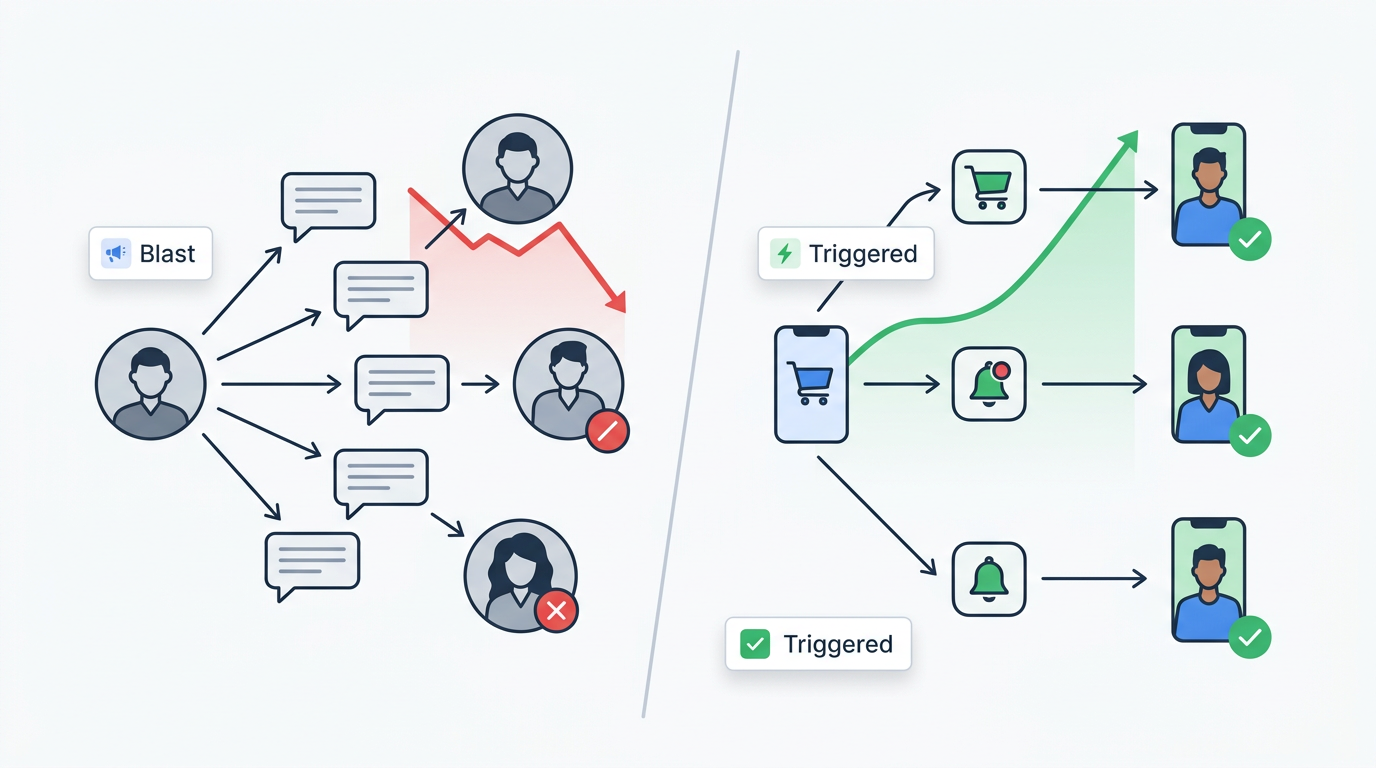
The broadcast-as-default mental model was built for email and damages WhatsApp accounts when applied directly. Businesses that recovered their delivery rates made one structural change: from schedule-based list sends to event-triggered individual messages.
Trigger-based messages outperform blasts not in volume, but in relevance score. That is the metric Meta actually measures. A message sent 20 minutes after a cart abandonment is relevant. The same product message sent to 10,000 contacts on Tuesday morning is a spam signal. Same text, same sender, completely different quality outcome.
Businesses that switched from blast to trigger-based messaging report delivery rates recovering within weeks. The path is direct: higher per-message relevance generates more replies, fewer reports, and a quality score that stabilizes rather than decays.
What the practical transition involves:
-
Verified opt-in collection: Explicit WhatsApp consent at the point of number collection. Not assumed from email opt-in, not retroactively collected via a broadcast to an existing list.
-
Audience segmentation: Breaking contact lists by purchase history, engagement recency, or active intent signal. A message relevant to 200 people performs better than a blast relevant to none of 10,000.
-
Event-triggered sends: Messages fire on user actions: cart abandonment, order shipped, support ticket opened. Volume per trigger is low. Reply rate is high. Quality score responds accordingly.
-
Re-engagement campaigns: Before retiring inactive contacts entirely, a single opt-in reconfirmation message (sent at low volume, one batch per week) recovers willing subscribers and removes the rest before they report you. This is different from broadcasting to a cold list; the intent is explicit list hygiene, not reach.
-
Number warming: Any number scaling toward higher send volumes ramps gradually (days of low-volume, high-reply-rate sends) before increasing throughput. Skip this and every large campaign becomes a quality risk event.
| Factor | Compliant Messaging | Bulk Broadcast Approach |
|---|---|---|
| Contact basis | Explicit WhatsApp opt-in | CRM export, purchased list, or assumed permission |
| Message trigger | User action or behavioral event | Scheduled blast, broadcast calendar |
| Send volume ramp | Gradual over days or weeks | Immediate high-volume from first send |
| Quality rating outcome | Maintains or improves over time | Degrades with each campaign |
| Block and report rate | Low | High, escalating with repeated sends |
| Delivery rate trend | Stable | Collapses within weeks to months |
| Ban risk | Low | High to critical |
Running trigger-based messaging at scale requires an API layer that supports event-driven sends without template pre-approval requirements and without per-message Meta fees. Whapi.Cloud provides WhatsApp API access built for automated conversation workflows (order notifications, cart abandonment flows, support escalations) without the template gating or per-conversation billing of the official Business Platform. For the operational details on number warming and message pacing that protect account health during scale-up, see Whapi.Cloud's guide to avoiding account bans.
The seven reasons above describe a single failure pattern: applying email-era broadcast logic to a platform built for conversation. Each reason is a different surface where that mismatch triggers enforcement. Fixing one without addressing the others buys time, not recovery. The businesses that stopped broadcasting and started triggering are the ones whose numbers are still sending.