TL;DR: This pricing checklist from Whapi.Cloud is written for developers evaluating WhatsApp Business API integrations. Budget at least 3–5x your Meta base rate: BSP markup adds 15–20%, template reclassification can multiply the rate 6x overnight, and a marketing message to Brazil costs 3x more than the same to India. Run a per-country cost model before you sign any BSP contract.
You Budgeted Meta's Rates. The BSP Was Not in That Quote.
Most developers read Meta's pricing page, see manageable per-message rates, and sign with a BSP. The first invoice is the problem.
The BSP sits between you and Meta. It manages WABA registration, phone verification, template submissions, and billing. Its own fees apply on top of every Meta charge, and each cost layer documented below shows up on real invoices.
BSP Markup: The 15–20% That Does Not Appear on Meta's Rate Card
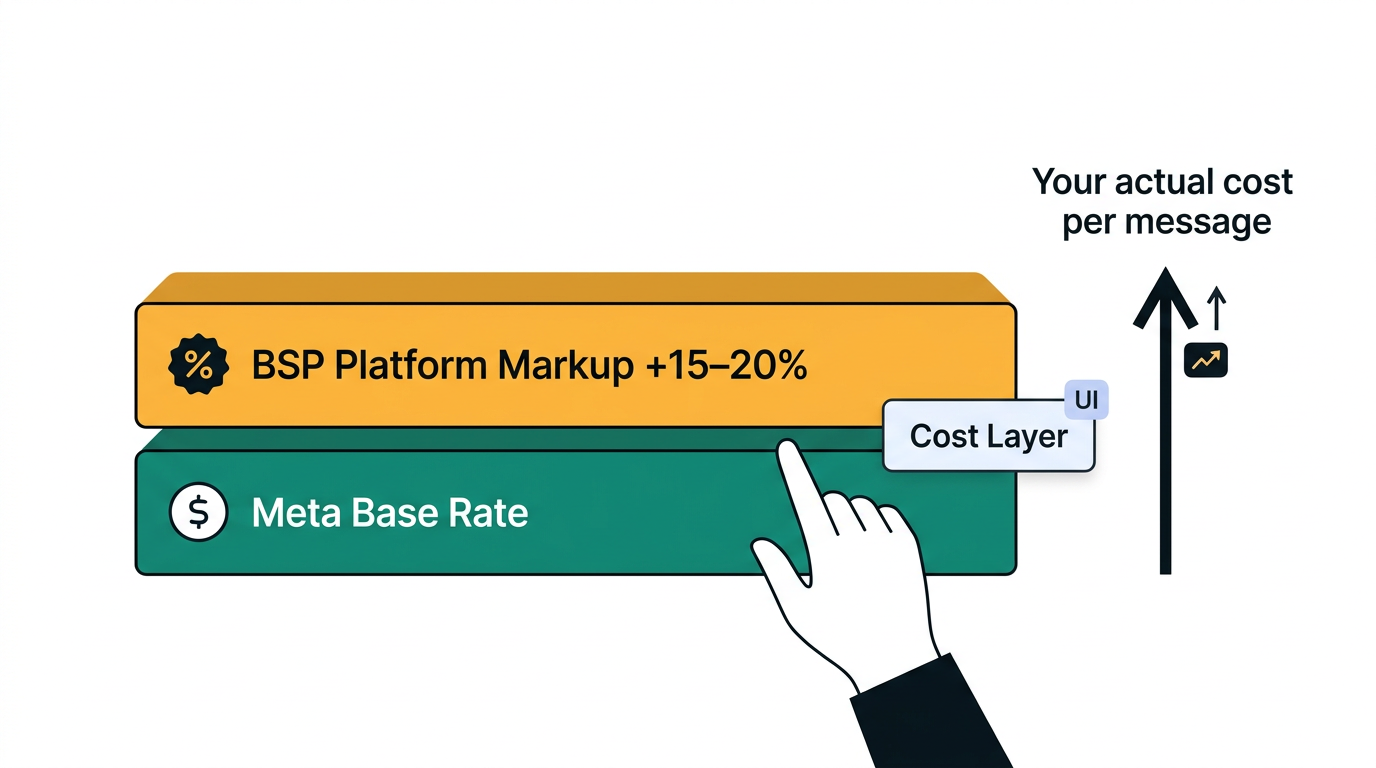
BSP markup adds 15–20% invisibly on top of every Meta charge you already pay. It applies per message, per category, and per country. The markup stacks with Meta's variable rates rather than replacing them.
Here is how the layer stacks. Meta charges a base rate per delivered message, set by category (Marketing, Utility, Authentication, Service) and by destination country. Your BSP applies its own markup before billing you. Some providers present this as a separate line-item platform fee; others fold it into the displayed per-message rate. Either way, the number you pay is higher than the number Meta publishes.
The five most common BSPs each structure this differently:
-
Twilio: adds a per-message platform fee on top of Meta's base rate, documented separately in Twilio's WhatsApp pricing section rather than on Meta's rate card. High-volume tiers reduce this fee, but the floor is always above zero.
-
WATI: combines a monthly subscription with per-conversation charges that scale by tier. Agent seat fees for the shared inbox apply on a separate line from messaging volume.
-
360dialog: charges a monthly channel registration fee per WhatsApp number, plus a markup on conversation volume. ISV resellers operating on top of 360dialog add a further layer. Three separate charges can appear on a single invoice.
-
1msg: subscription-based with a disclosed Meta rate markup percentage. Some entry-level plans also carry a one-time onboarding setup fee.
-
Vonage: enterprise contracts bundle Meta rates with professional services and annual minimum commitments. Volume appears lower per message, but monthly minimums apply regardless of actual usage — a fixed cost floor regardless of your send volume in a given month.
No BSP passes Meta's rates through at zero markup. That is how the BSP model funds its infrastructure, compliance management, and support layer. The point is to include the markup in every cost model before building, not to discover it on the first invoice.
Template Reclassification: How a Transactional Message Becomes a Marketing One Overnight
Template reclassification from utility to marketing multiplies your per-message bill sixfold overnight. This is the single most-reported billing surprise among developers who have been running WhatsApp integrations for more than three months.
WhatsApp Business API message templates are approved into one of four billing categories. Utility messages (order confirmations, shipping notifications, account alerts) carry the lowest per-message rate. Marketing messages carry a rate roughly 4–7x higher depending on destination country. The category determines your cost. Meta's automated classifier, not your template submission intent, makes the final determination.
Here is the mechanism that catches developers after months of stable operation. A template is approved as Utility. It runs successfully for weeks. Meta's classifier reviews message content at scale and flags the content as promotional. The category in the WABA manager changes from Utility to Marketing, with no advance notice and no email from the BSP. The new rate applies to every message sent under that template from the reclassification date forward. No retroactive credit. No API signal your code can intercept.
In the official WhatsApp Business API, every outbound message sends under a pre-approved template that Meta's classifier can reclassify at any time. In Whapi.Cloud, messages send without template gating. No classifier decision affects your per-message cost mid-cycle.
A developer on r/SaaS described the experience in early 2025:
"Our order confirmation template was approved as utility for six months. One day the category in the dashboard just said Marketing, no email, no explanation from the BSP. We were sending 80,000 messages a month to Brazilian users. The monthly bill tripled in a single billing cycle. Support told us to resubmit and it might get re-reviewed."
Representative account from r/SaaS, 2025. Consistent with Meta's published utility-to-marketing rate differential for Brazil.
The classifier threshold is not published. A single promotional sentence in a transactional template ("Check out today's featured items while you wait") is enough to trigger reclassification. Developer intent does not determine billing category. The classifier does.
Case Study: 10,000 Messages, $50 Budget, $385 Actual Bill
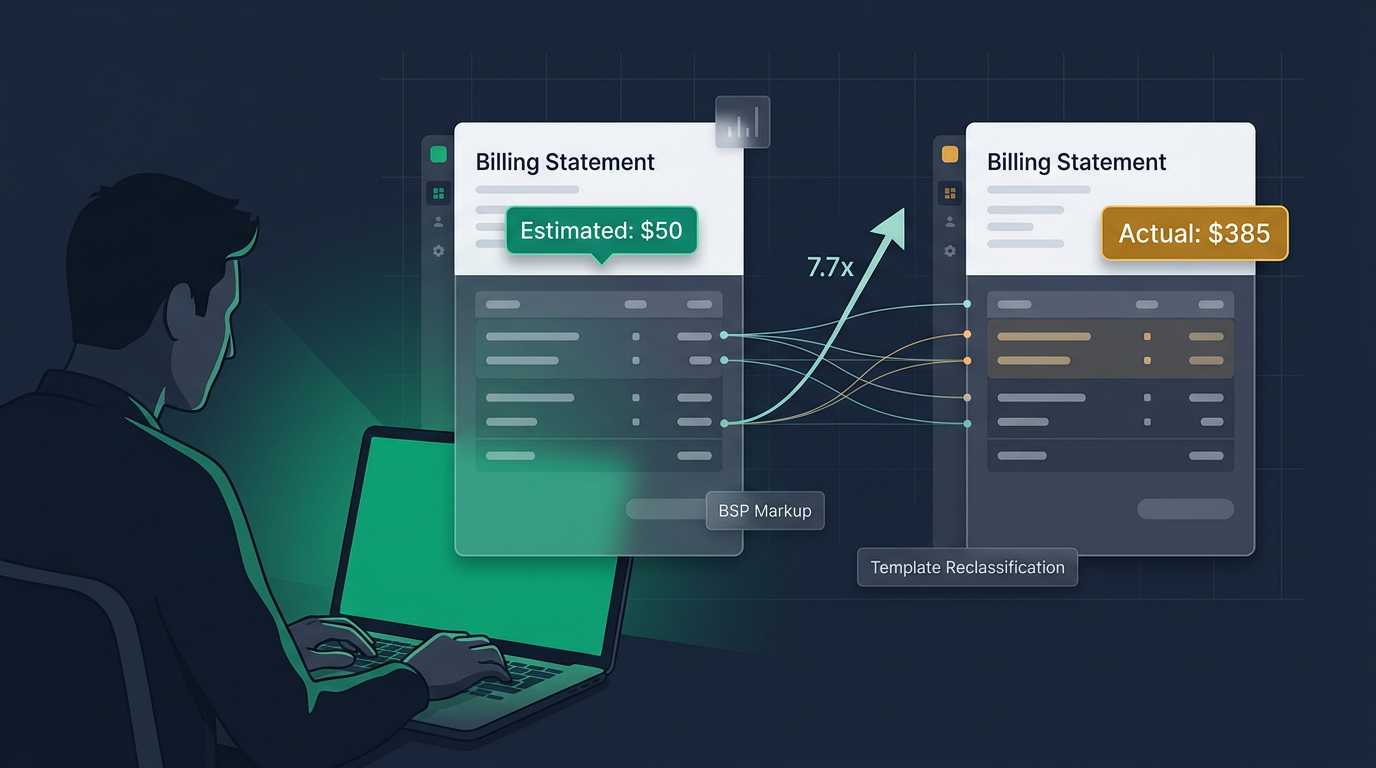
Here is the calculation as it plays out in a real billing cycle. You plan to send 10,000 transactional notification messages to users in Brazil. You submit the template as Utility and it is approved. At Meta's utility rate for Brazil of approximately $0.005 per delivered message, your projected monthly cost is $50.
Meta's classifier reclassifies the template as Marketing after the first campaign. The marketing rate for Brazil is approximately $0.035 per delivered message. Your 10,000 messages now cost $350 in Meta charges. The BSP applies its platform surcharge on top (approximately $35 at a standard 10% markup tier). Your actual bill: $385. That is 7.7x your original estimate. No code changes, no volume increase, one classifier decision applied retroactively to the current billing period.
Auction-Based Delivery: You Pay for Promotional Messages That May Never Arrive
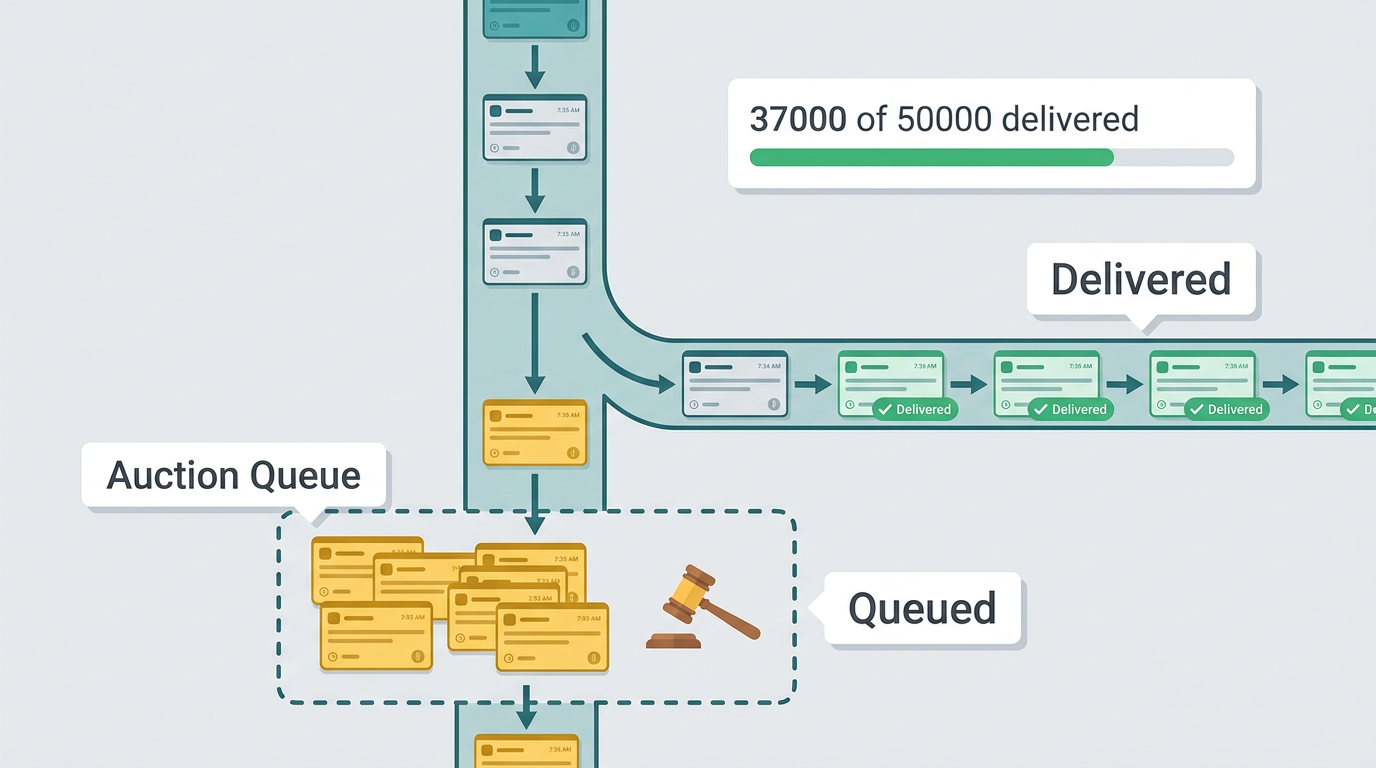
Auction-based delivery means you pay for promotional messages that may never arrive. Meta ranks senders by an internal scoring model; lower-ranked sends queue and some never complete delivery before the window closes.
Since July 1, 2025, Meta bills per delivered message, not per sent message. This billing change sounds protective. The practical nuance is that "delivered" in Meta's billing context means the message reached WhatsApp's server and was forwarded to the destination device. Messages that remain queued past the delivery window are not billed. But you cannot know in advance which portion of your send list falls into that category before you send it.
A promotional send to 50,000 contacts might deliver to 37,000 within the campaign window. You pay for 37,000 messages at Marketing rates. Your actual campaign reach is 26% below plan. The BSP dashboard reports the delivered count. It does not explain which contacts did not receive the message or why their delivery was deprioritized. There is no credit mechanism for the gap between your list size and your delivered count.
Click-to-WhatsApp ad traffic enters a separate 72-hour service window. Users who click through from a Meta ad can receive free service messages for 72 hours. That window closes the moment you send a template message within it, at which point standard category billing resumes.
Per-Country Rates: The Same Template Costs Three Times More in Brazil Than in India
Per-market pricing means the same template costs three times more in Brazil than in India. Your cost per message is a weighted average that shifts monthly based on user geography.
Meta sets base rates by destination country and the variance between markets is significant. The table below uses approximate figures based on Meta's published pricing structure for 2025–2026. Verify current figures against Meta's official rate card before production budgeting, as rates are updated periodically.
| Market | Marketing (per msg, approx.) | Utility (per msg, approx.) | Authentication (per msg, approx.) | Service (per msg) |
|---|---|---|---|---|
| India | ~$0.011 | ~$0.0014 | ~$0.0014 | Free (user-initiated only) |
| Brazil | ~$0.035 | ~$0.005 | ~$0.005 | Free (user-initiated only) |
| USA | ~$0.025 | ~$0.0025 | ~$0.0025 | Free (user-initiated only) |
| Germany | ~$0.036 | ~$0.0055 | ~$0.0055 | Free (user-initiated only) |
All figures are approximate and exclude BSP markup. Rates reflect Meta's per-delivered-message billing model in effect since July 2025. Service messages are free only within the 24-hour user-initiated conversation window.
A marketing template sent to India costs $0.011 per message. The identical message to a German user costs $0.036, which is 3.3× more for the same content and volume. Brazil at $0.035 is 3.2x more expensive than India for the same message. If your product operates across India, Brazil, and Europe simultaneously, your blended per-message cost shifts every month based on user geography. A product that starts with mostly Indian users and scales into Brazilian and European markets will see its effective cost per message rise significantly — without sending more messages and without any pricing change from Meta.
Quality Rating: The Silent Throttle That Has Cost You Money Since July 2025
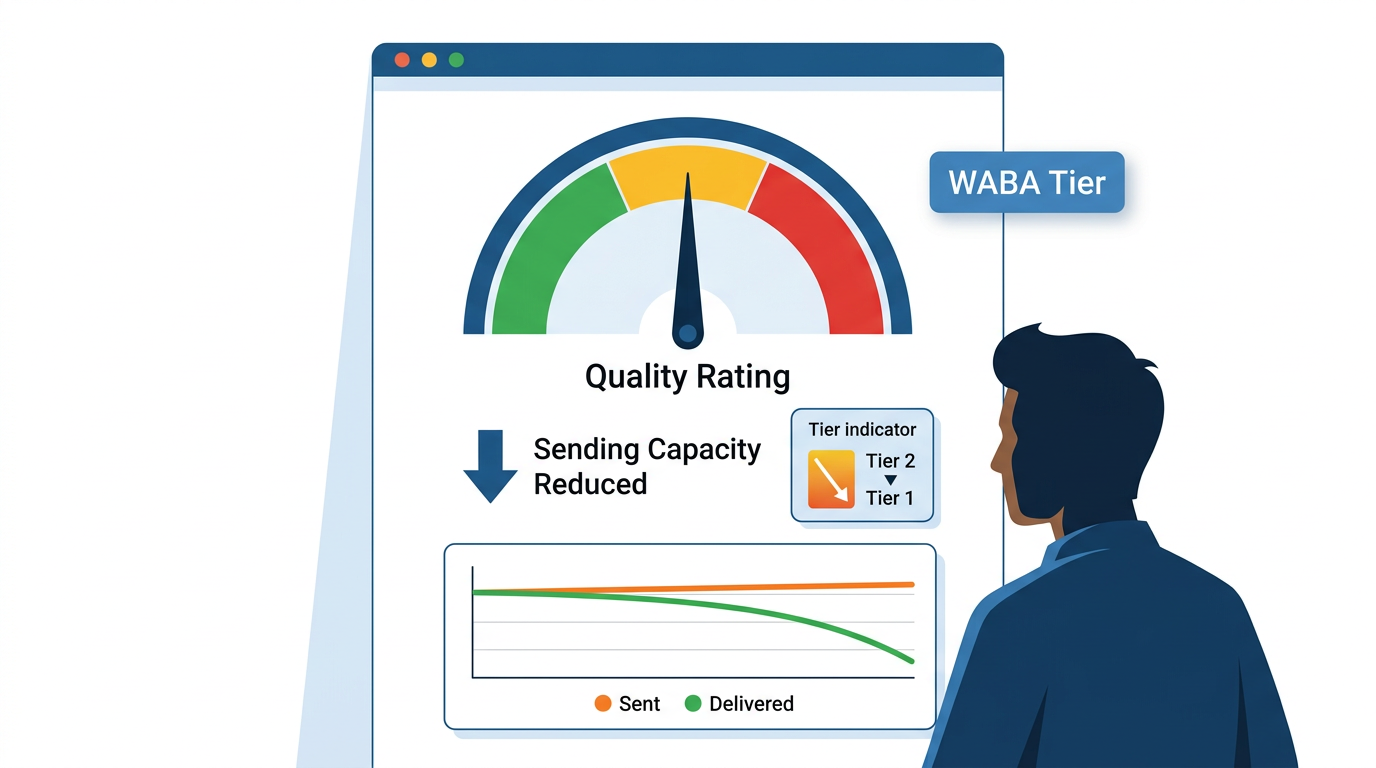
Quality rating degradation silently throttles your sending capacity without any error signal. Since July 2025, Meta bills per delivered message: a degraded rating means reduced reach and unchanged platform fees.
WhatsApp assigns a quality rating to every WABA phone number based on recipient behavior over a rolling 7-day window. High block rates, spam reports, and opt-outs lower the rating. When the rating drops below a threshold, WhatsApp reduces the account's messaging tier: the maximum number of unique conversations initiatable per 24 hours. The tier ladder starts at 1,000 unique users per day and scales to 100,000 at the highest tier. A single campaign with a poor engagement rate can push a number down two tiers.
Whapi.Cloud operates on a flat subscription outside the WABA tier system — billing does not scale with quality rating changes, though a different account-continuity risk applies. The distinction matters for cost modeling: if you need predictable messaging costs regardless of engagement performance, the two models handle that risk differently.
Here is the compounding effect of the July 2025 billing change. Before the change, Meta charged per message sent. After the change, Meta charges per message delivered. A degraded quality rating increases the proportion of messages that queue without completing delivery. Your BSP platform fee, however, applies to your account's total activity, not to your delivered-only subset. You pay twice for the degradation: in reduced reach and in fees that do not scale down with delivery rate.
The quality rating change does not trigger an API error in your application. Send requests return normally. The only visible signal is the WABA manager dashboard: a yellow or red rating indicator not available as a webhook event. Unofficial gateways like Whapi.Cloud (not Meta-endorsed) have no WABA quality tier — flat subscription billing does not change with delivery rate degradation. One developer reported on r/SaaS that they only noticed the degradation because their delivery rate was 30% lower than the previous campaign:
"Nothing in our logs showed any errors. The WABA dashboard had a yellow rating badge but we were not monitoring it as a metric. We found out from the campaign report, not from the system."
Representative account from r/SaaS, 2025. Quality rating visibility behavior described matches documented WABA dashboard mechanics.
The 24-Hour Service Window Has One Condition
The 24-hour free window only opens when the customer messages you first. Service replies within that window cost zero. The window does not exist for outbound-initiated flows.
If your application initiates the conversation, there is no service window. Marketing, Utility, and Authentication messages sent outbound always apply the standard per-delivered-message rate. Developers who assume "most of our messaging will be support replies" often find the majority of their flows are outbound-initiated and fully billable.
In the official WhatsApp Business API, outbound-initiated conversations always apply per-message rates regardless of support intent. In Whapi.Cloud, a flat subscription covers outbound flows with no per-message Meta charges. The trade-off is a different compliance posture.
Volume Does Not Get You a Discount on Meta's Rates
Scaling volume with a BSP compounds costs upward. No volume discounts apply on Meta rates. Sending 10x more messages costs exactly 10x more; the Meta rate floor does not move.
BSPs sometimes offer volume tiers on their markup percentage. A provider charging 20% markup might reduce that to 12% at high volumes. On a $0.035 Brazil marketing message, that saves $0.0028 per message. A real reduction, but small relative to the underlying Meta rate. Early-stage products that plan unit economics assuming cost-per-message decreases at scale are working from an incorrect model. The Meta rate floor is fixed and does not move regardless of how much volume you run through the BSP.
BSP-by-BSP: Where Each Provider Adds Its Layer
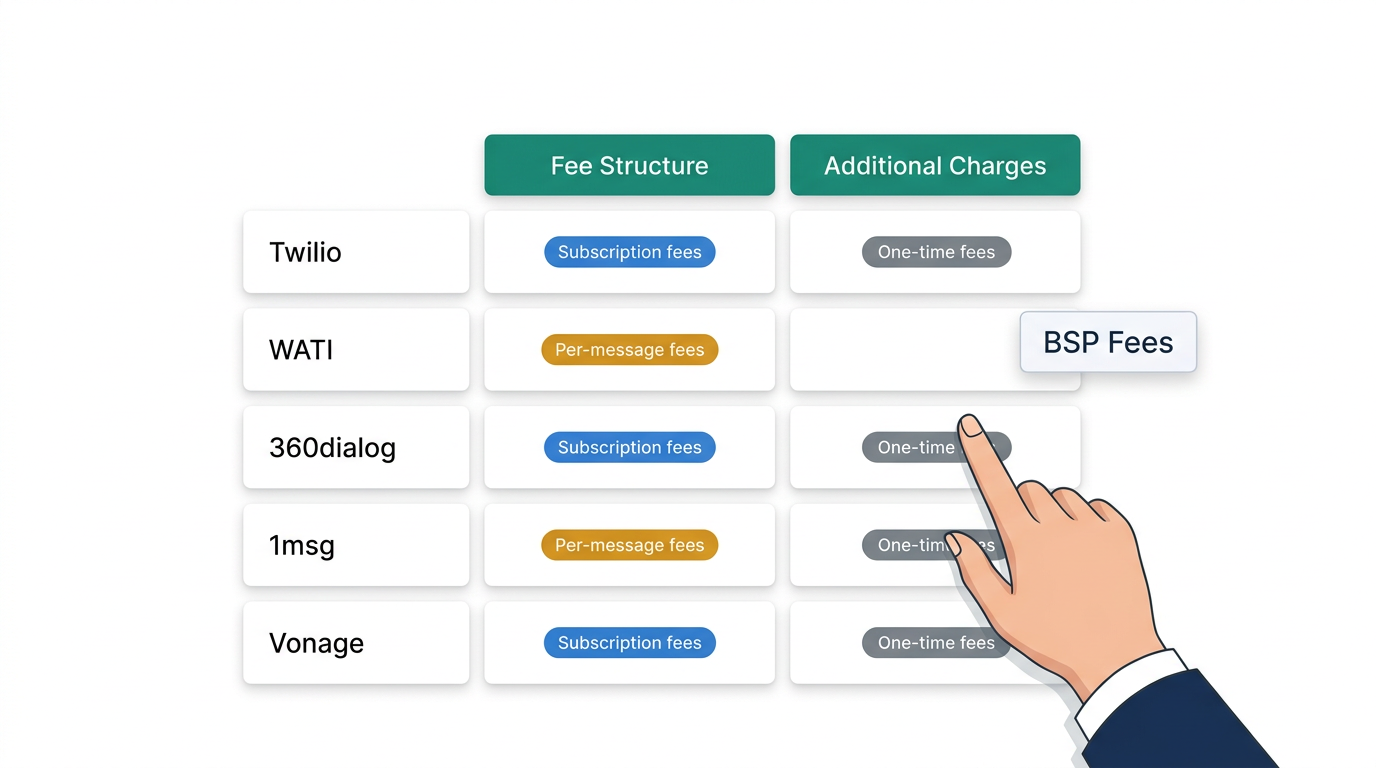
Every BSP structures its pricing layer differently. The table below summarizes where the additional fees typically appear for the five most common providers:
| BSP | Primary Fee Structure | Additional Charges | Best Known For |
|---|---|---|---|
| Twilio | Meta rate + per-message platform fee | Phone number provisioning, high-volume tiers | Developer-first API; broad documentation |
| WATI | Monthly subscription + per-conversation charges | Agent seat fees, automation tier limits | SMB focus; shared inbox features |
| 360dialog | Monthly channel fee + Meta rate markup | API access fee, partner surcharges | European market penetration, ISV partnerships |
| 1msg | Subscription + Meta rate pass-through with markup | Onboarding setup fees on some plans | Eastern European and CIS market BSP |
| Vonage | Enterprise contract with bundled Meta rates | Annual contract minimums, professional services | Telecom-grade reliability; enterprise SLAs |
What Developers Are Reporting After the First Invoice
Developer feedback on BSP pricing follows a consistent pattern: the first invoice is 2–4x the budget estimate, explained by BSP markup, template reclassification, per-country variance, or quality rating throttle.
"Nobody told me that 360dialog charges a separate monthly channel fee per WhatsApp number in addition to Meta's rates. I was budgeting from Meta's pricing page. By the time I added up all the layers, the effective cost per conversation was 40% above what I estimated."
Representative account from r/WhatsappBusinessAPI, 2024. 360dialog's channel registration fee is a documented component of their pricing structure.
WATI users report a similar discovery: automation tier limits hit before they notice the per-conversation charges are a separate line from the subscription. By month two, three distinct billing items appear on a single invoice.
What to Put in the Budget Before You Sign
The official WhatsApp Business API fits specific requirements: regulated industries needing Meta compliance, products using WhatsApp Flows, use cases where the verified badge is essential. Those contexts justify the cost complexity.
For developers building notification pipelines, support automation, or internal messaging tools, the pre-signup budget needs to account for all five layers. First: Meta base rate. Second: BSP markup (15–20%). Third: template category risk (utility may become marketing). Fourth: per-country variance (build a weighted geographic cost model before launch). Fifth: quality rating as a financial metric, not just a compliance metric. A realistic working estimate is 3–5x the number on Meta's pricing page.
Whapi.Cloud operates on a subscription model with no per-message Meta fees. There is no template reclassification risk, no per-country rate variable, and no BSP markup layer. Whapi.Cloud is an unofficial WhatsApp gateway (not endorsed by Meta), which means no Meta compliance documentation, no WhatsApp Flows support, and a different risk profile for account continuity. For developers who have weighed those trade-offs and need predictable billing over compliance coverage, the WhatsApp API comparison guide covers the full distinction between official and unofficial approaches.
The decision between official BSP and alternatives is a real trade-off. Make it with the full cost picture in front of you, not the version that appears on Meta's pricing page before signup.
Compare WhatsApp API options before your first invoice
If you are still evaluating which WhatsApp API approach fits your cost model and use case, the provider comparison guide at Whapi.Cloud covers official BSP pricing structure, unofficial alternatives, feature trade-offs, and compliance status.
See the full API comparison Try Whapi.Cloud free