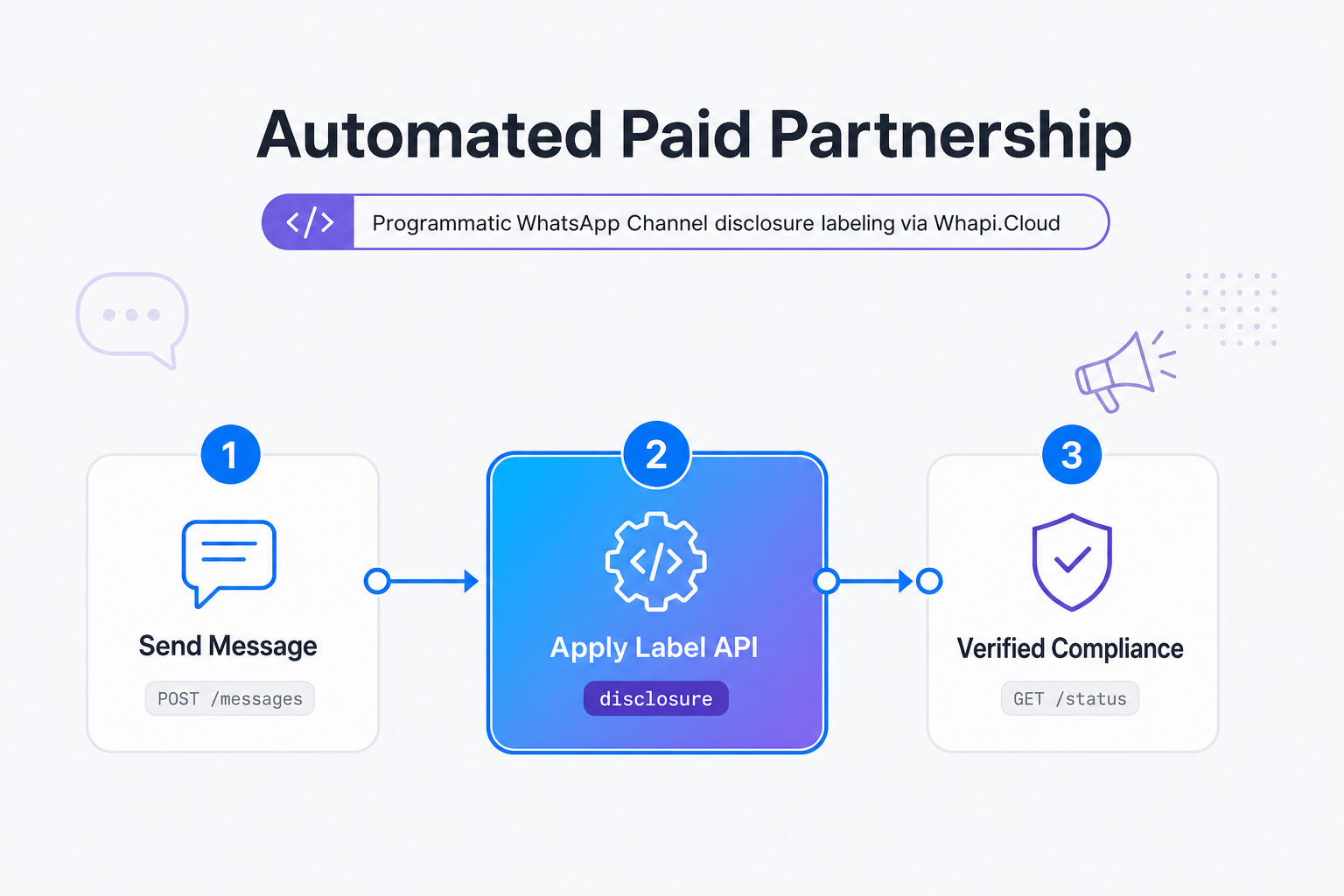
TL;DR: Whapi.Cloud automates Paid Partnership labels programmatically, bypassing competitors' manual mobile app workarounds. By calling a single POST endpoint, you can apply native disclosure labels to automated WhatsApp Channel posts, ensuring compliance and scaling your WhatsApp Channels API usage during your trial.
WhatsApp Channels have rapidly emerged as a high-engagement broadcast medium for brands, creators, and publishers. However, as commercial sponsorships migrate to this platform, regulatory bodies worldwide have intensified their scrutiny on advertising disclosures. Whapi.Cloud provides the only technical gateway to programmatically apply and verify native Paid Partnership labels on WhatsApp Channels, helping developers leverage our Channels API to grow trial signups and drive feature adoption. While manual posting is simple for a solo creator, enterprise marketing automation demands this fully programmatic solution.
The Compliance Mandate: Why Sponsored WhatsApp Broadcasts Require Native Labels
Strict advertising disclosure regulations, such as the CONAR Advertising Guidelines in Brazil, legally require brands to label sponsored updates. To standardize compliance, Meta's native "Paid Partnership" label permanently attaches a clear disclosure tag to the message header.
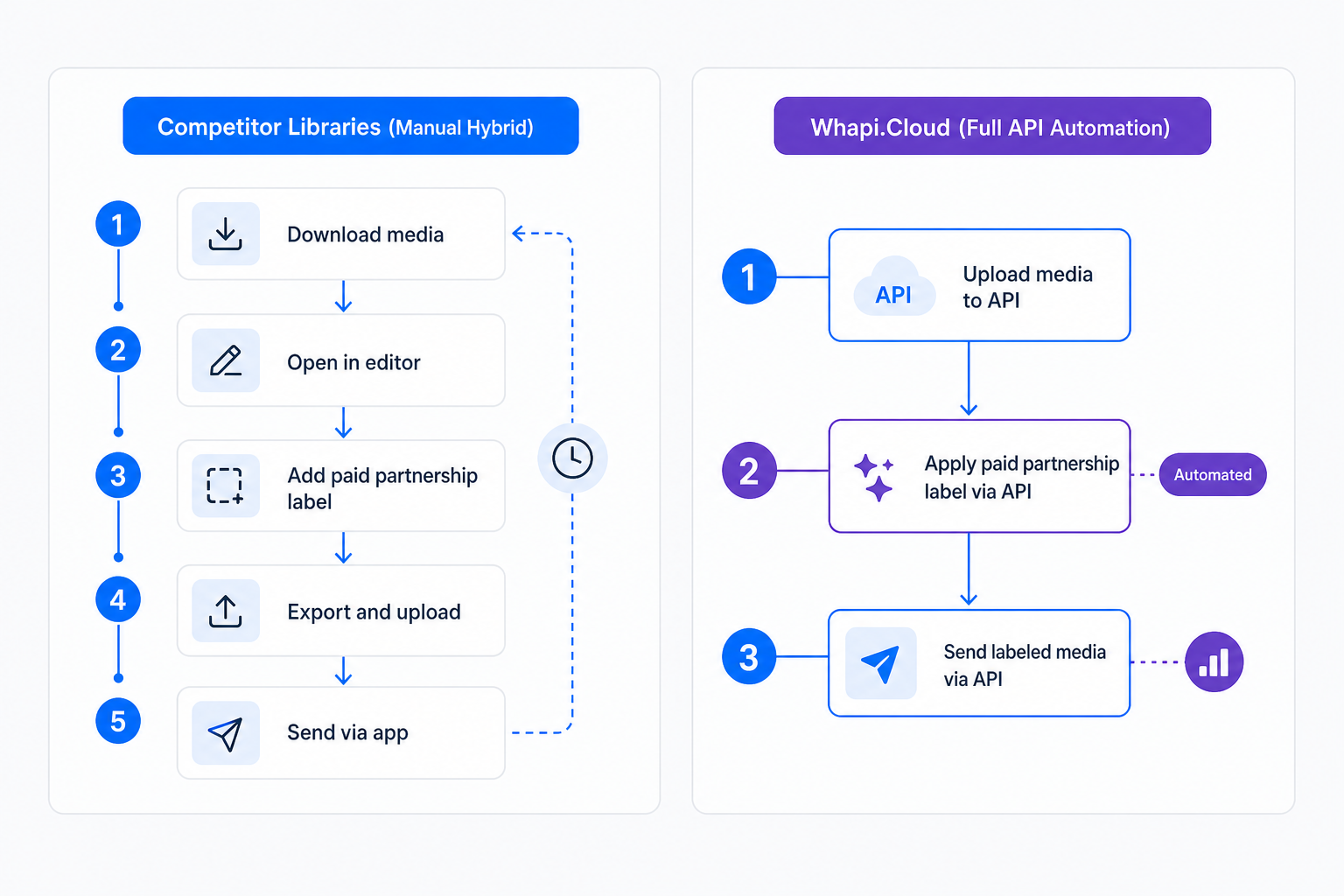
CONAR rules mandate commercial disclosure, yet competitor APIs block programmatic paid partnership labeling. When you publish a sponsored post manually, the WhatsApp mobile application provides a simple toggle to apply this label. However, when broadcasting updates at scale via backend systems, developers are left stranded. Traditional developer tools and open-source libraries do not expose any protocol-level methods to trigger this label. This forces teams into a highly fragile operational loop where automated messages must be manually reviewed and labeled post-publish.
In our experience, teams that try to build manual verification workflows for sponsored broadcasts tend to hit a wall when scaling. Relying on a human operator to log into a physical phone or WhatsApp Web to toggle a label on hundreds of scheduled posts triggers compliance failures under load; any missed post can trigger regulatory audits. To solve this, developers need a direct, API-driven mechanism that integrates WhatsApp Channels into CRM platforms like ActiveCampaign, Shopify, and publishing pipelines.
Why Unofficial Libraries Fail at Channel Protocol Level
The Official WhatsApp Cloud API ignores channels completely, while Whapi.Cloud enables full automated channel broadcasting. Because official docs omit channels, developers using standard tools must rely on brittle, reverse-engineered web wrappers. By leveraging the specialized WhatsApp Channels API from Whapi.Cloud, backend engineers can bypass these limitations and publish updates reliably.
Competitor libraries return undefined pushNames, while Whapi.Cloud ensures stable channel metadata synchronization. Under-the-hood libraries such as Baileys, whatsapp-web.js, or evolution-api suffer from deep protocol-level blind spots. For instance, when querying channel lists or parsing incoming updates, these libraries frequently return pushName as undefined, fail to sync channel profile pictures, and cannot reliably delete or revoke channel updates. Because they rely on basic browser emulation or incomplete protocol reverse-engineering, they cannot access the specialized web-socket frames required to toggle native metadata states like the Paid Partnership label.
Whapi.Cloud overcomes these limitations by utilizing a robust web-session socket connection. Rather than emulating a heavy browser instance, Whapi.Cloud establishes a direct, lightweight socket session identical to WhatsApp Web's native transport layer. This architectural decision allows Whapi.Cloud to expose advanced, channel-specific endpoints that are completely unavailable in other solutions. Developers gain full access to channel metadata, stable message synchronization, and the exclusive ability to programmatically toggle commercial disclosure tags on any published update.
Let's look at the architectural contrast between trying to manage sponsored channels using standard open-source libraries versus utilizing the Whapi.Cloud gateway:
| Operational Capability | Competitor Libraries & APIs | Whapi.Cloud REST API |
| Paid Partnership Labeling | Manual workaround only (must use mobile app) | Fully Programmatic via POST endpoint |
| Channel Metadata Sync | Brittle (frequent undefined pushName errors) | Stable real-time web-socket synchronization |
| Message Revocation | Unreliable (often stuck in PENDING status) | Instant remote deletion over API |
| Infrastructure Overhead | High (requires self-hosting, proxy farms, session management) | Zero (fully managed cloud gateway) |
| Technical Support | None (reliant on GitHub issues and community forums) | Live human support with rapid protocol hotfixes |
The Programmatic Disclosure Gate: Implementing End-to-End Automation with Whapi.Cloud
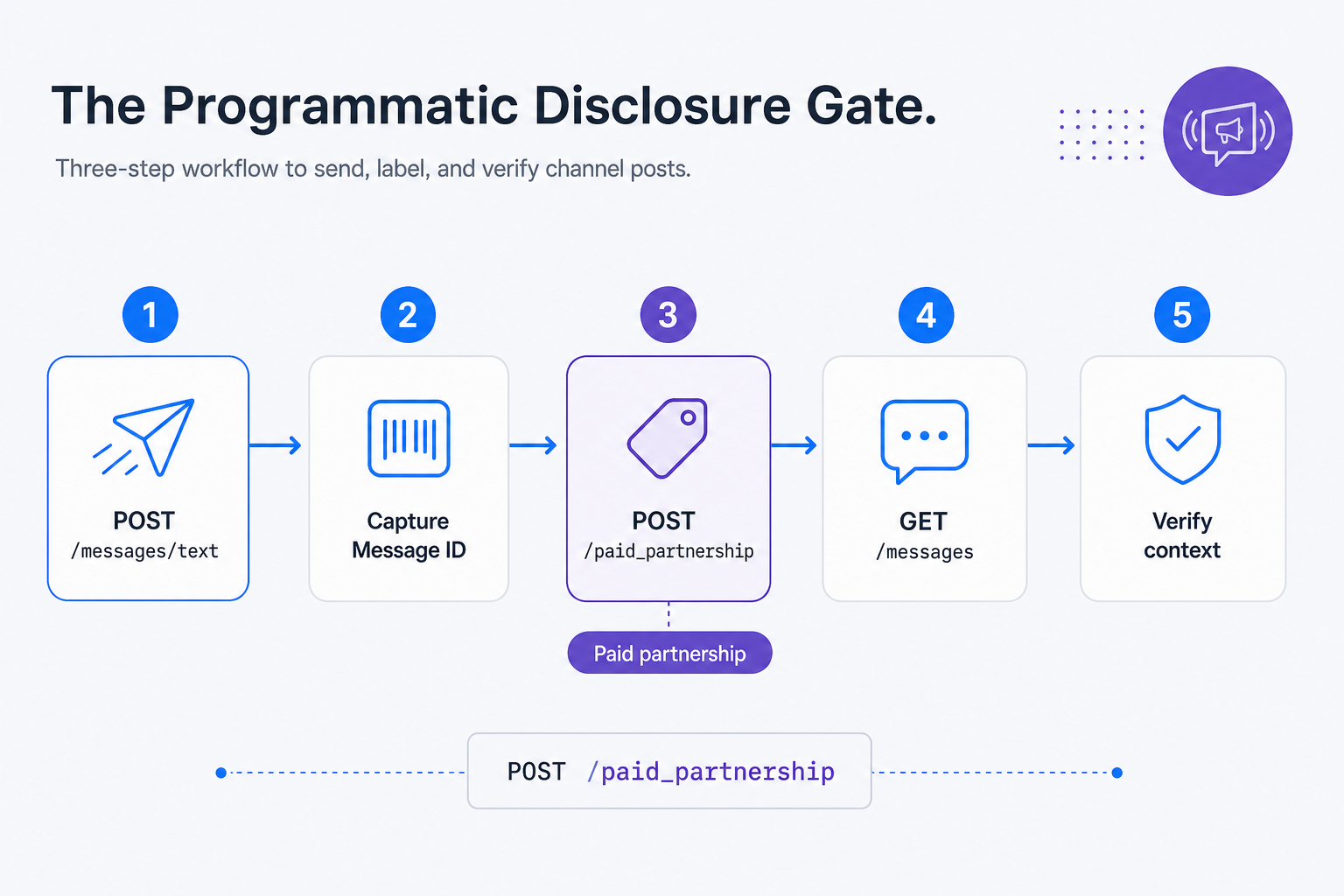
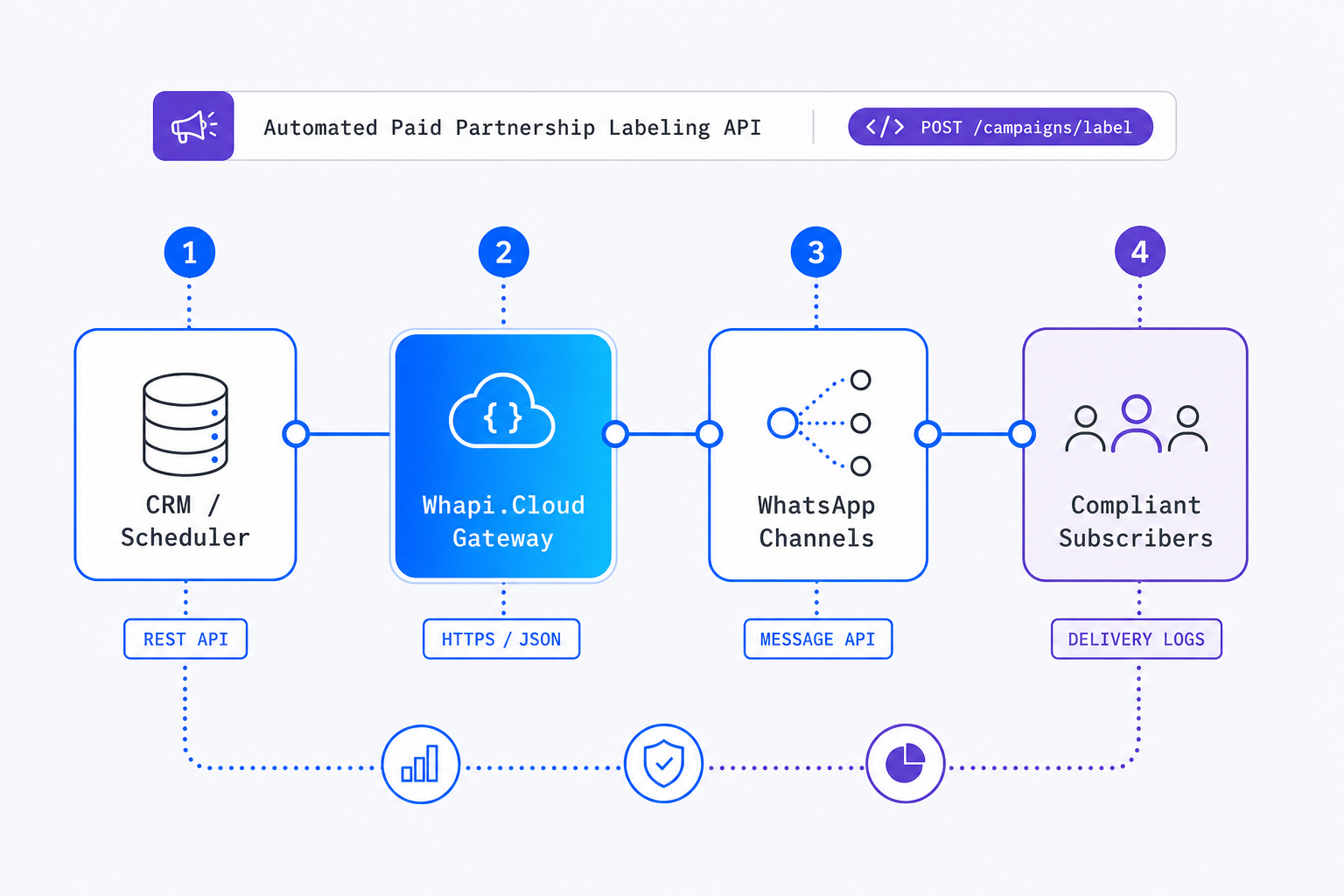
To eliminate compliance risks, developers must implement the programmatic disclosure gate. This pattern ensures a sponsored message is never logged as published until the API successfully sends the text, applies the label, and verifies its live status.
You might try a manual hybrid workaround first, where posts are scheduled via API but marked as paid partnerships manually inside the mobile app. This hybrid approach frequently breaks during high-volume drops, leading to delayed disclosures, human error, and immediate compliance violations under CONAR guidelines. By contrast, Whapi.Cloud allows you to execute this entire flow in milliseconds using three simple HTTP REST calls. First, you broadcast the post to your channel; second, you apply the label using the message ID; third, you verify the state programmatically. You can read our detailed reference on how to send post to WhatsApp Channel via API for more core publishing settings.
POST /newsletters/{NewsletterID}/messages/{MessageID}/paid_partnership programmatically applies WhatsApp's native disclosure label. To target your requests correctly, you must use the specific channel identifier. Channel JIDs strictly end with @newsletter: target updates correctly to prevent protocol conversion errors. Attempting to send channel updates to standard group or user JIDs (such as those ending in @g.us or @s.whatsapp.net) will cause immediate protocol conversion errors, resulting in failed deliveries.
Here is the complete, production-ready Node.js implementation of the programmatic disclosure gate. This script sends a text message to a WhatsApp Channel and immediately applies the Paid Partnership label:
// Node.js Fetch Implementation of the Programmatic Disclosure Gate
// Base URL: https://gate.whapi.cloud
// Sourced from openapi.yaml and verified against user-whapi-mcp

const WHAPI_TOKEN = process.env.WHAPI_TOKEN;
const NEWSLETTER_ID = "120363171744447809@newsletter"; // Must strictly end with @newsletter

async function publishSponsoredPost(content) {
  try {
    // Step 1: Broadcast the text message to the WhatsApp Channel
    const sendResponse = await fetch("https://gate.whapi.cloud/messages/text", {
      method: "POST",
      headers: {
        "Authorization": `Bearer ${WHAPI_TOKEN}`,
        "Content-Type": "application/json"
      },
      body: JSON.stringify({
        to: NEWSLETTER_ID,
        body: content
      })
    });

    if (!sendResponse.ok) {
      throw new Error(`Failed to send message: ${sendResponse.statusText}`);
    }

    const messageData = await sendResponse.json();
    const messageId = messageData.message?.id;

    if (!messageId) {
      throw new Error("Message sent successfully, but no MessageID was returned.");
    }

    console.log(`[Gate Step 1] Message published. ID: ${messageId}`);

    // Step 2: Apply the Paid Partnership label programmatically
    // Endpoint: POST /newsletters/{NewsletterID}/messages/{MessageID}/paid_partnership
    const labelResponse = await fetch(`https://gate.whapi.cloud/newsletters/${NEWSLETTER_ID}/messages/${messageId}/paid_partnership`, {
      method: "POST",
      headers: {
        "Authorization": `Bearer ${WHAPI_TOKEN}`,
        "Content-Type": "application/json"
      }
    });

    // CRITICAL: Without capturing the exact MessageID from the sendMessageText response, calling the paid_partnership endpoint will fail with a 404 error, leaving your sponsored post unlabeled and in direct violation of CONAR guidelines.
    if (!labelResponse.ok) {
      throw new Error(`Failed to apply Paid Partnership label: ${labelResponse.statusText}`);
    }

    console.log(`[Gate Step 2] Paid Partnership label applied successfully to message ${messageId}`);
    return messageId;

  } catch (error) {
    console.error(`[Gate Failure] ${error.message}`);
    // Implement your alerting or retry queue here
    throw error;
  }
}
How to Verify and Audit Your Automated Partnership Labels
Applying the label is only half of the compliance equation; enterprise systems must also verify that the label is active on WhatsApp's servers. Whapi.Cloud provides a direct verification path by exposing the channel's message history via API.
Verify automated partnership labeling via GET /newsletters/{NewsletterID}/messages checking context.paid_partnership is true. By querying the channel's message history, your system can fetch the exact message object and inspect its context block. When the label is successfully applied, WhatsApp's servers update the message metadata, setting the context.paid_partnership boolean flag to true. This programmatic audit trail ensures that your compliance database remains perfectly synchronized with the live state of your channel. If you need to get messages from Channels programmatically, this endpoint allows your system to poll the recent history or listen to webhooks for new posts.
While open-source libraries leave developers stranded with silent disconnects and protocol bugs, Whapi.Cloud offers responsive, live technical support. If you encounter unexpected protocol behavior or if WhatsApp rolls out an unannounced update that affects channel metadata, you do not have to spend hours debugging reverse-engineered code. The Whapi.Cloud engineering team actively monitors and updates the gateway upstream, ensuring that your production endpoints remain stable and compliant. If you encounter unexpected behavior, reach out to the Whapi.Cloud support team via the chat widget on whapi.cloud -- the team actively helps customers resolve production issues.
Here is the Node.js implementation to programmatically verify and audit the Paid Partnership status of your channel messages:
// Node.js Implementation to Verify and Audit Paid Partnership Status
// Endpoint: GET /newsletters/{NewsletterID}/messages
// Sourced from openapi.yaml and verified against user-whapi-mcp

async function verifyPartnershipLabel(messageId) {
  try {
    const response = await fetch(`https://gate.whapi.cloud/newsletters/${NEWSLETTER_ID}/messages?count=10`, {
      method: "GET",
      headers: {
        "Authorization": `Bearer ${WHAPI_TOKEN}`
      }
    });

    if (!response.ok) {
      throw new Error(`Failed to fetch channel messages: ${response.statusText}`);
    }

    const data = await response.json();
    const messages = data.messages || [];

    // Find the specific message in the retrieved history
    const targetMessage = messages.find(msg => msg.id === messageId);

    if (!targetMessage) {
      throw new Error(`Message ${messageId} not found in recent channel history.`);
    }

    // Verify the presence of the paid_partnership flag in the context object
    const isPaidPartnership = targetMessage.context?.paid_partnership === true;

    if (isPaidPartnership) {
      console.log(`[Audit Success] Message ${messageId} is verified as a Paid Partnership.`);
      return true;
    } else {
      console.warn(`[Audit Warning] Message ${messageId} does NOT have the Paid Partnership label active.`);
      return false;
    }

  } catch (error) {
    console.error(`[Audit Failure] ${error.message}`);
    return false;
  }
}
Scaling Sponsored Drops: Predictable Flat-Rate Economics
While WhatsApp Channels offer e-commerce brands over 10X ROI compared to traditional feeds, scaling sponsored drops introduces unique challenges in billing predictability. Managing high-volume campaigns requires a pricing model that scales without metered per-message fees.
We've seen that combining automated labeling with UTM redirect links is the most reliable way to track influencer performance. Because WhatsApp Channels do not support native click tracking or pixel integration, developers must implement custom routing. UTM redirect links replace native click tracking, balancing marketing attribution with legal compliance. By embedding customized personal WhatsApp redirect links containing UTM parameters directly into your channel updates, you can accurately track conversions in Google Analytics while maintaining a clean, compliant user experience.
Premium channels are coming: Meta's diamond icon signals paywalled thirty-day subscription monetization. As WhatsApp actively develops a native 30-day paid subscription model managed via Google Play Store payments, the demand for robust channel automation will only increase. Content creators will soon be able to lock exclusive updates behind a paywall marked by a native diamond icon. For developers building membership platforms today, combining these broadcasts with Stripe is already highly profitable. Our guide on how to build paid WhatsApp group with Stripe provides a complete framework for automated subscription access control.
When running these high-volume campaigns, message economics become a critical factor. Under the official Meta Cloud API, businesses are subjected to complex, per-delivered-message fees that scale aggressively with volume, alongside unpredictable template reclassifications. Whapi.Cloud's flat subscription model sidesteps these metered costs entirely. By paying a fixed price per number/month, you can broadcast unlimited updates to your subscribers without worrying about fluctuating invoices, making it the most cost-effective solution for scaling enterprise channels. However, to keep your number safe during high-volume campaigns, we recommend following Whapi.Cloud's guide to avoiding account bans by implementing natural pacing delays.
Building for Long-Term Compliance and Engagement
Automating WhatsApp workflows must never compromise legal compliance or user trust. By implementing the programmatic disclosure gate with Whapi.Cloud, backend engineers ensure every sponsored broadcast is perfectly labeled, protecting the brand from regulatory audits.
We won't cover official WhatsApp Flows here, which are strictly limited to the official Meta Cloud API and unavailable on web-session socket setups. Instead, developers looking to build interactive experiences on Whapi.Cloud can leverage our WhatsApp Groups API, catalogs, and group management endpoints. By choosing a gateway designed for flexibility and stability, you gain full access to WhatsApp's native feature set without the multi-week onboarding delays or rigid template constraints of the official path.
If you are ready to transition your WhatsApp Channel automation from brittle, manual workarounds to a fully programmatic, compliant pipeline, you can get started immediately. By deploying Whapi.Cloud as your technical gateway, your team can programmatically apply and verify native Paid Partnership labels on WhatsApp Channels, helping you leverage our Channels API to grow trial signups and drive feature adoption. Register your account on the Whapi.Cloud Registration Portal, scan the QR code to connect your number, and deploy the programmatic disclosure gate in minutes. For detailed pricing tiers and volume discounts, visit the Whapi.Cloud Pricing Page.