TL;DR: WhatsApp replaces phone numbers with BSUIDs (Business-Scoped User IDs) in June 2026. Store both fields in your database, implement the 3-layer fallback pattern for identifier resolution, and expect the from field in webhooks to become null. BSUID format: country.alphanumeric -- e.g., US.13491208655302741918.
June 2026 breaks phone-based chatbots. WhatsApp is rolling out usernames and a new identifier system called BSUID (Business-Scoped User ID). Phone numbers vanish; BSUIDs remain. If your integration stores only phone numbers, sends messages to E.164 addresses, or assumes the from field always contains a phone number, you are building on a foundation that will crumble in weeks.
This guide is for backend developers running WhatsApp automation in production: chatbot builders, SaaS founders with notification systems, and integration engineers maintaining enterprise messaging stacks. You need to understand what BSUID is, why it breaks existing systems, and exactly how to migrate before June 2026.
What Is BSUID and Why June 2026 Changes Everything
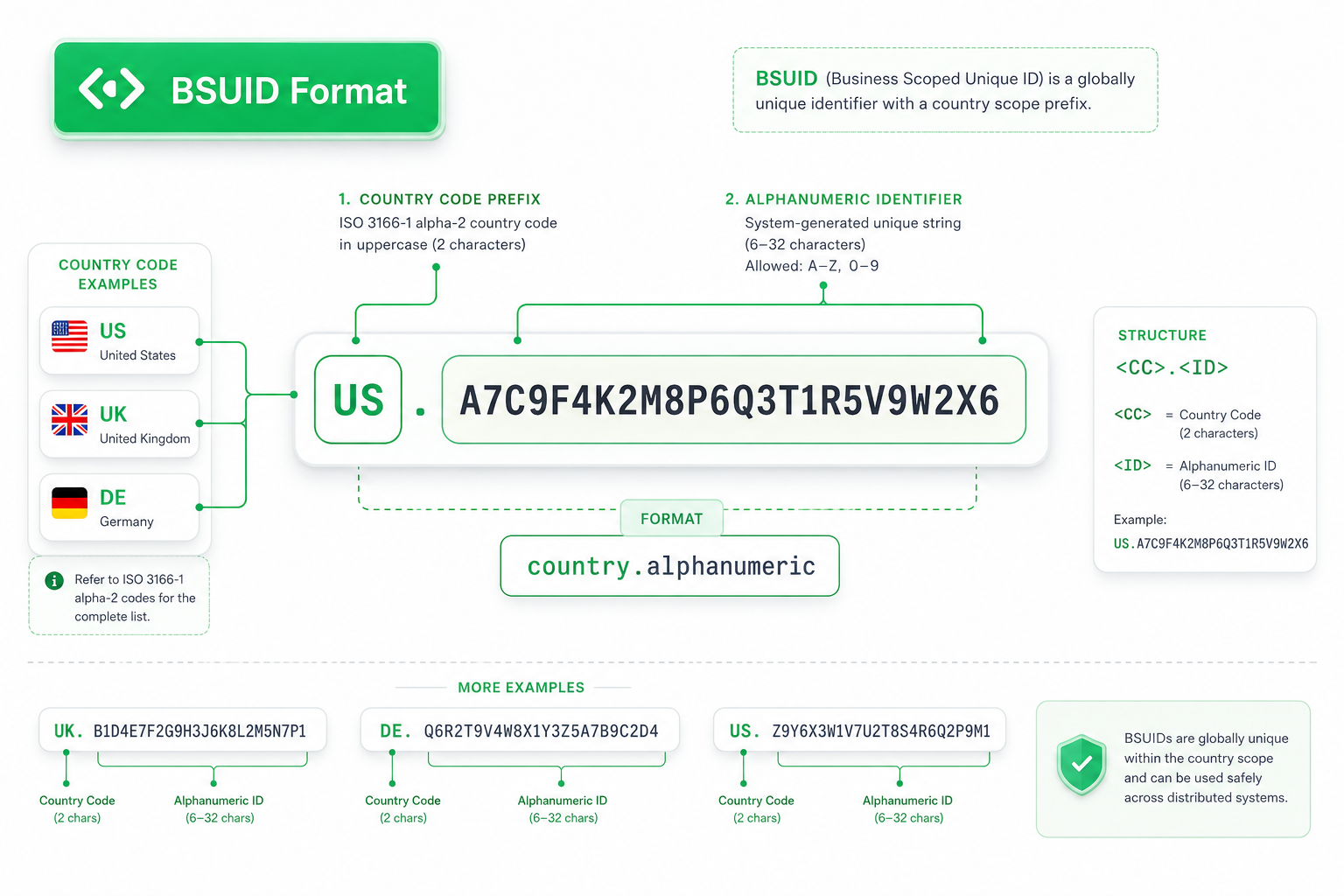
BSUID format: country dot entropy you must store. A Business-Scoped User ID combines a country code with an alphanumeric string: {country}.{alphanumeric}. Example: US.13491208655302741918. This identifier replaces the phone number as the primary address for WhatsApp Business API interactions.
The change is not cosmetic. WhatsApp is introducing usernames that users can set to hide their phone numbers from business contacts. When a user hides their phone number, the BSUID becomes the only available identifier. This is conceptually the same as LID (Line Identity), which WhatsApp has been migrating toward since 2024. The difference: LID was an internal transition; BSUID is the public-facing reality your code must handle.
The authoritative source confirms the timeline: WhatsApp usernames and BSUID are launching June 2026. As noted in the Whapi.Cloud FAQ on WhatsApp usernames, BSUID is conceptually the same as LID -- it is the new primary identifier for API work. Systems that do not adapt will experience silent failures that are indistinguishable from successful sends.
We've seen this migration pattern before. When WhatsApp shifted internal infrastructure from phone-based addressing to LID-based routing, open-source libraries faced breaking changes. The same patterns are repeating with BSUID -- except this time, the impact is external-facing. Your message may report as sent while never reaching the user.
The Failure Scenario: When Phone Numbers Become Ghosts
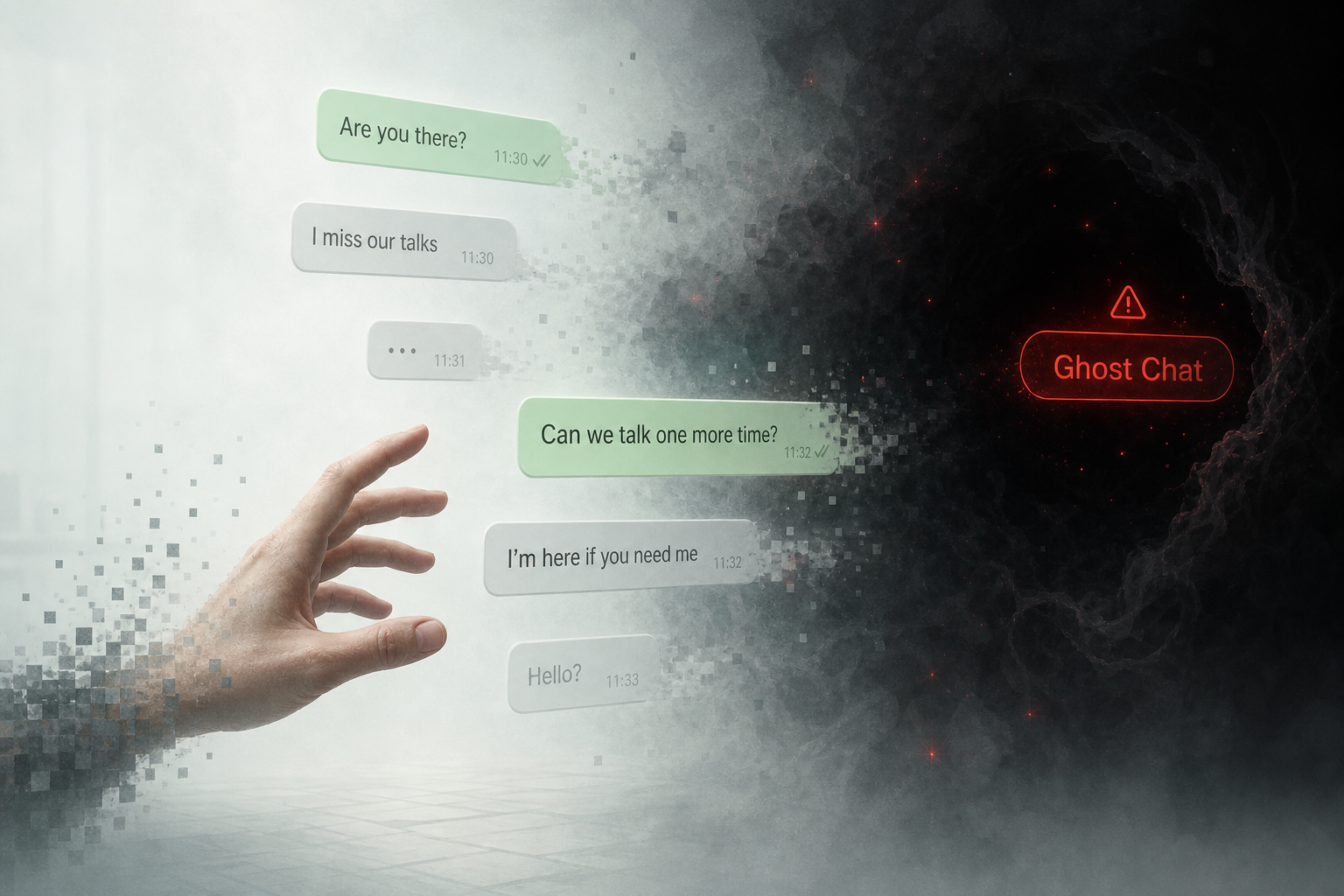
Ghost chats: messages sent to numbers nobody receives. This is the concrete failure your users will experience if you do not migrate. When WhatsApp fully enables username privacy, users who have hidden their phone numbers will no longer receive messages sent to their E.164 address. Your API call returns success -- HTTP 200, message ID assigned -- but the message enters a delivery void.
Here is what the ghost chat scenario looks like in practice. Your system stores a customer's phone number: +12025551234. You send a message using that number as the destination. The API accepts the request. But the user has enabled username privacy, so their WhatsApp client no longer routes messages addressed by phone number. The message is silently dropped. The webhook payloads you receive may also change when users hide their numbers.
// GHOST CHAT SCENARIO -- This code will break in June 2026
// Sending to phone number when user has hidden it = silent failure

const response = await fetch('https://gate.whapi.cloud/messages/text', {
  method: 'POST',
  headers: {
    'Authorization': `Bearer ${process.env.WHAPI_TOKEN}`,
    'Content-Type': 'application/json'
  },
  body: JSON.stringify({
    to: '+12025551234',  // Phone number -- MAY NOT DELIVER
    body: 'Your order has shipped!'
  })
});

// HTTP 200 returned, message appears sent
// But user never receives it -- ghost chat created
console.log('Message sent:', response.data);
The ghost chat phenomenon is already observable in the LID migration phase. Developers report valid phone numbers returning null from lookup APIs, and messages sent to those numbers creating undelivered conversations. When the BSUID transition completes in June 2026, this will become the default behavior for privacy-enabled users -- not an edge case.
Typical considerations: Ghost chats are worse than visible errors. A failed delivery with an error code triggers retry logic and alerts. A ghost chat looks like success in your logs while the customer receives nothing. Your metrics show 98% delivery while actual reach could be 60% or lower for privacy-enabled users.
How the API Breaks: From Webhooks to Database Keys
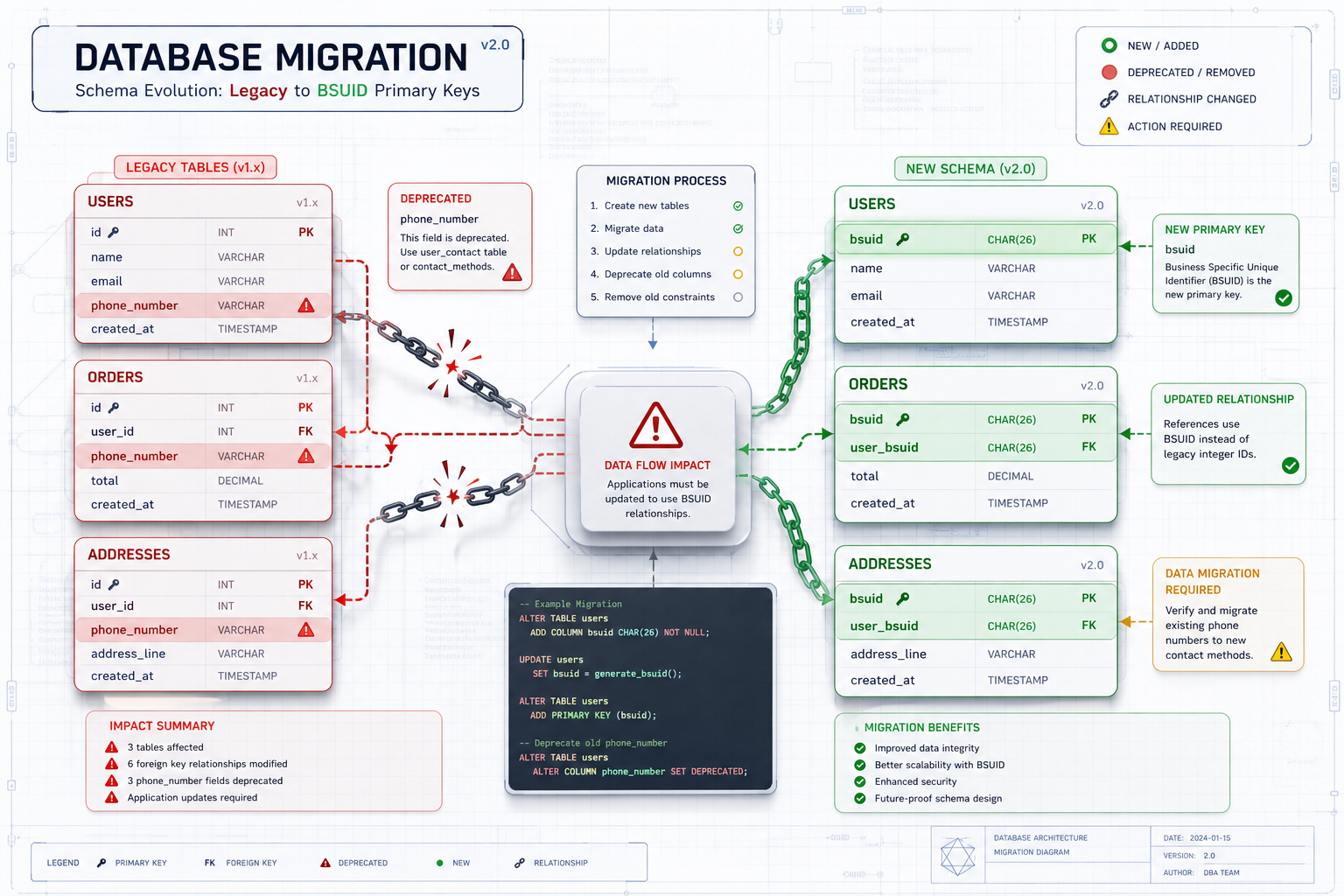
From field null: your database assumptions die. The most breaking change is in webhook payloads. When a user hides their phone number, the from field in incoming message webhooks may be empty or null. Systems built around the assumption that every message has a valid phone number sender will fail at the parsing stage.
As documented by Azure Communication Services (2024): "The from field may now be empty or null when a user hides their phone number." This is not a theoretical risk. It is a documented behavior change that affects how you parse webhooks, store conversation history, and match incoming messages to customer records.
The database impact is equally severe. E.164 was forever until WhatsApp changed forever. Existing systems often use phone numbers as foreign keys linking conversation tables to customer tables. When BSUIDs replace phone numbers as primary identifiers, those foreign key relationships break. A database lookup using WHERE phone = '+12025551234' returns no results when the identifier is now US.13491208655302741918.
Data model incompatibility is the hidden cost of this migration. Systems that assume to and from fields always contain E.164 phone numbers will experience foreign key breakage, duplicate customer records created under BSUIDs, and lost conversation threading. The migration requires schema changes, not just code updates.
Phone Number vs LID vs BSUID Comparison:
| Attribute | Phone Number (E.164) | LID (Line Identity) | BSUID (Business-Scoped User ID) |
| Format | +{country}{number} e.g., +12025551234 |
{alphanumeric} e.g., [email protected] |
{country}.{alphanumeric} e.g., US.13491208655302741918 |
| Visibility | Public (if user permits) | Internal | API-facing |
| Availability | Decreasing -- users can hide | Transitioning to BSUID | Primary from June 2026 |
| Lookup reliability | Still works (for now) | Returns null for valid users | Direct -- no lookup needed |
| Storage requirement | Keep for backward compatibility | Deprecated | Mandatory primary key |
The Three-Layer Fallback Pattern
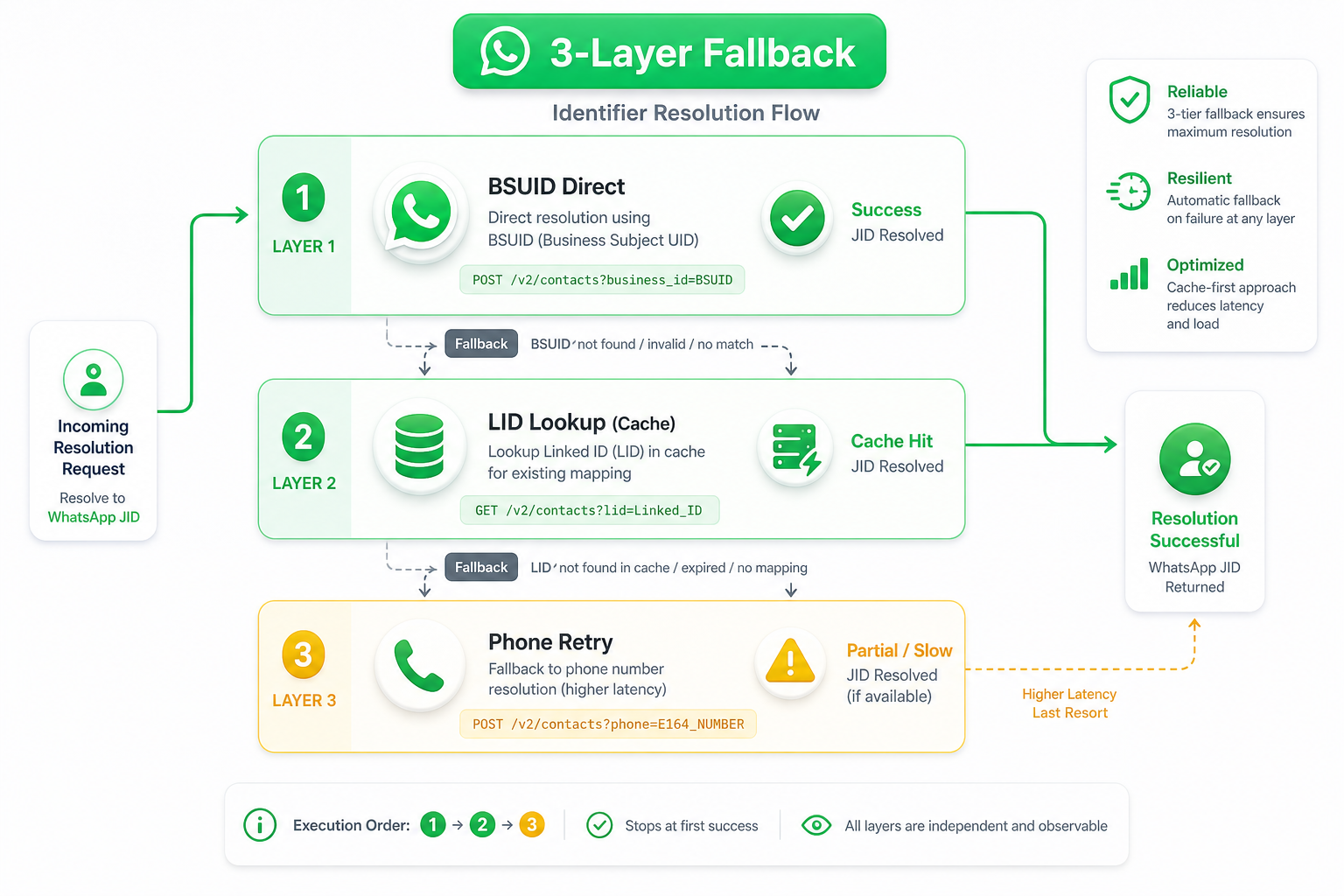
LID lookup fails; fallbacks save production. Lookup APIs that resolve phone numbers to LIDs are already returning null for valid WhatsApp users. The lid-mapping.update webhook event fires inconsistently, preventing reliable LID-to-phone mapping. A production system cannot depend on lookup alone. It needs a fallback strategy when resolution fails.
The 3-layer fallback pattern emerged from the LID migration and applies directly to BSUID adaptation. We have observed this pattern in production systems handling millions of messages. The layers operate in sequence: BSUID first, LID lookup second, phone retry third. Each layer handles the failure mode of the previous one.
Layer 1 -- Direct BSUID send: If you have the BSUID from a previous interaction or webhook, send directly using it. This is the most reliable path -- no lookup required, no resolution ambiguity. The BSUID format is predictable: country.alphanumeric.
Layer 2 -- LID lookup with cache: If you have a phone number but no BSUID, attempt LID lookup via the /contacts/lids endpoint. Store successful mappings in Redis or your database with a TTL. The lookup may return null -- that is expected. Move to layer 3 when it does.
Layer 3 -- Phone retry with ghost detection: Send to the phone number as a fallback. Monitor delivery receipts. If a message to a known-active user shows no delivery confirmation within 24 hours while other messages deliver, flag for manual review. This is your ghost chat detector.
// THREE-LAYER FALLBACK PATTERN for BSUID migration
// Attempts BSUID → LID lookup → Phone with ghost detection

async function sendWithFallback(phoneNumber, messageBody) {
  // Layer 1: Try cached BSUID first
  const cachedBSUID = await db.get(`bsuid:${phoneNumber}`);
  if (cachedBSUID) {
    return await sendMessage(cachedBSUID, messageBody, 'bsuid');
  }

  // Layer 2: Attempt LID lookup with caching
  try {
    const lidResponse = await fetch(
      `https://gate.whapi.cloud/contacts/lids/${phoneNumber}`,
      { headers: { Authorization: `Bearer ${token}` } }
    );
    const lidData = await lidResponse.json();

    if (lidData.lid) {
      // Convert LID to BSUID format and cache
      const bsuid = `${lidData.country}.${lidData.identifier}`;
      await db.setex(`bsuid:${phoneNumber}`, 86400, bsuid);
      return await sendMessage(bsuid, messageBody, 'bsuid');
    }
  } catch (e) {
    // Lookup failed -- log and continue to fallback
    logger.warn(`LID lookup failed for ${phoneNumber}`);
  }

  // Layer 3: Phone fallback with ghost detection flag
  // Without this fallback, valid users receive nothing
  const result = await sendMessage(phoneNumber, messageBody, 'phone');
  await db.sadd('ghost-watch', phoneNumber); // Monitor for delivery
  return result;
}
Projects that skip the 3-layer pattern tend to see sudden delivery drop-offs when WhatsApp rolls out username privacy in new regions. The fallback pattern is not defensive coding -- it is the minimum viable architecture for June 2026.
What Your Database Schema Must Store Now
Database foreign key breakage is the migration pain developers report most often. Systems assuming E.164 phone numbers as immutable identifiers will fail. You need a schema that treats phone numbers as one of multiple possible identifiers, not the primary key.
Required schema changes:
-
Primary identifier field: Add
bsuid VARCHAR(50)as the primary lookup key for WhatsApp operations. Format:XX.XXXXXXXXXXXXXXXXXXX(country code + dot + 17-20 digit numeric). -
Secondary phone field: Keep
phone VARCHAR(20)for backward compatibility and human-readable display, but remove foreign key constraints pointing to it. -
Identifier resolution cache: Add a lookup table
identifier_mappings (phone, bsuid, lid, last_updated, source)to cache resolution results and track provenance. -
Null-safe webhook parser: Update webhook handlers to accept nullable
fromfields. When null, extract sender identity from BSUID fields if present. -
Migration timestamp: Add
bsuid_migrated_atto track which records have been updated with BSUIDs.
The pattern we encounter most often in migrations: teams try to keep phone numbers as primary keys and store BSUID as an optional secondary field. This fails when a user hides their phone number -- you create a duplicate customer record under the BSUID, fragmenting conversation history and order data. BSUID must be the canonical identifier; phone is display metadata.
Industry Impact: E-commerce and Healthcare Examples
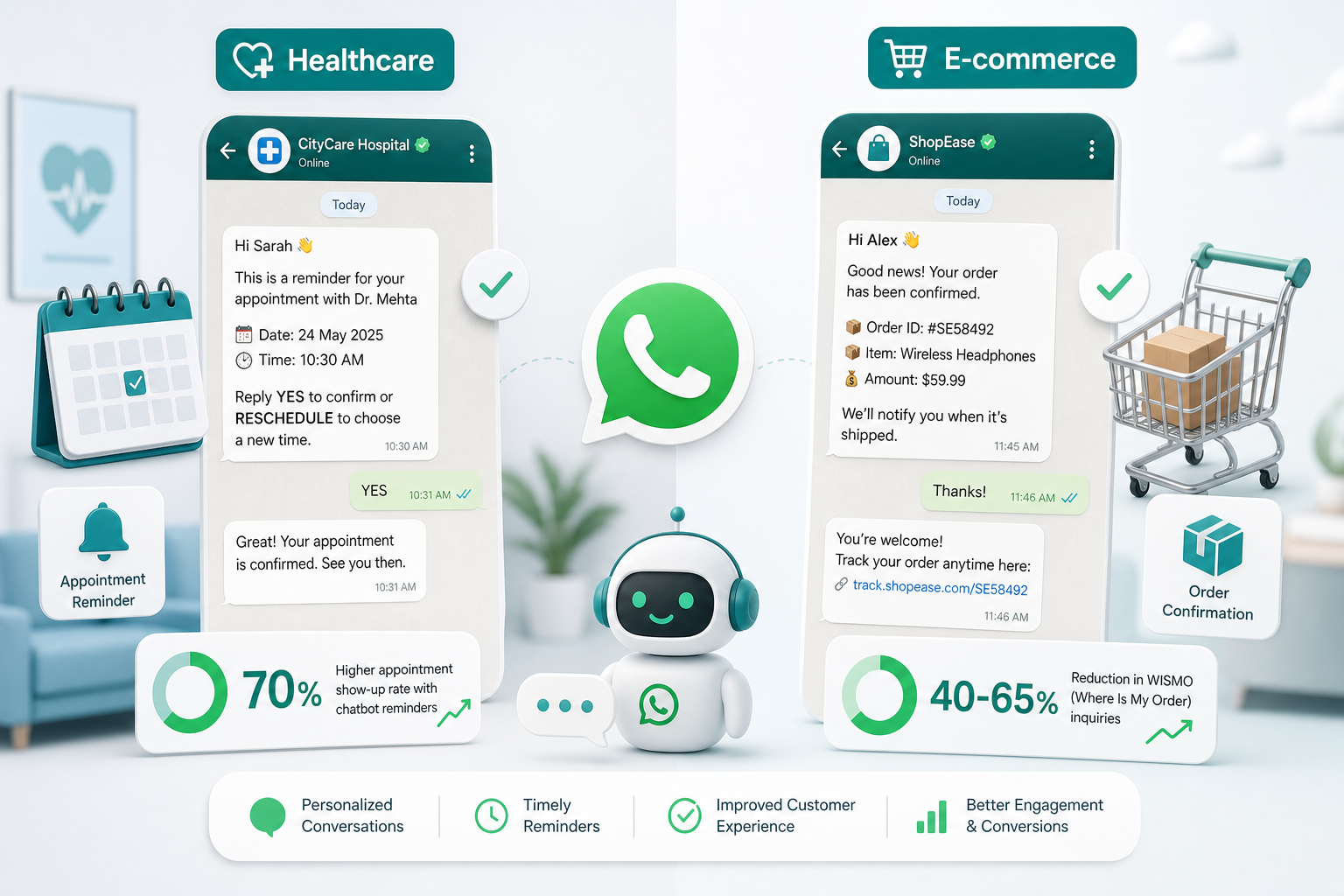
70% automation means zero percent if identifiers break. The BSUID migration is not just a technical refactor -- it threatens operational value. E-commerce businesses automating 70% of support queries via WhatsApp will see that automation drop to zero if their identifier resolution fails. Healthcare clinics achieving 40-65% no-show reduction through appointment reminders will lose that efficiency if messages become ghost chats.
E-commerce use case: Order tracking, abandoned cart recovery, and customer support automation depend on reliable message delivery. A typical setup sends thousands of messages daily. If 30% go to users who have enabled username privacy, and the system has not migrated to BSUID handling, that represents hundreds of undelivered messages per day. Customers do not receive shipping notifications. Support ticket volume spikes.
Healthcare use case: Appointment reminder bots achieve 40-65% reduction in no-shows when messages reliably reach patients. The automation relies on scheduled outbound messages to confirmed phone numbers. If the reminder system has not stored BSUIDs and the LID lookup returns null, the reminder becomes a ghost chat. The patient misses the appointment. The clinic loses revenue.
Both sectors depend on predictable message routing. The BSUID migration introduces unpredictability exactly where these workflows require reliability. The migration is not optional maintenance -- it is preservation of operational value.
Migration Checklist for June 2026
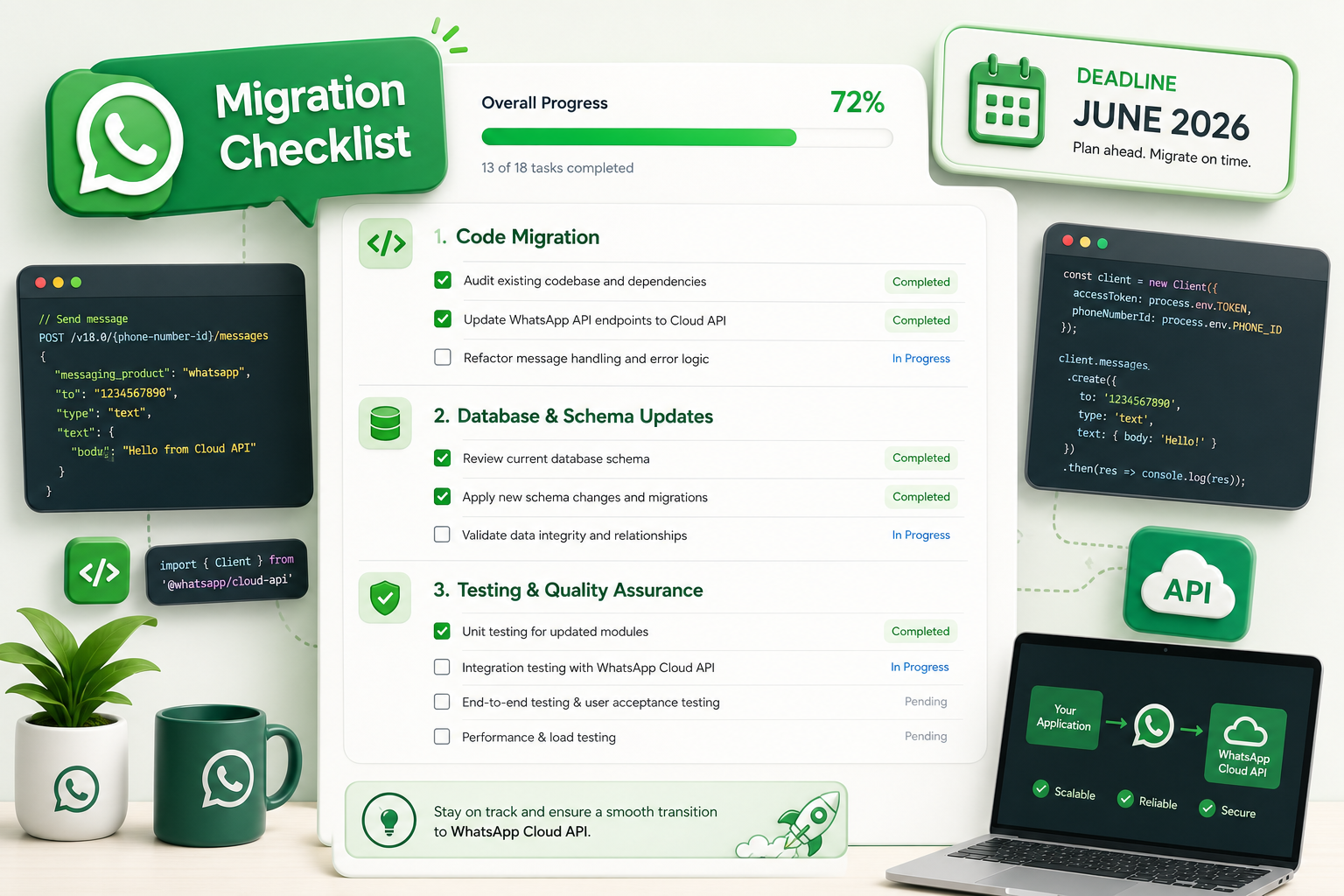
Migrate now or migrate in fire later. The checklist below covers the essential steps to prepare your WhatsApp integration for the BSUID transition. Complete these before June 2026 to avoid ghost chats and delivery failures.
Pre-migration (Complete by May 2026):
-
Audit current database schema -- identify all tables using phone numbers as foreign keys
-
Implement BSUID column alongside phone numbers in customer and conversation tables
-
Deploy 3-layer fallback pattern in message sending logic
-
Update webhook parsers to handle null
fromfields gracefully -
Test LID lookup endpoint behavior -- document null response handling
Migration (Complete by June 1, 2026):
-
Batch-populate BSUIDs for existing contacts via LID lookup API
-
Switch primary send logic to use BSUID as first-priority identifier
-
Enable ghost chat monitoring -- track messages with no delivery confirmation within 24 hours
-
Update customer support documentation to reference BSUID instead of phone number
Post-migration monitoring: Watch for duplicate customer records -- a sign that phone-based lookups are missing migrated BSUID records. Monitor delivery rates by identifier type. Expect 95%+ delivery via BSUID, 80-90% via phone fallback, with the gap representing ghost chat risk.
Why Whapi.Cloud Handles BSUID Without Breaking
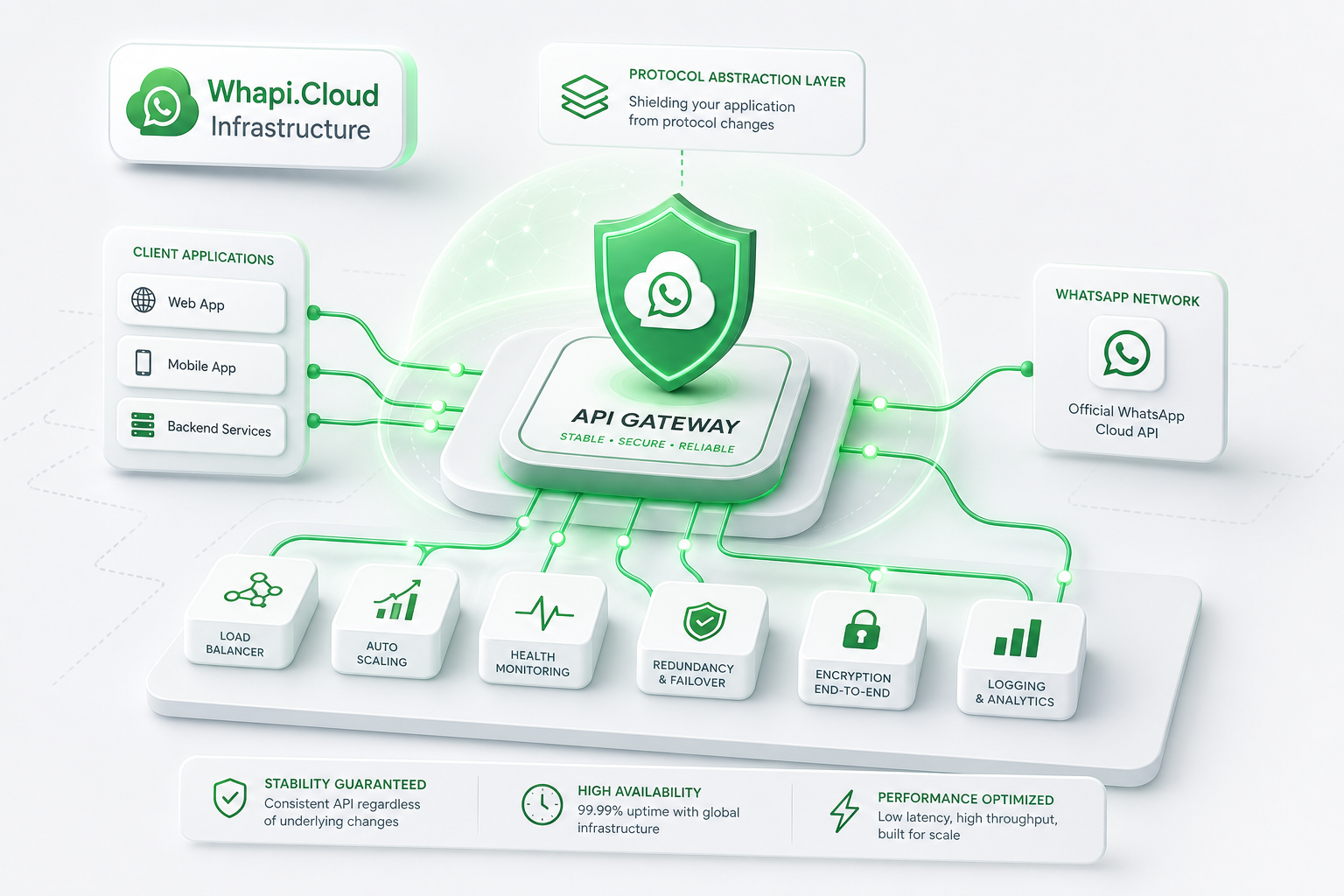
Baileys burned; Whapi.Cloud prepared. The open-source library ecosystem has struggled with WhatsApp's identity migrations. Developers report Bad MAC errors, No Session failures, and Invalid PreKey exceptions when LID transitions occur. These are not application-layer bugs -- they are protocol-layer fractures that require infrastructure-level fixes.
Whapi.Cloud absorbs protocol changes upstream so your API surface stays stable. The web-session socket architecture -- the same mechanism WhatsApp Web uses -- provides a more stable foundation than browser-emulation approaches. When WhatsApp changes identifier formats, the Whapi.Cloud infrastructure team handles the protocol adaptation. Your HTTP API calls remain unchanged.
Open-source integrations break at 3am with no accountable party. Whapi.Cloud has a live support team that actively helps customers resolve production issues -- including migration guidance for BSUID preparation. We've guided hundreds of integrations through protocol changes. The pattern recognition from that operational history feeds into infrastructure improvements that prevent breakage. For teams deciding between self-hosted libraries and managed gateways, the BSUID migration is a decision point. Self-hosted stacks require you to monitor GitHub issues, apply patches, test protocol changes, and handle migration timing yourself. Managed infrastructure shifts that operational burden to the provider. Given that WhatsApp makes protocol changes without notice, the managed path offers predictability that self-hosted cannot match at small-to-medium scale.
If you encounter unexpected behavior during your BSUID migration, reach out to the Whapi.Cloud support team via the chat widget on whapi.cloud -- the team actively helps customers resolve production issues.
We won't cover the official WhatsApp Business API migration path here -- that requires Meta business verification, template approval workflows, and per-message pricing tiers that are incompatible with the unofficial API architecture. For teams committed to the official API, consult Meta's BSP documentation directly.